Yes, industrial CO2 laser cutters offer robust power, large work areas, and precise autofocus to handle demanding projects. This guide highlights five top options that balance power, speed, and reliability for businesses, sign makers, makerspaces, and serious hobbyists upgrading from hobby machines. The right choice depends on material thickness, bed size, and workflow automation. Below, you’ll find a concise buyer’s table, then detailed product sections with practical comparisons and cautions to help you decide.
Product Snapshot Table
- xTool P2S 55W CO2 Laser Cutter — Best for: compact, high-precision desktop projects with long material support.
- xTool P3 80W CO2 Laser Cutter — Best for: large format desktop production with advanced automation.
- VEVOR 100W CO2 Laser Engraver — Best for: wide-area projects with robust software compatibility.
- OMTech 100W CO2 Laser Engraver — Best for: balanced power and dependable local support.
- VEVOR 130W CO2 Laser Engraver — Best for: large, heavier-duty jobs with autofocus and long material handling.
xTool P2S 55W CO2 Laser Cutter

The xTool P2S is a compact CO2 laser cutter designed for desktop use with industrial-level features. It delivers sharper cuts and cleaner engravings thanks to enhanced airflow, dual smart 16MP cameras, and a high-precision LiDAR autofocus system. The bed size expands to 26″ by 14″ with passthrough for long materials and a riser base for tall objects. It is best for small-to-medium runs, serial-number engraving, and curved cylinder projects such as tumblers. A caution: larger, thicker materials may approach the upper limits of the 55W power and bed size, potentially slowing production.
- Best for: precise desktop production with long-material handling.
- Why selected: strong airflow, dual cameras, and autofocus streamline setup and repeatability.
- Limitation: not ideal for very thick materials beyond capability of 55W power.
xTool P3 80W CO2 Laser Cutter
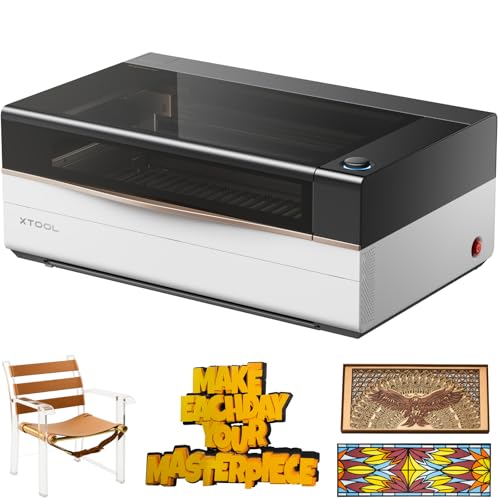
The xTool P3 is a flagship desktop CO2 laser cutter with 80W of power and a focus on automation. It features ACS Auto-Focus with LiDAR ranging, dual HD cameras for precise positioning, and a large 36″ x 18″ workspace. The AutoLift Base accommodates materials up to 8.7″ high, supporting long or tall projects. This model suits mid-to-large production tasks, including thicker woods and clear plastics, with faster speeds up to 1200 mm/s. Caution: higher upfront cost may be a consideration for smaller studios.
- Best for: large desktop production with automated focus and positioning.
- Why selected: expansive workspace and automation streamline complex runs.
- Limitation: larger footprint and higher price point.
VEVOR 100W CO2 Laser Engraver

The VEVOR 100W model provides a broad working area (24″ x 35″) with two-way pass-through doors to feed long materials. It can cut up to 0.59″ thickness in a single pass and engrave a wide range of materials, including wood, acrylic, fabric, and leather. It supports popular software like LightBurn and CorelDRAW and works across Windows, Mac, and Linux. This unit is suitable for mid-sized production and studios needing significant bed space. Limitation: Class 1/IEC ratings vary by region; verify local safety requirements and room ventilation for your setup.
- Best for: large working area and versatile material compatibility.
- Why selected: strong cutting depth and broad software compatibility.
- Limitation: safety and ventilation considerations for a 100W system.
VEVOR 50W CO2 Laser Engraver

The VEVOR 50W model is a compact option for smaller studios or bench-top work with a dual bed and four-way pass-through for longer pieces. It’s well-suited for hobbyists transitioning to more robust capabilities and for light commercial tasks on wood, acrylic, and fabric. A caution: lower wattage limits thickness and speed for demanding professional production.
- Best for: smaller spaces and light commercial work.
- Why selected: flexible bed design and accessible price point for entry-level users.
- Limitation: not ideal for thick materials or high-volume production.
OMTech 100W CO2 Laser Engraver

The OMTech 100W model offers powerful cutting performance with up to 23.6 ips speeds and a 20″ x 28″ work area. It includes four-way pass-through doors and compatibility with widely used software, making it a strong choice for workshops that require dependable service and local support. The focus is on delivering balanced power and practicality for both hobbyists and small businesses. Caution: ensure proper ventilation and space for safe operation given the power class.
- Best for: reliable power with solid local support.
- Why selected: strong balance between bed size, speed, and software compatibility.
- Limitation: Class 4 laser requires appropriate safety measures and enclosure.
VEVOR 130W CO2 Laser Engraver

The VEVOR 130W unit targets heavy-duty production with a large 55″ x 35″ bed and autofocus through a motor-controlled system. It can handle thick materials and longer pieces with a two-way pass-through, aided by a honeycomb bed and aluminum blade bed. It reaches up to 1200 mm/s and supports frequent or batch engraving and cutting. Best for: sign shops, furniture makers, and large-scale prototyping. Caution: ensure adequate ventilation and a sizable workspace to maximize safety and throughput.
- Best for: large-format, heavy-use environments.
- Why selected: high wattage and expansive bed support demanding jobs.
- Limitation: requires substantial space and robust ventilation.
Buying Guide: Key Considerations For Industrial CO2 Laser Cutters
What should you consider before buying?
Power matters. Higher wattage (50W to 130W) enables cutting thicker materials and faster finishing times but requires better ventilation and enclosure. Bed size determines utility for signs, furniture parts, or long sheets. Look for pass-through doors that accommodate longer pieces and a honeycomb or aluminum bed for stability.
Automation and workflow readiness
Automated features like autofocus, dual cameras, and integrated lifting platforms reduce manual setup time. Carbon-coated lenses and air assist improve cut quality and edge cleanliness. If you produce at scale, consider a laser with automatic material detection, alignment accuracy, and compatibility with design software such as LightBurn or CorelDRAW.
Safety and compliance
CO2 lasers require proper enclosure, ventilation, and eyewear. Verify that the model meets local safety standards and has clear installation instructions. Class ratings and operator warnings should be clearly posted. For busy shops, a dedicated enclosure and smoke filtration can minimize workspace contamination.
Support, software, and ecosystem
Look for manufacturers offering reliable technical support, software updates, and long-term availability of spare parts. Compatibility with common software and straightforward file workflows reduces downtime. Consider whether you need accessories like rotary engravers, lift bases, and extended beds to expand capability over time.
Cost of ownership
Beyond sticker price, account for electricity use, maintenance, replacement parts like lenses and spindles, and the cost of ventilation upgrades. A higher upfront investment may yield lower long-term operating costs through faster throughput and better reliability.
FAQ
- What size CO2 laser cutter should I buy for signs? Look for at least a 24″ x 35″ bed with pass-through doors and a stable honeycomb bed. Higher wattage is useful if you also engrave thicker acrylics or wood panels.
- Is autofocus essential for CO2 lasers? Autofocus increases setup speed and repeatability, especially on curved or varying material thickness. It is beneficial for professional workflows with lots of batch work.
- Do I need a water chiller? For higher-wattage systems, a water chiller helps maintain stable performance and prolongs laser tube life in continuous production settings.
- What software should I use with these machines? Most models support LightBurn and CorelDRAW. Dual-camera systems improve alignment accuracy, making integration with these programs smoother.
- Are these machines safe for a small workshop? Yes, with proper enclosure, ventilation, and eye protection. Always follow the manufacturer’s safety guidelines and install in a well-ventilated space.
- Which model is best for thick materials? Models with higher wattage (100W–130W) generally perform better on thicker materials, provided the system includes suitable lenses, air assist, and proper cooling.