Looking for industrial air compressor sales that fit your work demands? This guide highlights five reliable models suited for different needs—from ultra-quiet portable units to high-capacity stationary systems. Choose the best option based on your power supply, required CFM, and typical job profiles. This overview helps buyers decide who each product is best for and why it stands out in a competitive market.
| Product | Best For | Key Benefit |
|---|---|---|
| Metabo HPT Quiet Air Compressor | Small jobsites and professionals who value quiet operation | Ultra-quiet at 59 dB |
| POLAR AIR 5HP 60 Gal | Medium to large shops needing reliable continuous air | Energy-efficient with American assembly |
| Albott 13HP Gas, 30 Gal | Remote sites and heavy-duty needs | Gas-powered with large tank capacity |
| VEVOR 80 Gallon Stationary | Industrial manufacturing and workshops | Large capacity for extended runs |
| DCYL 10HP Variable Speed Screw | Precision air with variable speed and efficiency | Soft-start and energy savings |
Metabo HPT Quiet Air Compressor EC28M — 1 Gallon Portable

Best for: Pros who need a compact, ultra-quiet unit for framing, finish, or trim work on small job sites. This model emphasizes portability without sacrificing tool compatibility thanks to a universal quick coupler and an ergonomic design.
- Ultra-quiet operation at 59 dB allows conversation during use.
- Universal quick coupler enables fast tool changes.
- Only 25.2 lbs with a compact 1-gallon tank for easy transport.
Caution: The small tank limits extended continuous operation; best suited for light to medium-duty tasks and quick tool changes rather than prolonged runs.
POLAR AIR Industrial 3-Cylinder Silent Air Compressor

Best for: Industrial environments needing continuous, steady air supply with robust build quality. This 5HP, 60-gallon vertical unit is designed for demanding applications and long-term operation.
- Energy-efficient performance with strong CFM output relative to horsepower.
- Assembled in the USA with quality components.
- 50,000-hour cast iron pump for durability and longevity.
Limitation: A larger footprint and higher upfront investment may be a consideration for smaller workshops or home garages.
Albott 13HP Gas Air Compressor With 30 Gallon Tank
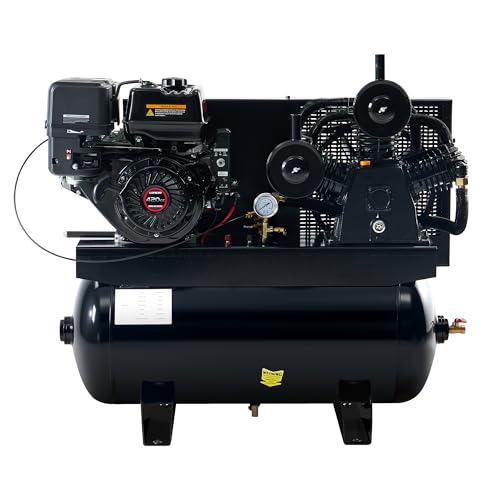
Best for: Remote worksites or heavy-duty applications where a portable gas-powered unit is advantageous. The 30-gallon ASME tank supports longer runtimes with robust air delivery.
- Gas-powered with 13 HP and up to 180 PSI for ample air pressure.
- 30-gallon tank supports prolonged air supply and reduced running time.
- Three-cylinder cast iron pump delivers efficient compression and wear resistance.
Limitation: Gas engines require fuel management and can be noisier than electric models; best for sites without reliable electrical power on demand.
DCYL 10HP Variable Speed Rotary Screw Air Compressor

Best for: Facilities needing precise, adjustable air delivery with energy efficiency and soft-start performance. The variable speed screw design adapts to changing air demands while maintaining stable pressure.
- 10 HP rated power with 38 CFM @ 116 PSI output.
- Single-phase operation and a 30-gallon tank for solid runtime.
- Soft start and motor speed adjustment improve efficiency and reduce wear.
Caution: Installation and setup can be more involved than smaller portable models; best for semi-permanent installation in a workshop or plant.
Buying Guide: Key Considerations for Industrial Air Compressors
- Purpose and load: Determine whether you need a portable unit for light framing or a high-capacity stationary system for continuous production. Match CFM and PSI to your tools and workflow.
- Tank size vs. duty cycle: Larger tanks support longer runtimes between cycles, while smaller tanks are more portable. Consider the duty cycle and duty cycle rating for your typical tasks.
- Power source: Electric models require a suitable power supply; gas models offer independence from electrical infrastructure but require fuel management and maintenance.
- Noise and environment: If the workspace requires quiet operation, prioritize low dB options like the Metabo HPT unit. Consider room reverberation and occupant comfort.
- Reliability and maintenance: Look for durable pumps (cast iron), long service life, and availability of replacement parts. Continuous-duty units benefit from proven pump longevity.
- Size and mobility: Trade-offs exist between portability and capacity. Heavier, larger units are typically stationary but deliver longer operation between refills.
- Energy efficiency: Variable speed drives and efficient compressors can reduce running costs. Weigh initial cost against projected energy savings over time.
- Compatibility: Ensure threaded fittings, couplers, and hoses match your existing tools and connections for smooth operation.
Frequently Asked Questions
- What is the main difference between portable and stationary air compressors?
Portable units are light and mobile, best for small tasks and tight spaces; stationary units offer larger tanks and higher CFM for continuous use. - Do I need oil-free or oil-lubricated pumps?
Oil-free pumps require less maintenance but may have different longevity considerations; oil-lubricated pumps can deliver longer life in heavy-duty use with proper maintenance. - What CFM do tools typically require?
Common nailers and spray tools vary from ~2 to 6 CFM; industrial tools can require 10–40 CFM. Match to your most demanding tool. - Is a higher PSI always better?
No; many tools operate within a given PSI range. Excess PSI can waste energy and wear components faster. - How important is a dual-stage or two-stage compressor?
Two-stage or multi-stage units provide higher pressure efficiency and better performance for continuous heavy use. - What maintenance is typical for large compressors?
Regular oil checks (for oil-lubricated units), filter changes, drain moisture, and inspecting hoses and fittings are standard maintenance tasks.