If you need rapid, deep evacuation for automotive or residential HVAC systems, a high-CFM vacuum pump is essential. This guide highlights five top options that balance airflow, depth of vacuum, and practicality for professionals and serious DIYers. The selections cover two-stage rotary vane models for faster evacuations and single-stage pumps for lighter workloads. Each product is best for specific use cases, from demanding automotive work to budget-friendly maintenance tasks.
Buyer preferences vary: professionals often prioritize deeper vacuum (lower microns) and durability for repeated use, while hobbyists may seek lighter, quieter models with good oil management. The table below summarizes key attributes to compare at a glance.
| Product | Max Flow (CFM) | Stage | Best For | Notable Feature |
|---|---|---|---|---|
| VIVOHOME 1.5 HP 14.4 CFM | 14.4 | 2-stage | Heavy-duty HVAC/R servicing | Gas ballast and strong cooling |
| Orion Motor Tech 14.4 CFM | 14.4 | 2-stage | Professional AC work | Low oil mist, quiet operation |
| Robinair 15500 VacuMaster | 5 | 2-stage | General A/C and refrigeration | Filtration and moisture removal emphasis |
| SPECSTAR 9.6 CFM 1 HP | 9.6 | 2-stage | Mid-range automotive HVAC work | Included oil bottles |
| VIVOHOME 1 HP 9.6 CFM A2L | 9.6 | 2-stage | Flammable refrigerants safety-minded work | Sparkless, low-noise operation |
VIVOHOME 1.5 HP 14.4 CFM Vacuum Pump

Best for heavy-duty HVAC and automotive cooling systems. This dual-stage pump delivers up to 14.4 CFM and can reach deep vacuums, down to 0.2 Pa. A robust aluminum housing, shock-absorbing base, and a gas ballast valve support efficient evacuation and long service life. It also includes an anti-backflow design to protect the oil, and filtration in the exhaust for safer operation. Limitations include higher weight and a larger footprint, which may be less ideal for compact workspaces.
Orion Motor Tech 14.4 CFM 2-Stage Vacuum Pump
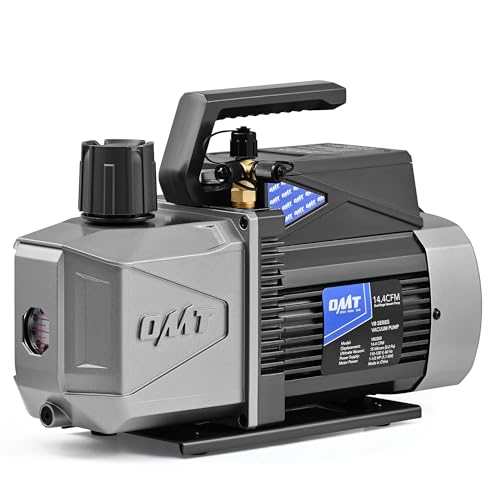
Better for quick, deep evacuations with louder but manageable power. This pump uses a 1.5 HP motor to achieve 14.4 CFM and pulls down to about 1.5 microns (0.2 Pa). It minimizes oil mist with an oil mist-free cap and keeps noise down to a practical level for a shop environment. Choose this if you need fast evacuations in a professional setting and can accommodate modest noise.
Robinair 15500 VacuMaster Economy

Best for budget-conscious pro maintenance and hobbyists. This two-stage pump offers reliable performance with a 5 CFM capacity and 2-stage design, designed for a range of A/C-R systems. It includes a filtration path to protect the pump and ensure cleaner exhaust. It is best for smaller service jobs or first-time pros who need dependable results without high upfront costs. A limitation is slower evacuation on larger systems compared with higher-CFM models.
SPECSTAR 110V 9.6 CFM 1 HP Vacuum Pump
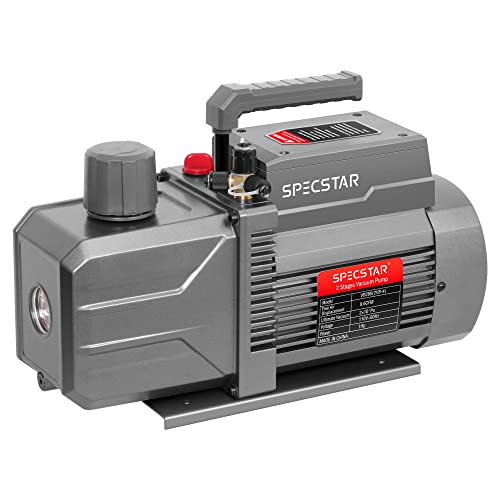
Chosen for mid-range efficiency and value, this 9.6 CFM, 1 HP two-stage pump rides a balance between speed and affordability. It includes two vacuum oil bottles, a durable aluminum housing, and a design aimed at minimizing backflow and heat buildup. Best for technicians who need solid performance without the premium price of top-end units. Note that for very large HVAC jobs, higher-CFM options may evacuate faster.
VIVOHOME 1 HP 9.6 CFM A2L Vacuum Pump

Best for safety-focused work with flammable refrigerants. This 1 HP, 9.6 CFM pump uses sparkless operation designed for R32, R1234yf, and R454B A2L refrigerants, while also handling R410A, R134a, R12, and R22. It reaches 0.2 Pa in about three minutes, making it suitable for automotive and HVAC tasks requiring deep evacuations. A potential limitation is the need for careful handling with ignition-protected features in certain work environments.
Buying Guide
What to consider when choosing a high-CFM vacuum pump for HVAC and automotive work
- Stage count and ultimate vacuum: Two-stage pumps evacuate faster and reach deeper vacuums than single-stage models, which is important for moisture removal and efficient service.
- CFM rating vs. system size: Higher CFM speeds up evacuations on larger systems. For smaller jobs, a mid-range pump can save weight and cost without sacrificing performance.
- Motor power and cooling: A robust motor (1 HP–1.5 HP) paired with effective cooling extends run times and reduces overheating risk in continuous use.
- Oil management: Pumps with oil mist filters, backflow protection, and oil bottles simplify maintenance and improve longevity.
- Noise and workspace: Quieter models are preferable for shared workshops; consider dB levels and enclosure placement when selecting a pump.
- Refrigerant compatibility: Some pumps are optimized for A2L refrigerants (sparkless operation) or specific R-series types. Ensure the model supports your refrigerants.
- Accessories and maintenance: Look for included oil bottles, gauges, and clear oil sight glasses for easier upkeep and monitoring.
Frequently Asked Questions
- What is considered a high-CFM vacuum pump for HVAC work?
A pump delivering around 9–14 CFM or more is typically categorized as high-CFM for HVAC and automotive tasks, enabling faster evacuations on common systems. - Why choose a two-stage over a single-stage pump?
Two-stage pumps achieve lower ultimate vacuum, remove moisture more effectively, and evacuate faster on larger or more complex systems. - What is a micron in vacuum terms?
Micron measures vacuum depth; lower microns indicate a deeper vacuum. Common HVAC work targets around 1–5 microns for thorough moisture removal. - Are sparkless (A2L) pumps necessary?
They are safer for systems using flammable refrigerants (A2L). If you work with R32, R1234yf, or R454B, a sparkless model reduces ignition risk. - What maintenance should I perform after use?
Regularly check and replace oil, inspect filters, ensure no backflow, and clean inlet/outlet ports to prevent debris buildup. - Is louder always worse?
Not necessarily. Some high-CFM pumps are louder but offer faster evacuations; consider your workspace and tolerance for noise when choosing.