Answering the question most buyers have: Which heavy-duty options deliver reliable, gravity-powered movement for pallets, cartons, and loads in warehouses or shops? This guide highlights five top picks that balance durability, load capacity, and flexible layouts. It is especially helpful for warehouse managers, shop floor supervisors, and contractors who need portable, unpowered conveyor systems or rugged pallet handling rails. Below you’ll find product-specific details, who each option is best for, and practical buying guidance.
Summary table of chosen products
| Product | Best For | Key Benefit | Limitations |
|---|---|---|---|
| Ultimation Flow Rail Heavy Duty (5′) with Skate Wheels | Large spaces with gravity flow | Durable galvanized steel frame, modular sections | Unpowered, relies on gravity |
| 3-Pack Heavy Duty Plastic Pallets (48x40x5) | Heavy load storage and shipping | Made in USA, 3,500 lb capacity | HDPE; not a conveyor itself |
| Heavy Duty Roller Conveyor Table (15″ x 78″) | Temporary loading/unloading and mobile workflows | Stainless frame, 600 lb capacity, foldable | Requires flat surfaces for setup |
| Ultimation Roller Conveyor (5′, 200 lb/ft) | Compact pallets and cargo handling | Galvanized rails, gravity flow, portable | Load rating per foot; depends on slope |
| Galvanized 5′ Flow Rail with Skate Wheels | Pallets and cartons on a line | 260 lb/ft load rating, durable skate wheels | Requires proper mounting for stability |
Ultimation Flow Rail – Heavy Duty Gravity Conveyor

This heavy-duty flow rail is built on a galvanized steel frame with durable skate wheels designed for pallets, cartons, and general material handling. It excels in warehouse settings and basement spaces where gravity drives movement without power. Best for: larger, open areas where sections can be joined for continuous flow. The system supports flexible layouts and easy reconfiguration as operations shift.
Why this pick: The galvanized construction provides long-term durability in industrial environments, and the modular design supports multiple configurations for unloading or extended work zones. It’s ideal for teams that need to reconfigure layouts without heavy machinery. Limitation: Being gravity-based, movement depends on incline — in flat areas, manual assistance may be needed.
Key features: galvanized steel frame, durable skate wheels, multi-section compatibility, unpowered flow. Best for warehouses looking to create scalable, gravity-fed lines that can adapt as throughput changes.
3-Pack Heavy Duty Plastic Pallets (USA Made)

These heavy-duty plastic pallets deliver a robust 3,500 lb load capacity per pallet, constructed from recycled HDPE. They are designed for industrial storage, shipping, and handling of heavy inventory. Best for: operations prioritizing durable, moisture- and chemical-resistant pallets that can survive tough warehouse cycles.
Why this pick: The USA-made pallets emphasize local manufacturing standards and consistency. They’re well-suited for environments where pallets endure rough handling and frequent re-use. Limitation: They are pallets, not a conveyor, so you’ll pair them with rails or conveyors to enable movement.
Heavy Duty Roller Conveyor Table (15″ W x 78″ L)

This foldable gravity conveyor table supports up to 600 lbs and features a stainless steel frame with ABS rollers for smooth movement of flat-bottom items. Best for: temporary loading zones, mobile warehouse operations, and spaces where a quick-setup conveyance solution is needed. Limitation: Foldable design means some rigidity is lost when fully extended compared to fixed conveyors.
Why this pick: The combination of steel frame and foldable design provides a practical balance of strength and portability, suitable for limited-space environments or temporary workstations. Choose this if you expect frequent setup and takedown across shifts.
Ultimation Heavy Duty Roller Conveyor – 5′, 200 lb/ft

This gravity flow conveyor uses galvanized steel rails and staggered skate wheels, designed for pallets and cargo on trucks or trailers. Best for: portable bed slides or temporary loading guides where gravity can move items efficiently. Limitation: 200 lb/ft capacity requires careful load distribution to avoid overstressing the section.
Why this pick: Its portability and rugged rail design make it suitable for truck bed or trailer loading, where space is at a premium and movements must be self-contained. Choose this if you need a compact, mobile gravity conveyor to assist with on-site loading and unloading.
Galvanized 5′ Flow Rail with Paired Skate Wheels
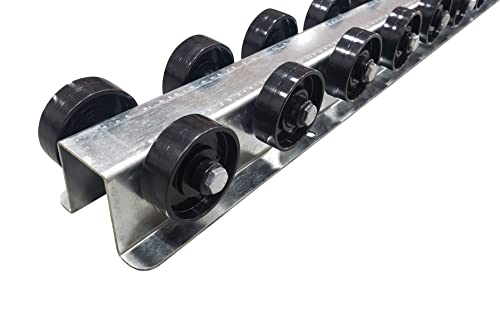
This galvanized flow rail provides a robust 200 lb/ft rating with paired plastic skate wheels for smooth pallet and carton movement. Best for: installations where a steady, gravity-assisted flow is required over a 5-foot span. Limitation: Requires secure mounting to avoid wobble on uneven floors.
Why this pick: The 5-foot, heavy-duty flow rail is ideal for establishing short, repeatable movement paths in tight spaces such as loading docks or shop floors where a compact, durable guide rail is needed.
Conveyor Rails with Plastic Skate Wheels 5′ – T1 Style

Heavy-duty, 5-foot rails featuring 260 pounds per foot load rating and four wheels per foot. Best for: stable, longer gravity paths where consistent pallet movement is essential. Limitation: Wheel configuration and bore dimensions require precise mounting alignment to avoid binding.
Conveyor Rails with Plastic Skate Wheels 5′ – T2 Style

Heavy-duty rails rated at 220 pounds per foot with four wheels per foot and 3-inch wheel centers. Best for: slightly different wheel spacing when matching with existing rails or side guides. Limitation: Slightly lower load rating per foot than some 260 lb/ft alternatives, so plan capacity accordingly.
Buying Guide: Key Considerations For Heavy-Duty Pallet Conveyors
- Load capacity: Match the system to the heaviest item you move and to the total line length. Heavier rails support higher dynamic loads but require proper support and incline for slope-based movement.
- Conveyor type: Gravity-powered rails are simple and reliable but rely on incline. If your space has no slope, consider unpowered tables or manual assistance setups.
- Material and durability: Galvanized steel frames resist corrosion and wear in industrial environments. Plastic pallets and HDPE pallets offer moisture resistance and longevity for shipper-use.
- Modularity: Look for rail sections that join seamlessly and allow reconfiguration as operations evolve. This reduces downtime when expanding or relocating lines.
- Mobility vs. fixed installations: Foldable or portable tables and trailer-ready conveyors suit changing work zones, while fixed rails emphasize stability and long-range flow.
- Mounting requirements: Ensure correct anchoring and alignment on concrete or workshop floors to prevent wobble or misrouting of items.
- Compatibility: Check wheel diameter, bore size, and spacing to ensure smooth interaction with your pallets, crates, or carton sizes.
- Maintenance: Choose rails and wheels designed for easy cleaning and minimal lubrication needs to maintain consistent movement over time.
FAQ
- What is a heavy-duty pallet conveyor best used for?
Gravity-fed rails and roller tables move pallets and cartons without power, ideal for unloading docks, staging areas, and reconfiguration-friendly loading zones.
- Do these systems require electrical power?
Most options listed are unpowered or gravity-based, meaning no electrical connection is needed, which reduces energy costs and maintenance.
- Can these rails handle wet or chemical environments?
Galvanized steel rails are generally corrosion-resistant, and plastic pallets offer moisture resistance; however, confirm material compatibility with your specific chemicals and cleaning solvents.
- How do I choose between T1 and T2 style rails?
Both styles provide similar load ratings, but wheel spacing and bore details differ. Choose the style that best matches your existing hardware and pallet sizes.
- Is a 5-foot rail enough for most operations?
Five feet is a common length for short, modular sections. For longer runs, combine multiple sections to maintain continuous flow.
- What should I consider for installation?
Plan for secure mounting, level surfaces, and gentle slopes to promote smooth movement and prevent jams or pallet damage.