Looking for reliable heavy duty industrial water pumps that can handle solids, debris, and high-flow demands? This guide highlights five top options that balance power, durability, and practicality for construction sites, basements, landscaping, and agriculture. Each pick is suited to specific workloads, such as high-volume transfer, dewatering with solids, or elevated head pressure. Use the quick reference table to compare their core strengths at a glance.
| Product | Best For | Key Benefit | Limitations |
|---|---|---|---|
| Honda WB20 | Heavy-duty transfer and debris-prone water | 164 GPM with solid filtering up to 5/16 inch | Gas engine requires fuel and maintenance |
| Tsurumi HS2.4S | Submersible dewatering with sand and debris | Semi-vortex impeller with integrated agitator | Requires submersible setup and power source |
| FOTING 1.5HP 9000GPH | Sewage and effluent pumping | Heavy duty cast iron with 2″ NPT discharge | Warning about float switch handling |
| NorthStar 8120 GPH | Long-distance pumping and high pressure | 94 PSI capability with Honda GX160 engine | Requires regular maintenance for seals |
| ECO-WORTHY 33-Series | Low-profile 110V diaphragm transfer | 4.0 GPM with smart pressure switch | Lower flow; best for moderate transfer |
Buyer note: Consider flow rate, head height, solids handling, power source, and maintenance when selecting a pump for industrial tasks. The products below are presented in order of general applicability to heavy duty, mixed-load pumping while offering clear buying cues for different work scenarios.
Honda WB20 2-Inch General Purpose Water Pump

Features include a 164 GPM capacity and a large strainer permitting up to 5/16 inch solids. The pump uses a durable 2″ discharge and a heavy duty frame with a cast iron volute and four-vane high-efficiency impeller. The rigid mount reduces wear and extends life. Best for: agricultural, construction, and landscaping tasks that require steady transfer with moderate debris. Better for users who need reliable, portable gas-powered performance with a rugged build. Caution: Gas-powered engines require proper fueling, oil maintenance, and periodic starting checks to ensure peak operation in cold or hot conditions.
Why this pick: The WB20 balances power and durability with a commercial-grade Honda OHV engine, making it suitable for tough environments where a dependable start and steady flow matter more than ultra-high head. It is especially relevant for sites where fuel is readily available and diesel is not preferred.
Tsurumi HS2.4S Submersible Trash Pump

The HS2.4S is built to handle debris up to 0.3 inch with a semi-vortex impeller and integrated agitator. Powered by a 1/2 HP motor and designed to run on standard 115V power, it excels in dewatering applications that involve sand and solids. The 2″ discharge port and a 20-foot cord provide flexible setups for job sites, basements, or disaster response. Best for: rapid, submersible dewatering where solids aren’t too large but need solid protection against clogging. Limitation: Submersible units require correct immersion depth and a reliable power source, especially in field operations.
FOTING 1.5HP 9000GPH Sump Pump

This heavy duty cast iron pump delivers up to 9000 GPH at a lift of 29 feet. It features an automatic/manual operation with a tethered float switch, a 10-foot power cord, and a robust 2″ NPT discharge. Best for: basement or septic applications where large volumes must be moved quickly and reliably. Choose this if you need automatic operation to reduce manual monitoring. Caution: The unit should never be moved by its power cord; always detach and handle safely.
H Hallmark Deep Well Submersible Pump
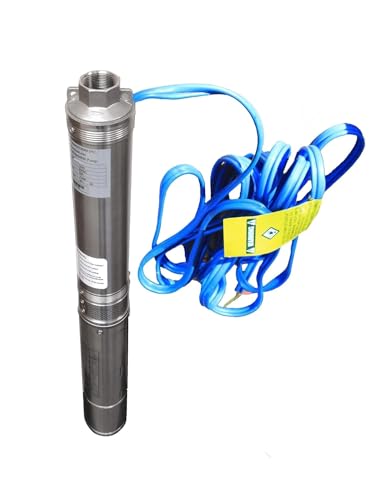
Rated at 1 HP and 230V, this 33 GPM stainless steel body pump provides a robust, long-life solution for deep well lifting and industrial applications. With a 207 feet head and a heavy duty discharge, it’s optimized for high-altitude or long-distance pumping in industrial settings. Best for: long-term water extraction from deep wells or elevated pumping tasks where durability matters. Limitation: Lower flow compared to high-volume transfer pumps; match to need rather than impulse operation.
ECO-WORTHY 33-Series 110V Diaphragm Pump
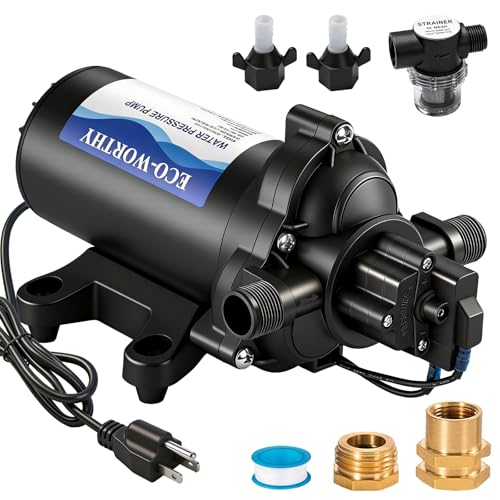
The ECO-WORTHY diaphragm pump operates at 110V and provides 4.0 GPM with a 50 PSI pressure switch. It’s designed for quiet operation, smart automatic on/off, and self-priming up to about 9.8 vertical feet. It can lift water up to 131 feet and includes thermal overload protection for safe operation. Best for: irrigation, RV fresh water transfer, or small-scale plumbing tasks where consistent, controlled flow is needed. Limitation: Lower flow makes it less suitable for large-scale dewatering or flood scenarios.
Buying Guide
Key considerations when choosing a heavy duty industrial water pump:
- Flow rate vs. head: Match gallons per minute to the required vertical lift. High flow is essential for rapid transfer, while greater head is important when pumping to elevated locations.
- Solids handling: If debris is common, select pumps with appropriate impeller design and a solids-capable intake.
- Power source: Gas engines offer mobility; electric models provide reliability and quiet operation. Consider fuel availability and safety requirements on-site.
- Durability: Cast iron frames and volutes improve longevity in harsh environments; look for solid seals and robust switch gear for long-term use.
- Automatic vs manual: Float switches and pressure switches reduce monitoring needs on large-scale operations.
- Maintenance: Availability of spare parts, ease of service, and accessibility of filters or agitators impact total ownership costs.
How to choose by scenario
- Construction or landscaping sites with mixed debris: Consider the Honda WB20 for robust transfer and debris tolerance.
- Basement or disaster dewatering with sand: The Tsurumi HS2.4S offers reliable submersible performance and clog resistance.
- Sewage or effluent removal: Choose FOTING models for high-volume, solids-lling capacity and automatic control.
- Long-distance or elevated pumping: NorthStar high-pressure units excel when pushing water far or up tall heights.
- Low-flow transfer with pressure control: ECO-WORTHY 33-Series is ideal for precise, small-scale tasks and irrigation.
FAQ
- What type of pump is best for dewatering with sand?
– Submersible trash or solids-handling pumps (like Tsurumi HS2.4S) are designed to manage debris and reduce clogging in wet environments. - Do I need an automatic pump for basement sump applications?
– An auto/manual option with a tethered float switch provides hands-off operation when water levels change, which is convenient for continuous cycles. - Is a higher GPM always better?
– Not necessarily. Consider the lift height and discharge capacity; a high GPM pump may not reach the needed elevation if head height is excessive. - Are electric pumps safer than gas-powered models on construction sites?
– Electric pumps reduce emissions and noise but require stable power sources; gas units offer mobility where power isn’t available. - Can diaphragm pumps handle irrigation tasks?
– Yes, diaphragm models like ECO-WORTHY are well-suited for low-flow, constant-pressure irrigation and auxiliary water transfer.