Answering the need for durable, high-performance drill presses, these machines are ideal for metal fabrication, wood workshops, and industrial settings. This guide highlights five strong options, explaining who each is best for and why. Whether you’re drilling large steel sections, performing precision work, or needing reliable magnetic drilling on site, you’ll find practical guidance below.
Summary table of selected products:
| Product | Best For | Key Benefit | Limitations |
|---|---|---|---|
| Zinnore Mag Drill Press | Industrial fabricators, shipyards, field work | High torque, 1800W motor, strong magnetic base | Magnetic setup requires ferrous surface |
| QK-KYOHO 8″ Benchtop | Home shops, hobbyists, light professional use | 5 speeds, cast iron build | Small benchtop size limits large workpieces |
| DeWalt 10″ Drill Press | General workshop, versatile wood/metal work | Long spindle travel, multiple speeds | Non-magnetic; fixed benchtop setup |
| Skil DP9505 | Budget-conscious professionals and DIYers | Laser alignment and work light, 5 speeds | Smaller size; power isn’t for heavy metal drilling |
| VEVOR 1550W Mag Drill | Beams, fabrication, portable magnetic drilling | Strong holding force, 2″ core diameter | Powerful magnet can require flat, clean surface |
Zinnore Mag Drill Press, 1800W Magnetic Drill

The Zinnore 1800W magnetic drill press is designed for heavy metal work with a 3370 lbf / 15000 N magnetic base. It supports coring up to 55 mm and twist drilling up to 31.75 mm, plus tapping from M6 to M22. This model is best for industrial fabrication, shipbuilding, and field installations where a strong magnetic hold is essential. Choose this if you need a 3-in-1 tool for coring, drilling, and tapping on metal surfaces, especially on larger, flat steel workpieces. A potential limitation is the magnet’s performance on curved or nonferrous surfaces.
QK-KYOHO 8″ Benchtop Drill Press
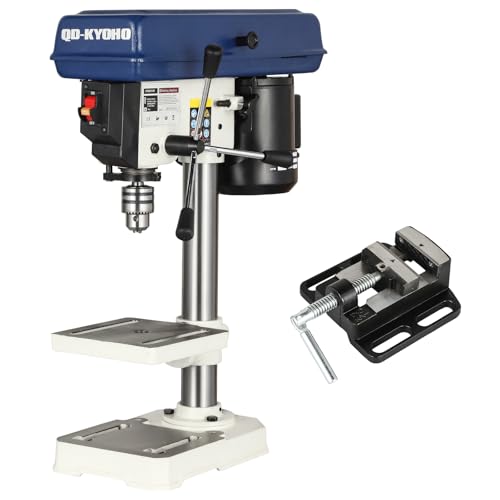
The QK-KYOHO 8″ benchtop drill press features a 300W motor and five preset speeds (620–3100 RPM), with a sturdy all-cast-iron construction. It includes a precision vise for secure workholding and a robust base to minimize vibration. Best for home shops and professional benches that require reliable, straightforward operation. Best-for note: compact size makes it less suitable for large, heavy-metal projects; may be better suited for smaller or precision drilling tasks.
DeWalt 10″ Drill Press
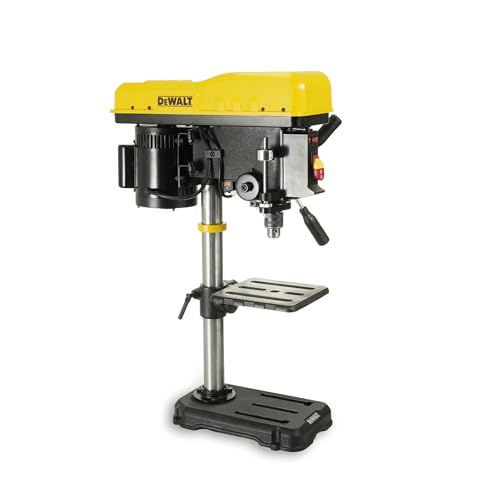
The DeWALT 10″ drill press employs a 7.0-amp motor and five speeds, with 3.5″ spindle travel for deeper cuts. It’s designed for wood, metal, and plastic drilling with dependable power in workshops, garages, and job sites. Best for versatile, medium-duty drilling across multiple materials. Choose this if you want a reliable all-rounder with extended spindle travel and straightforward operation. A caution: it is not a magnetic drill; surface compatibility is different from magnet-based models.
SKIL 6.2 Amp 10 In. Benchtop Drill Press

The Skil DP9505-00 features a 6.2-amp motor and five speeds (610–2800 RPM) with a laser alignment system and work light. This makes precise drilling easier, particularly for wood and light metal projects. Best for budget-conscious professionals and DIYers who want accuracy without overinvesting. It’s a benchtop unit, so very large or heavy-duty metal work may require alternative tools or larger machines.
VEVOR Magnetic Drill Press, 1550W

The VEVOR 1550W mag drill delivers 2″ core drilling capacity with a strong 2922 lbf / 13,000 N holding force and 0–550 RPM variable speed. It’s designed for heavy-duty metalworking, including I-beam work and fabrication. Best for professional fabricators seeking a portable magnetic drill with stable performance and multiple speeds. A limitation: higher magnetic strength requires a clean, flat ferrous surface to maximize holding power.
Buying Guide
What matters most when choosing a heavy-duty drill press?
- Power and torque: Higher wattage or horsepower improves performance on thick metals. Consider motor ratings and torque continuity for prolonged use.
- Magnetic vs. non-magnetic: Magnetic bases excel for on-site metal drilling on ferrous surfaces; non-magnetic drill presses suit fixed benchtops.
- Spindle travel and depth: Deeper travel enables longer cuts without repositioning; users drilling thick materials should prioritize larger travel.
- Speed range and control: A broad speed range with stable RPM settings improves drilling accuracy across different materials.
- Workholding: Precision vises and robust bases reduce vibration and improve accuracy. Ensure table and headstock robustness for heavy tasks.
- Size and portability: Benchtop models fit smaller spaces; floor-standing units handle larger workpieces but require more space.
Which features indicate a good fit for industrial use?
- High magnetic force for secure mounting on metal surfaces.
- Durable cast iron components to resist wear and maintain alignment.
- Safety features such as overload protection and rapid cooling where provided.
- Consistent, multi-speed control for precise drilling in tough materials.
Common limits to watch for
- Magnetic drill presses require ferrous surfaces and may struggle on curved surfaces.
- Benchtop models have limited reach and capacity for large-scale metal work.
- Higher power often means heavier machines and greater footprint; plan for workspace and ventilation.
FAQ
- What is a heavy-duty drill press best used for?
- How does a magnetic drill press differ from a standard drill press?
- Is a higher RPM always better for drilling metal?
- What maintenance keeps a drill press accurate over time?
- Can these machines be used for wood as well as metal?
- How do I ensure safety when using a high-powered drill press?