Answering the question “which bench vise handles heavy-duty industrial tasks?” this guide highlights the top five heavy-duty models suited for harsh workshop environments, metalworking, pipe work, and fabricating projects. Each option is chosen for durability, jaw options, and secure clamping. Best for pro shops, backyard manufacturers, or industrial maintenance teams seeking reliable, long-lasting vises.
Buyer note: for quick comparison, the table below summarizes each product’s core specs and best use cases.
| Product | Jaw Width | Max Opening | Throat Depth | Best For |
|---|---|---|---|---|
| Forward CR80A 8″ Bench Vise | 8″ (200 mm) | 9″ (229 mm) | 4.1″ (104 mm) | Heavy-duty fabrication, large workpieces |
| Forward HY-DT150B 6″ Bench Vise | 6″ (152.4 mm) | 5″ (125 mm) | 2.6″ (66.6 mm) | Versatile clamping with multiple jaw options |
| VEVOR Heavy Duty Bench Vise 6.5″ (6.5″) | 6.5″ (165 mm) | 5″ (125 mm) | 3.5″ (8.8 cm) | Pipe and irregular shapes, 360° positioning |
| Forward DT08125A 5″ Bench Vise | 5″ (125 mm) | 5″ (125 mm) | 2.6″ (67 mm) | Compact, durable ductile iron with multiple jaws |
| VEVOR 6″ Bench Vise with Anvil | 6″ (15.2 cm) | 5.9″ (15 cm) | 3.5″ (8.8 cm) | Great all-around with 360° head/base |
Forward CR80A 8 Inch Bench Vise: Heavy Duty With Anvil

Best for: workshops that require large-capacity clamping and a robust build. The CR80A uses ductile iron construction rated at PSI 60,000 and features two jaw sets: replaceable serrated top jaws with slot jaws and built-in pipe jaws (φ 1/2″ to 3 1/2″). This makes it suitable for heavy metalworking, pipe work, and general fabrication. The 8″ jaw width and 9″ opening cover large workpieces, while the 4.1″ throat depth supports thicker stocks.
Why chosen: its dual-jaw system provides adaptable grip for diverse tasks, improving stability during tough presses and cuts. The 190-degree swivel base adds positioning flexibility for welding and grinding setups. A potential limitation is that the heavy iron frame adds weight; consider mounting on a sturdy workbench for best leverage.
Forward HY-DT150B 6-Inch Heavy Duty Bench Vise
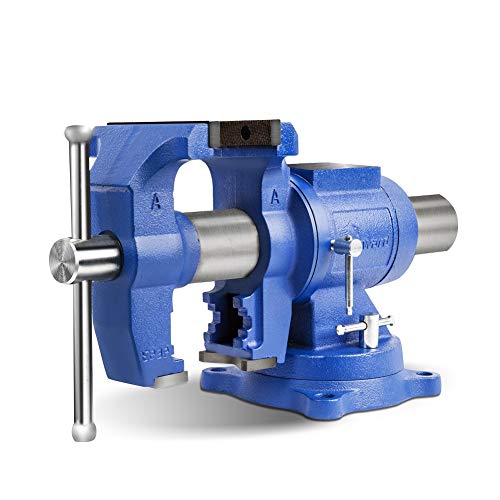
Best for: metalworkers and fabricators who need multiple clamping options without sacrificing space. The DT150B provides three jaw systems: replaceable top jaws with microgroove teeth, built-in pipe jaws (φ 3/5″ to 2 1/2″), and V-jaws. It is built from high-strength cast iron with at least PSI 60,000 ductile iron, delivering sturdy performance. The 360-degree swivel head and base enable precise positioning for welding or crafting tasks.
Why chosen: the additional jaw configurations support a wide range of shapes, from pipes to angled components. The pommels and microgroove teeth offer better grip on smooth or slippery surfaces. Limitation: weight (~42 lbs) may require assistance for re-positioning on a busy jobsite.
VEVOR Heavy Duty Bench Vise, 6.5 Inch

Best for: users needing strong clamping power with versatile jaw configurations. This vise uses premium ductile iron, delivering up to 5,520 lbs (≈24.98 kN) of clamping force. It includes pipe jaws and V-jaws, plus a 360° rotating head and base for precise positioning. The large anvil area (2.9″ x 3″) supports metalworking tasks and light forging operations.
Why chosen: the 360° pivot and wide jaw options make it a flexible option for welding, pipe fitting, and metal fabrication. A caveat: the included magnetic jaw pads and extras help with setup but do not replace dedicated workholding accessories for specialized tasks.
Forward DT08125A 5-Inch Heavy Duty Bench Vise
Best for: compact spaces with high durability requirements. The 5″ DT08125A uses ductile iron with PSI 60,000 rating and offers three jaw sets: replaceable top jaws with microgroove teeth, built-in pipe jaws (φ 3/5″ to 2 1/2″), and V-jaws. It weighs about 33 lbs, making it easier to handle on smaller workstations while still providing solid clamping force (at least 5,500 lbs).
Why chosen: its compact footprint is ideal for smaller shops or benchtops without sacrificing performance. Limitation: with a 5″ jaw width, it may not accommodate very large stock pieces as readily as bigger models.
VEVOR Bench Vise with Anvil and 360° Base

Best for: multi-purpose workbenches needing a robust all-around vise. The 6″ jaw width with 5.9″ max opening, plus a 360° swivel head and base, supports drilling, cutting, welding, and pipe work. The vise is constructed from 60,000 PSI ductile iron and includes a complete accessory kit with nuts, screws, manual, and magnetic jaw pads for installation. It’s designed to stay steady under heavy use.
Why chosen: the included accessories and the robust 360° design improve setup speed and repeatability. Limitation: some users may want higher jaw capacity for larger stock pieces beyond 6″.
Buying Guide
What should you consider before buying a heavy-duty bench vise?
- Jaw width and opening: Match the largest workpiece you’ll handle with adequate clearance.
- Clamping force: Higher force helps prevent movement on tough tasks but consider the trade-off with weight and mounting requirements.
- Base and rotation: A 360° swivel base provides flexibility for welding, cutting, or fabrication; ensure your bench can support the torque.
- Jaw options: Replaceable top jaws, pipe jaws, and V-jaws expand versatility for pipes, tubes, and irregular shapes.
- Material and durability: Ductile iron frames with PSI around 60,000 are common for heavy-duty vises; corrosion resistance and coatings matter in humid spaces.
- Size vs. workspace: Bigger vises offer more capacity but require more bench space and heavier mounting hardware.
- Included accessories: Jaws, anvil area, and installation hardware can save setup time and improve grip stability.
Which vise is best for your workflow?
- Large, frequent heavy-duty metalwork: choose 8″ or larger models with multiple jaw types and a strong anvil.
- Small to medium parts with frequent repositioning: a compact 5″ to 6″ vise with a 360° base and diverse jaws works well.
- Pipe and tube work: pipe jaws and V-jaws are essential; ensure the jaw configurations match your pipe sizes.
- Welding and fabrication in tight spaces: a 360° rotating base helps; consider models with integrated or convenient access to anvil work surfaces.
Maintenance and care
- Regularly inspect jaw teeth for wear; replace when grip declines.
- Keep lubricants contained; enclosures or enclosed spindles help prevent contaminants.
- Tighten mounting bolts to the recommended torque to prevent movement during heavy use.
FAQ
- What is the typical clamping force for industrial vises?
Industrial vises commonly offer clamping forces from about 5,000 to 12,000 lbs, depending on jaw design and build material.
- Should I prioritize a 360-degree swivel base?
Yes for tasks requiring flexible positioning, such as welding or grinding; it improves alignment and repeatability.
- Are pipe jaws necessary for metalworking?
Pipe jaws are beneficial if you frequently clamp pipes or round stock; they help secure round shapes firmly.
- Is ductile iron better than cast iron for vises?
Ductile iron typically offers higher toughness and durability under load, making it favorable for heavy-duty use.
- Can a bench vise be mounted on any workbench?
Most vises are designed for standard bench thicknesses; verify mounting dimensions and hardware compatibility with your bench.
- What maintenance steps extend vise life?
Keep moving parts clean, lubricate sliding components, replace worn jaws promptly, and store in a dry environment to prevent corrosion.