When selecting a heavy duty conveyor belt, you want durability, adjustable speed, anti-static surfaces, and a frame that resists corrosion. This guide highlights five robust options from VEVOR and Moonshan, chosen for reliability in industrial and packaging settings. Each product is evaluated for who it’s best for, why it stands out, and any practical limitations to consider before purchase.
| Product | Best For | Key Benefit |
|---|---|---|
| VEVOR Belt Conveyor, 59 x 7.8 inch | Small to mid-sized parts lines | Sturdy stainless steel with adjustable speed and dual guardrails |
| VEVOR PVC Belt Conveyor 47″x 7.8″ | Compact high-traffic tasks | Compact, adjustable speed, durable PVC belt |
| VEVOR Belt Conveyor, 59 x 15.7 inch | Medium parts in inkjet coding | Longer table area with robust build and adjustable speed |
| VEVOR Conveyor, 59 x 23.6 Inch Table | Inkjet coding and packaging lines | Largest surface among the options for bigger items |
| Moonshan Belt Conveyor 20 inch Desktop | Desktop or small workstation needs | Reverse switch and stepless speed control |
VEVOR Belt Conveyor, 59 x 7.8 Inch
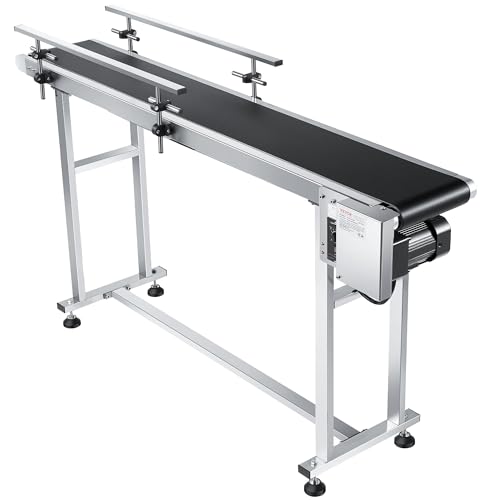
Industrial-Grade Stainless Steel provides long-term durability in demanding settings. The belt is coated for rust and wear resistance, making it well-suited for continuous use in production or warehousing environments. The PVC belt is wear-resistant and anti-static, with a 59″ by 7.8″ working surface. A rotating screw allows precise belt tension adjustments, and infinitely adjustable feet keep the unit stable on uneven floors. Speeds range from 30 to 120 RPM and can run in either direction, offering flexibility for bidirectional workflows.
Best for: Small to mid-sized parts lines where a robust, corrosion-resistant surface is important. The dual guardrails help keep items aligned during transfer.
Caution: Limited belt surface area means it’s less suitable for very long items or high-volume continuous feeding without staging.
VEVOR PVC Belt Conveyor 47″x 7.8″

This model shares the same industrial-grade stainless steel frame and anti-static PVC belt, but on a shorter 47″ by 7.8″ platform. It features a 30–120 RPM adjustable speed range and a bidirectional drive. Its compact footprint helps in tight automation lines or small packaging setups that require reliable transfer without sacrificing space.
Best for: Workstations needing a compact, reliable belt for minor to mid-sized parts with occasional bidirectional flow.
Caution: The smaller surface may limit throughput for large items; ensure your parts fit within the 47″ length.
VEVOR Belt Conveyor, 59 x 15.7 inch

A longer work surface at 59″ by 15.7″ expands handling capacity for item streams common in coding or labeling tasks. The same durable stainless steel frame and anti-static PVC belt ensure longevity in continuous operation. Like the smaller model, it features a rotating screw for belt tension control and height-adjustable feet for stability. Speeds from 30 to 120 RPM and bidirectional operation support varied packing or processing tasks.
Best for: Applications requiring more belt real estate for longer items or multiple items per pass, such as labeling or coding lines.
Limitation: Taller or larger items may require additional space planning to maintain smooth flow across the belt length.
VEVOR Conveyor, 59 x 23.6 Inch Table

This model offers the largest flat surface among the listed options, at 59″ by 23.6″. It is ideal for inkjet coding or packaging lines that require generous space for larger items or batching. It retains the multi-adjustment system with 30–120 RPM speeds and dual guardrails for item control. Its heavy-duty stainless steel frame and anti-static PVC belt support continuous operation in demanding environments.
Best for: Inkjet coding and packaging workflows with larger items or higher throughput demands where space matters for smooth conveyance.
Limitation: A larger footprint requires more room and can be less suitable for compact facilities without sufficient space planning.
Moonshan Belt Conveyor, Desktop Version

Designed for desk or compact workstation use, this Moonshan model offers a reverse switch and stepless speed regulation. The desktop form factor is suitable for packaging lines, small assembly areas, or personal production setups where a full-scale conveyor would be impractical. The adjustable steering direction supports flexible assembly or testing environments.
Best for: Small-scale operations, prototype lines, or desk-side tasks where a portable, adjustable conveyor is beneficial.
Limitation: Desktop units typically have lower load capacity and shorter life cycles in heavy industrial use compared to full-size floor models.
Buying Guide: Heavy-Duty Conveyor Belt Essentials
- Load capacity and item size: Match belt width and length to your typical item dimensions. Longer belts handle more items per pass, but require more floor space.
- Belt material and anti-static properties: PVC belts with anti-static features reduce charge buildup on conductive parts. Stainless steel frames resist corrosion in harsh environments.
- Speed and direction control: Look for adjustable speeds (commonly 30–120 RPM) and the ability to run bidirectionally if your process needs reverse flow or testing.
- Stability and adjustability: Infinitely adjustable footers and height adjustments help maintain level operation on uneven floors.
- Guardrails and item guidance: Dual guardrails keep items aligned, reducing off-center jams and increasing transfer accuracy.
- Space and layout considerations: Larger tables provide more throughput but demand more floor space. Desktop models fit small workflows or validation benches.
- Maintenance and durability: Stainless steel frames and rust-resistant coating extend life in busy facilities, while simple tensioning mechanisms ease routine upkeep.
- Installation and modularity: Choose a model that fits within your current line layout and allows future expansion or reconfiguration.
Practical buying questions
- What is the best belt width for my line speed and space? Choose wider belts for larger items and higher throughput, but ensure the space accommodates the length.
- Do I need bidirectional operation, and how will that affect layout? Bidirectional belts can simplify certain workflows but may require more precise guardrails and alignment in the path.
- Is a desktop model adequate for my operation, or do I need a floor-standing unit? Desktop units suit prototypes or small-scale tasks; floor models are better for heavy, continuous production.
- Should I prioritize anti-static properties? If your line handles electronic components or materials sensitive to static, anti-static belts reduce damage risk and dust attraction.
Frequently Asked Questions
- What defines a heavy duty conveyor belt? A heavy duty conveyor typically features a robust stainless steel frame, a wear-resistant belt, anti-static properties, and a wide speed range suitable for continuous industrial use.
- Can these conveyors run continuously in a factory? Yes, when properly installed with stable support feet, appropriate guardrails, and regular maintenance schedules.
- Do these units require specialization to install? Most are designed for straightforward integration into existing lines; however, confirm electrical compatibility and mounting clearances for your space.
- Which model provides the best value for mixed item sizes? Models with larger belt surfaces and bidirectional capability offer flexible handling for varied item dimensions.
- What maintenance tips improve belt life? Keep belt tension correct, clean the belt and rollers regularly, check guardrails, and inspect for wear on edges and fasteners.
- Is a heavier belt always better? Heavier belts provide durability, but the optimal choice depends on item size, weight, and line speed requirements.