When selecting heater bands for extrusion and injection molding, reliability, temperature stability, and ease of installation are critical. This guide reviews five top-rated bands designed to fit common 35x35mm and 42x50mm footprints, focusing on 110V systems with around 300–380W output. Each option combines durable materials with practical locking mechanisms to ensure flush mounting and consistent heat. Use the buying guide below to compare warranties, lead lengths, and compatibility with your equipment.
| Product | Brand | Footprint | Power | Voltage |
|---|---|---|---|---|
| YXQ 110V 380W | YXQ | 35x35mm | 380W | 110V |
| Saim 110V 380W | Saim | 35x35mm | 380W | 110V |
| BestTong 110V 380W | BestTong | 42x50mm | 380W | 110V |
| Nxtop 110V 380W | Nxtop | 35x35mm | 380W | 110V |
| DERNORD 110V 300W | DERNORD | 42x50mm | 300W | 110V |
YXQ 110V 380W Injected Mould Heater Band

The YXQ 110V 380W heater band is built for robust performance in plastic injection molding environments. Its rust-resistant steel sheath provides durability in demanding settings, while a stainless steel clamp-type lock-up ensures secure mounting. A notched sleeve design facilitates straightforward installation, enabling a flush fit with nozzle hexes. Suited for heating devices in injection molding and stuffing containers, this band delivers reliable heat output at 110V and 380W. The balanced combination of protective sheath and precise fit reduces heat loss and helps maintain stable process temperatures, which is key for consistent part quality in American manufacturing facilities.
Saim 110V 380W Band Heater 35x35mm (5 Pack)
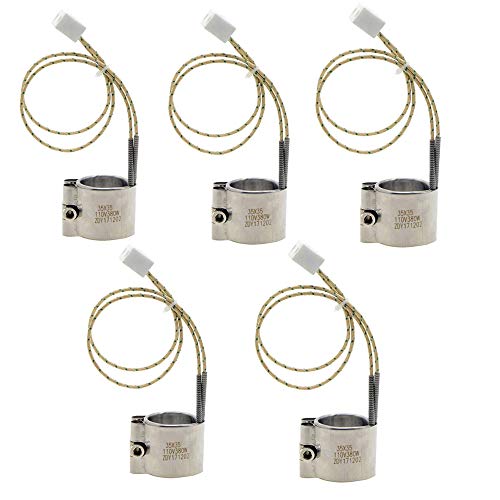
The Saim 35x35mm heater bands come in a 5-pack, offering a scalable solution for production lines requiring multiple zones. They feature a rust-resistant steel sheath and a stainless steel clamp-type lock-up for secure mounting. The notched sleeve enables easy installation, and the bands sit flush with the nozzle hex to minimize thermal gaps. With 380W output at 110V, these bands are suitable for injection molding, extrusion, and related processes. Each unit includes flexible lead length per band to accommodate standard equipment layouts, making them practical for batch replacements or coil installations.
BestTong 110V 380W Brass Band Heater 42x50mm

BestTong offers an electric copper barrel brass band heater designed for extrusion and injection molding applications. The installation is straightforward, with hex-based release tools to untie screws and secure the band. This 110V, 380W unit is suitable for heating devices in injection molding, rubber molding, and other plastic-processing machinery. The brass construction coupled with ceramic wire connections provides reliable heat transfer and electrical integrity. For facilities requiring durable bands that resist chemical exposure while maintaining steady temperatures, this model provides an effective balance of performance and durability.
Nxtop 110V 380W 35x35mm Band Heater (2-Pack)

The Nxtop 35x35mm heater bands are designed for stable operation with a rust-resistant steel sheath and a stainless steel clamp-type lock-up. A notched sleeve enables precise alignment during installation, allowing the unit to sit flush with nozzle hexes. Rated at 110V and 380W, these bands are well-suited for heating devices in plastic injection machines. The leading design focus is on ease of installation and consistent heat delivery, supporting uniform temperature control across molds and extruder barrels. The 31 cm lead length per band offers flexible routing in compact factory spaces.
DERNORD 110V 300W 42x50mm Brass Band Heater

The DERNORD 42x50mm brass band heater combines brass band material with a ceramic wire connection for robust heat transfer. At 110V and 300W, it fits injection molding machines that require a reliable, compact heater solution with a larger footprint than 35x35mm bands. The specified inner diameter and height enable compatibility with a range of cylindrical heating zones. This unit emphasizes durability and steady warmth, reducing thermal cycling and improving cycle consistency for mid-sized tooling applications. Wire length and construction are designed to withstand industrial use and repetitive thermal loads in production environments.
Buying Guide: Key Purchase Considerations
- Voltage and wattage: Most options operate at 110V with 300–380W output. Ensure your equipment’s power supply and circuit capacity match the heater’s requirements to avoid tripping and thermal instability.
- Footprint and fit: 35x35mm and 42x50mm footprints cover common barrel and nozzle geometries. Confirm inner diameter and height specifications to ensure flush mounting and effective heat transfer.
- Material and durability: Stainless steel or brass bands with ceramic wire connections offer good corrosion resistance and electrical reliability in harsh molding environments. Consider rust resistance where exposure to coolants or humidity is possible.
- Mounting and installation: Look for a clamp-type lock-up and notched sleeves for easy, secure installation. A design that sits flush with nozzle components minimizes heat loss and improves temperature uniformity.
- Lead length and wiring: Adequate braid or lead length (commonly around 31 cm) helps with cable routing and reduces strain on connections. Verify wire insulation compatibility with your process chemicals and temperatures.
- Maintenance and replacements: Availability of pack options or multi-pack sets can reduce downtime during replacements. Consider whether your workflow benefits from modular or multi-band configurations for different zones.
- Application scope: While designed for injection molding and extrusion, some bands suit rubber molding and other heat-transfer tasks. Assess whether a brass or copper band better supports heat distribution for your material.
- Safety and standards: Check for appropriate insulation and protective features suitable for industrial environments, including consistent performance under cycling temperatures and minimal risk of shorts.
When evaluating options, balance cost against lifespan, ease of installation, and compatibility with existing tooling. For facilities with multiple zones, a pack option can reduce downtime, while a higher-grade band may offer longer service intervals in high-cycle production lines. Consider ordering samples or pilot testing a single unit before committing to a full replacement across production cells.