Answering the most common buyer question: which handheld fiber laser welder offers a balance of power, ease of use, and versatility for metal fabrication at home or in a small shop? The top picks below are suited for different tasks—from daily welding and cutting to rust removal and surface cleaning. We highlight who each tool is best for and why, plus practical cautions to consider before buying.
| Product | Best For | Key Benefit |
|---|---|---|
| xTool MetalFab 1200W | Professional hobbyists and small shops | 3-in-1: weld, cut, clean with 108+ presets |
| NOUALASER 2000W | Industrial-like flexibility at home | 4-in-1 with dual swing heads for faster welds |
| X1pro 700W | Underwater and versatile operations | 6-in-1 system with underwater capability |
| OMTech 1500W | Precise multi-function welding | 3-in-1 with multiple nozzles and built-in control |
| G·WEIKE M 1200W | Fast welding with cleaning integration | Rapid welding with rust removal and cutting |
xTool MetalFab 1200W 3-in-1 Laser Welding Machine

The xTool MetalFab 1200W combines welding, cutting, and cleaning in one 3-in-1 unit. It uses a 1200W industrial laser to deliver deep, reliable welds on stainless and carbon steel with minimal heat-affected zones. It features an 8″ touchscreen and 108+ pre-loaded material parameters to simplify setup. An automatic wire feeder supports longer, steadier welds, reducing manual adjustments. Best for: small shops and enthusiasts who want factory-like weld quality with straightforward operation. Caution: keep in mind the system is geared toward metalwork up to 5 mm in weld depth; very thick sections may require alternative methods. Selection rationale: strong blend of power, preset materials, and automation for consistent results.
Double Wobble 2000W 4-In-1 Laser Welding Machine

This 2000W model adds a dual-swing welding head setup and several modes for easy handling of complex joints and large gaps. It’s designed to be fast—claiming welding speeds well above TIG and MIG for metals up to 6 mm thick. Best for: users who handle diverse project sizes and need flexible, multi-angle welding with rapid cleanup. Caution: higher power means greater cost of consumables and a larger footprint. Why chosen: higher throughput with a multi-head arrangement supports complicated geometries more efficiently than single-head systems.
X1pro 700W Laser Welding Machine
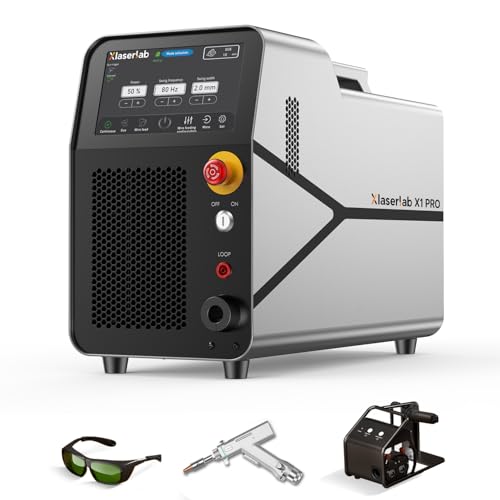
The X1pro is a versatile 6-in-1 handheld system with underwater welding capability and an external wire feeder. It promises strong welds with a minimal heat-affected zone, and it’s engineered to operate from -4°F to 104°F with a robust thermal management system. Best for: professionals or serious hobbyists who need underwater welding and CNC retrofit options without buying separate units. Caution: underwater operation adds complexity and requires proper training and safety protocols. Rationale: extended feature set reduces the need to buy additional equipment for specialized tasks.
OMTech 1500W Handheld Fiber Laser Welder

OMTech delivers a 1500W laser system with a 3-in-1 capability and multiple nozzles for cutting, welding, and cleaning joints up to several millimeters thick. A built-in water chiller helps maintain stable performance during longer sessions. Best for: users who need dependable power for thicker materials and a compact, all-in-one handheld unit. Caution: not all nozzles are included in every pack; verify nozzle availability for your typical material set. Rationale: strong welding performance with included cleaning capability keeps workflows lean.
GWEIKE M 1200W Handheld Fiber Laser Welder
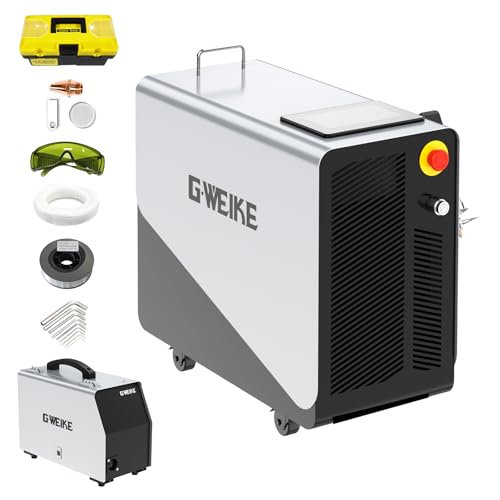
The G·WEIKE M 1200W emphasizes high-speed welding with integrated rust removal and cleaning capabilities. It supports handheld cutting and produces faster welds suitable for mid-thickness metal work. Best for: shops that require fast throughput with surface prep and rust removal integrated into the workflow. Caution: rust removal width per pass can vary by material; plan passes accordingly. Selection rationale: a balanced mix of speed, cleaning, and cutting in a single platform.
Buying Guide: Handheld Fiber Laser Welders
- Power vs. thickness: Higher wattage supports thicker material welds, but consider the typical metal thickness you work with most often.
- All-in-one vs modular: 3-in-1 or 4-in-1 systems save space and time but may compromise some specialization; separate modules offer customization at a cost.
- Wire feeder and automation: Auto wire feeding and CNC retrofit options improve consistency and allow scaling for larger projects.
- Material compatibility: Check presets or material parameter libraries. Availability of stainless, carbon steel, aluminum, and exotic metals varies by model.
- Duty cycle and cooling: Built-in water chillers and thermal management extend life during long sessions. Evaluate your workload to choose appropriately.
- Environment: Underwater capabilities and rugged designs are advantageous for challenging environments but add complexity and maintenance needs.
- Safety: Laser safety features, fume control, and PPE requirements should match your shop setup and local regulations.
FAQ
- What is the main advantage of a handheld laser welder over traditional TIG/MIG?
Answer: Handheld laser welders offer faster weld speeds, deeper penetration, and consistent seams with reduced heat-affected zones, which can lower finishing time in smaller production runs. - Do these machines require specialized training to operate safely?
Answer: Yes. Proper training on laser safety, ventilation, and handling of high-power equipment is recommended, especially for underwater or multi-mode systems. - Can I upgrade to CNC or automation later?
Answer: Some models support CNC retrofits or external wire feeders, allowing growth without a full replacement. - Are there models suited for hobbyists with lighter workloads?
Answer: Yes. Lower-wattage systems with abundant presets and simpler interfaces are designed for home workshops and beginners. - Is underwater welding necessary for typical projects?
Answer: Not usually; underwater capability is valuable for specific applications such as maintenance or submerged structures, but it adds cost and safety considerations. - What should I consider regarding maintenance and consumables?
Answer: Check nozzle availability, wire feeder reliability, and cooling system maintenance to minimize downtime and consumable costs.