The top picks below are ideal for buyers seeking precise glass engraving and light cutting at a desktop scale. Each option is best for different needs—from beginners exploring DIY glass projects to small studios handling personalized glassware. Domestic hobbyists will appreciate compact setups, while small business owners can value faster speeds and broader material compatibility.
| Product | Best For | Key Benefit |
|---|---|---|
| BlazeX M3 10W | Beginner to hobbyist | Ultra-fine 0.01mm engraving on glass |
| xTool P2S 55W CO2 | Small shop projects | High power and large bed for glass and curved surfaces |
| xTool S1 40W | Large, detailed projects | Big bed and fast speeds with advanced features |
| CREALITY FALCON 10W | Versatile beginners | Balanced power, safety features, easy setup |
| ACMER S1 6000mW | Budget-friendly precision | Good accuracy with lightweight hardware |
Note: The following products are selected for glass engraving and light cutting capabilities. Each listing includes a protective enclosure or safety features where applicable, and all data is drawn from provided features and product descriptions.
BlazeX M3 10W Laser Engraver
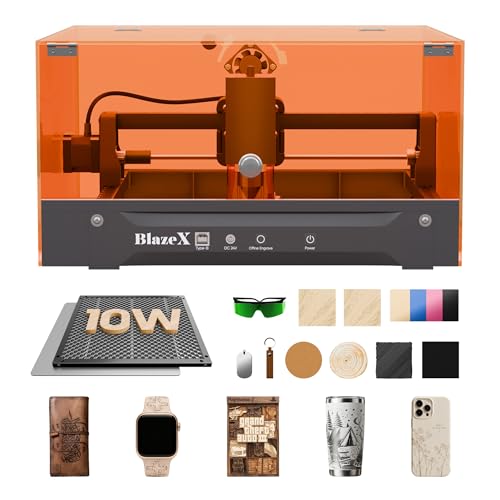
Best for beginners and hobbyists who want ultra-precise engraving on glass and other materials. The BlazeX M3 pairs a 10W laser with 0.01mm precision, enabling detailed patterns on glass, wood, leather, and coated metals. It ships with a starter kit, including a honeycomb bed and enclosure, helping new users achieve stable results on their first projects.
Who it’s for: Ideal for DIY enthusiasts creating personalized glass decorations, jewelry components, or small-batch gifts. It is less suited for large-volume production due to its desktop footprint and moderate cutting power.
Limitation: While highly precise for engraving, cutting thick glass or heavy-duty materials may require slower passes or alternative setups. The included materials and enclosure support beginner workflows but may limit advanced industrial use.
xTool P2S 55W CO2 Laser Cutter

Best for small shops that need more power and a larger work area. The P2S CO2 laser delivers stronger airflow, dual cooling features, and upgraded optics for crisper engraving and cleaner cuts. With a substantial bed and long-work-capable passthrough, it suits projects that involve glass panels, curved glassware, and longer glass strips.
Who it’s for: Suitable for studios that engrave or cut glass items like panels, signs, or curved glass objects. Better for users who value speed and repeatable accuracy at a larger scale.
Limitation: CO2 systems require proper ventilation and maintenance. The setup may be more complex than diode-based units, and ongoing consumable costs can be higher over time.
xTool S1 40W Laser Cutter And Engraver

Best for large-scale or multi-material projects, including glass, wood, metal, and acrylic. The S1 offers a 23.93″ x 15.16″ bed and speeds up to 600mm/s, with features like auto-focus and a robust software ecosystem. It’s especially strong for big glass panels or gifts requiring detailed, fast engraving across broad surfaces.
Who it’s for: Choose this if you regularly handle large glass pieces or need high throughput for prototyping and custom orders. It’s also suitable for users who want curve engraving capabilities on non-flat surfaces.
Limitation: The larger footprint requires more workspace and a stable mounting area. Power and ventilation considerations are more demanding than smaller units.
CREALITY FALCON 10W Laser Engraver

Best for versatile beginners seeking a safe and straightforward entry into laser engraving. The Falcon 10W includes safety features like an anti-UV protective filter and an emergency stop, making it suitable for glass engraving and light cutting on various surfaces. The 12 mm wood cutting claim and 10,000 mm/min speed offer a practical balance for home projects.
Who it’s for: Suitable for learners who want a reliable start with a safe setup and scalable options, including upgrade paths with additional rotary accessories for cylindrical glassware.
Limitation: Class specifications and real-world use for glass may require careful parameter testing to avoid surface cracking or etched blemishes on delicate glass pieces.
ACMER S1 Laser Engraver (6000mW)

Best for budget-minded buyers who still want solid engraving precision. The ACMER S1 6W diode laser offers 6,000mW output and a 0.04 mm spot for detailed work on glass, wood, leather, and plastics. It includes a compact bed and supports a 130×130 mm working area, balancing cost with usable accuracy.
Who it’s for: Choose this if you’re starting with glass engraving and want a lower upfront investment while still achieving crisp lines. It’s less ideal for high-volume production or heavy cutting on thick glass.
Limitation: Lower power compared with CO2 systems means slower cuts on glass and limited deep engraving. Ensure parameters are well-tuned to avoid edge chipping on some glass types.
Buying Guide: Glass Laser Engraving And Cutting Essentials
What matters most when choosing a glass laser system?
- Power vs. material: Glass engraving often benefits from higher power for deeper or quicker markings. For cutting, CO2 systems generally outperform diode lasers on thicker glass. Consider your primary use: engraving vs. cutting.
- Bed size and shape: A larger bed accommodates bigger glass panels and longer pieces. A passthrough or rotary option helps with curved glassware and tumblers.
- Safety and enclosure: Glass work can produce fine particulates and glare. Enclosures, UV protection, emergency stops, and proper ventilation are essential.
- Software and compatibility: Look for easy-to-use interfaces, presets for glass, and compatibility with common software like LightBurn or LaserGRBL. PC-free operation is a plus for beginners.
- Maintenance and consumables: CO2 lasers require regular tube/waste gas considerations and air assist. Diode lasers have lower ongoing maintenance but may require more parameter tuning for glass.
- Accuracy and repeatability: For glass engraving, precision in the X-Y plane is critical. Check advertised spot size and positioning repeatability to estimate finish quality.
FAQs
- Can these machines engrave glass? Yes. Most listed models support glass engraving with varying depth and precision depending on power and focal length.
- Do I need a safety enclosure? For glass work, yes. Enclosures reduce laser exposure and contain fumes, especially with CO2 systems.
- Is a larger bed always better for glass? Not always. A larger bed helps with bigger projects, but you may trade off footprint and stability. Match bed size to your typical project scale.
- Are CO2 lasers necessary for glass? CO2 lasers excel with glass due to the wavelength. Diode lasers can engrave glass, but cutting glass is usually better with CO2 systems.
- What maintenance should I expect? CO2 systems require regular ventilation checks and occasional tube/waste gas maintenance. Diode-based units need optic cleaning and software updates.
- Can I use these with curved glass? Yes, using rotaries and 3D engraving features helps with curved surfaces on several models.