Answering the need for reliable, quick-deploy secondary containment, these frac tank containment berms are ideal for oilfield operations, maintenance bays, and remote job sites. Each product is selected for durability, ease of setup, and suitability for vehicles or equipment driving over or near containment edges. This guide helps buyers choose berms based on vehicle access, material compatibility, and deployment speed. The top picks are best for: operators who require drive-over capability, field crews needing portable containment, and facilities seeking modular, scalable options.
Summary table of chosen products:
| Product | Best For | Key Benefit |
|---|---|---|
| ENPAC FRAC Tank Spill Containment Berm | Oilfield setups with drive-over needs | 12″ aluminum brackets; fast setup |
| 8’x10’x4″ DuraFlex Drive-Over Foam-Wall Berm | Vehicle access and quick deployment | Foam walls rise automatically; lightweight |
| 2nd Containment Spill Containment Berm – 18 oz PVC | Small areas and rapid response | Compact, foldable, no setup |
| Industrial Drum Spill Pallet | Workshops and labs needing spill trays | Modular, supports 50 kg |
| Proflex L-Bracket Berm (12’x12′) | Mid-size frac tanks and equipment | Reinforced sidewalls; removable brackets |
ENPAC FRAC Tank Spill Containment Berm, 10’x50′

The ENPAC Black Diamond containment berm offers secondary containment for frac tanks and drilling fluids in oilfield operations. It uses 12″ aluminum brackets to support durable sidewalls designed for driving over, though brackets must be removed for driving over. This berm emphasizes quick setup for fast on-site deployment, making it a solid choice where operators need minimal downtime between shifts. Best for oilfield crews that need a rugged, drive-over capable solution with straightforward installation.
Who this is best for: field teams requiring drive-over compatibility and rapid installation without complex assembly.
Limitations: brackets must be removed to drive over the berm, which adds a small extra step during deployment.
8’x10’x4″ DuraFlex Drive-Over Foam-Wall Berm
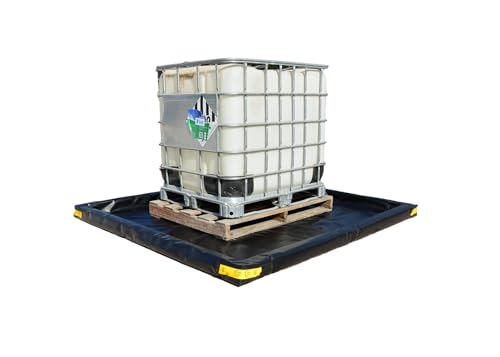
The DuraFlex foam-wall berm is designed for vehicle and equipment access. Its foam walls automatically rise back after passage, eliminating manual adjustments. Constructed with a durable, chemical-resistant geomembrane, it suits oilfields, construction sites, and industrial zones. Lightweight and portable, it folds down for quick transport and storage. Best for operations where frequent access is needed and ease of setup matters more than extreme height containment.
Who this is best for: teams needing fast deployment and smooth vehicle transitions without manual wall adjustments.
Limitations: foam walls may require careful handling to avoid damage in rough environments.
2nd Containment Spill Containment Berm – 18 oz PVC

This compact, lightweight PVC berm provides a strong chemical-compatible option for small spaces. It requires no setup, making it ideal for rapidly addressing leaks or drips from valves or small equipment. Its foldable design and attached strap allow easy stowage in a cabinet or vehicle cab. Best for quick-response scenarios or limited-space applications where a ready-to-deploy berm is preferred.
Who this is best for: responders and technicians needing immediate, no-fuss containment with minimal footprint.
Limitations: best used for smaller areas; may not scale to large frac tank operations.
Industrial Drum Spill Pallet

This modular spill pallet is designed for garage, basement, labs, and desks. It supports up to 50 kg loads and accommodates a range of spill containment needs, including paint buckets, chemicals, and oil drums. It emphasizes anti-slip storage and ease of forklift handling. Best for organized workspaces needing a reliable, modular tray to prevent drips and leaks from multiple containers.
Who this is best for: shops and labs seeking a compact, modular containment tray for everyday chemical and oil handling.
Limitations: not a full drive-over berm; best used in stationary containment or under smaller containers.
Proflex L-Bracket Berm (10’x12′)

The Proflex L-Bracket Berm features reinforced sidewalls with removable brackets for quick assembly and transport. Its chemical-resistant geomembrane liner withstands harsh oils, fuels, and industrial fluids. Available in multiple sizes, it fits a range of equipment from small utility devices to large frac tanks and trucks. Best for mid-sized containment needs where both durability and transportability matter.
Who this is best for: operations requiring sturdy, transport-friendly containment that scales with equipment size.
Limitations: larger sizes may require more setup time and transport planning.
Proflex L-Bracket Berm (12’x12′)
This size expands containment capacity while maintaining reinforced sidewalls and removable brackets. The chemical-resistant liner is designed to endure harsh fluids, making it suitable for larger frac tanks and related equipment. Best for businesses needing reliable, mid-to-large-scale secondary containment with flexible transport and storage options.
Who this is best for: teams managing larger equipment or tanks that still require modular, routable containment systems.
Limitations: balance between size and transport can affect deployment time in tight sites.
Proflex L-Bracket Berm (12’x40′)
Offering a long footprint, this berm suits industrial and commercial containment needs with reinforced sidewalls and removable brackets. It uses a rugged geomembrane liner to withstand tough oils, fuels, and fluids, and is available in large sizes to fit bigger frac tanks or fleets. Best for facilities requiring extended containment lengths in a single unit.
Who this is best for: sites needing extended containment without stitching multiple segments together.
Limitations: longer installation may require more planning and space. Avoid if site access is restricted or space-limited.
Buying Guide: Key Considerations and Comparisons
- Drive-over capability: If vehicle access is needed, prefer berms with reinforced sidewalls and removable brackets, like ENPAC or Proflex models.
- Material compatibility: For oilfield fluids and fuels, select chemical-resistant geomembrane liners and durable plastics to prevent leaks and punctures.
- Size and footprint: Choose berm length and height based on the expected tank size and spill volume. Larger frac tanks require longer berms, while smaller operations can use compact options.
- Portability and storage: Lightweight, foldable, or modular designs improve deployment speed and storage efficiency at remote sites.
- Setup time: Quick-setup designs with automatic wall retraction or simple assembly reduce on-site downtime.
- Maintenance: Consider whether brackets or frames need removal for driving over; factor in maintenance routines for frequent site moves.
- Cost vs. coverage: Balance upfront cost against containment capacity and long-term durability to ensure total cost of ownership aligns with project scale.
FAQ
- What is containment berm capacity and why does it matter?
Containment capacity determines how much fluid the berm can hold during a spill, which affects its suitability for larger tanks or heavier spills. Larger capacities reduce the risk of overflow during temporary storage or transfer.
- Can I drive over all berms with vehicles?
Not all berms are designed for driving over. Some require brackets to be removed for driving over, while others may be suitable for light vehicle access only. Check the product specs for drive-over compatibility.
- What materials are best for chemical resistance?
Geomembrane liners and high-density polyethylene variants offer strong chemical resistance. Look for liners described as chemical-resistant or suitable for oils and fuels.
- How do I choose the right size berm?
Match berm dimensions to your largest tank or transfer vessel plus a safety margin for drips and splashes. For large frac tanks, longer berms are typically needed.
- Are these berms portable for remote job sites?
Many models are designed for quick deployment and transport, with foldable or modular designs. Consider weight, foldability, and whether brackets are removable for easier transport.
- What maintenance is required after a spill?
Inspect the liner and sidewalls for wear, clean any residues, and store the berm in a dry place to extend its lifespan. Replace any damaged components before the next deployment.