Flexible skate wheel conveyors offer portable, expandable, and gravity-driven solutions for loading, unloading, and moving goods in warehouses, factories, and retail backrooms. This guide helps buyers pick the right system for their space, load types, and workflow. The top picks below cover different needs—from fully adjustable, telescoping layouts to unpowered, gravity-based lines that extend and fold for storage. Best for: lightweight to moderately heavy loads, tight storage, and setups that require quick reconfiguration.
The table below compares five strong options to help you decide at a glance. Each product targets specific use cases such as portability, length expansion, and load capacity.
| Product | Best For | Key Strength | Limitations |
|---|---|---|---|
| Global Industrial 18″W Portable Flexible & Expandable Conveyor | General purpose, light to medium loads | Long expandable length, sturdy casters | Heavy loads may require more support |
| Ultimation Roller Conveyor Flow Rail | Heavy duty, mixed pallet and carton handling | Galvanized steel, versatile flow layout | Non-powered; gravity needed for movement |
| INTSUPERMAI Portable Flexible Expandable Conveyor | Multi-industry general use, adjustable length | Wide length range, ABS rollers | Some assembly required; verify weight limits |
| Oasis Machinery T1732S Flexible Gravity Skatewheel Conveyor | Guided paths with twists and turns | Self-tracking design, strong frame | May require precise path planning |
| EQCOTWEA Non-Power Roller Conveyor | Low-cost, power-free setups | Free-adjusting, compact storage | Not suited for very heavy loads |
Note: This article uses objective descriptions based on listed features to assist buying decisions. All sections include practical reasons to choose or avoid each option, with clear pros and limits to fit typical warehouse and retail workflows.
Global Industrial 18″W Portable Flexible & Expandable Conveyor

Width and capacity: 18″ wide with a 175 lbs. per foot capacity. Length expands from 6’2″ to 24’8″. Features telescopic legs and four-inch thermoplastic rubber swivel casters for easy positioning. This model suits facilities needing a long, adjustable line that can stretch across rooms or docks for loading and offloading.
Best for: lightweight to medium loads in environments where you frequently reconfigure the belt path. The expansion capability supports long-distance transfer without needing a fixed conveyor rail.
Why selected: It combines substantial extendable length with portable mobility, making it a versatile choice for temporary setups or multi-zone workflows.
Caution: The system requires stable anchoring for longer spans and may need additional support for very heavy pallets.
Ultimation Roller Conveyor Flow Rail

Materials and build: Galvanized steel rail with durable skate wheels. Designed as a multi-functional flow rack system that can join multiple sections for continuous support over larger areas. This is an unpowered, gravity-based system ideal for unloading, sorting, or extending a line across warehouses or basements.
Best for: workflows requiring a robust, flexible, manual layout that can adapt to varying space layouts and materials, from cartons to light pallets.
Why selected: The galvanized frame and modular approach support long-term, heavy-duty use with configurable segments.
Caution: Movement relies on gravity; position and incline must be carefully planned to avoid unintentional rolling.
INTSUPERMAI Portable Flexible Expandable Conveyor

Specifications: Adjustable length from 47″ to 177″ (about 4 ft to 14.75 ft). Table width 23.6″ and height adjustable 29.5″ to 45.3″. ABS rollers reduce weight and facilitate smooth material handling. Designed for flexible deployment in vehicle loading, warehousing, and other material handling scenarios.
Best for: facilities needing a long, telescoping conveyor with adjustable height to fit loading docks and vehicle bays without power.
Why selected: The broad length and height range covers transit from trucks to shelves, offering a practical, non-powered solution for busy operations.
Caution: Ensure the carrier is kept level during operation to prevent material misalignment on longer runs.
Oasis Machinery T1732S Flexible Gravity Skatewheel Conveyor
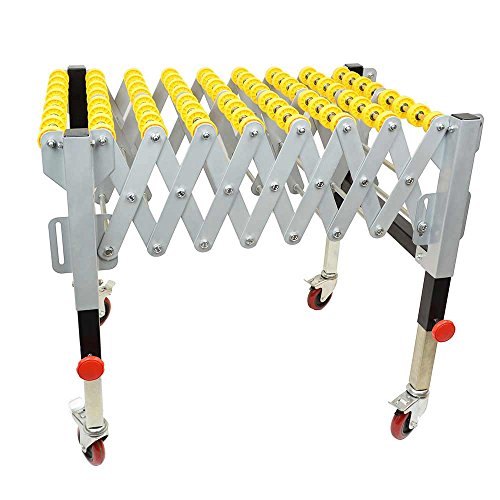
Features: Self-tracking design allows cartons to follow twists and turns without engineered curves. Structural steel support spans the entire width for strength. Square tubing legs add durability for long-term use.
Best for: operations needing a conveyor path with twists, turns, and gentle guiding without complex curve engineering.
Why selected: Its self-tracking capability reduces setup time and keeps material on track through irregular layouts.
Caution: Complex layouts may require careful planning to maintain consistent gravity flow across segments.
EQCOTWEA Non-Power Roller Conveyor

Design highlights: Flexible and adjustable with ABS skate wheels. Lengths from 76″ to 295″ and a load capacity around 35 kg per meter. Suitable for warehousing, factories, and markets needing a low-cost, power-free conveyor.
Best for: setups requiring an easily adjustable, non-powered line for general material handling and temporary conveyors.
Why selected: The no-power design reduces energy use and maintenance while offering substantial length flexibility.
Caution: For heavier items or frequent high-volume throughput, consider pairing with powered options or heavier-duty sections.
Buying Guide
Key considerations when choosing a flexible skate wheel conveyor:
- Load capacity: Match the conveyor’s per-foot capacity to your typical load weight. Heavier materials may necessitate stronger frames or multiple sections.
- Length and adjustability: Consider the maximum extended length and whether height adjustment is needed to align with dock heights, carts, or shelving.
- Power versus gravity: Decide if you need powered movement or if gravity-driven (unpowered) operation fits your workflow and safety requirements.
- Portability and storage: Folding or telescoping designs save space in between shifts and simplify site changes.
- Path layout: For layouts with twists or long straight runs, choose a self-tracking or modular system that minimizes misrouting and supports easy reconfiguration.
- Durability and materials: Steel frames offer long life in demanding environments; ABS rollers or thermoplastic wheels reduce noise and maintenance in lighter-use settings.
FAQ
- What is a skate wheel conveyor best used for? – It is ideal for moving boxes, cartons, and light pallets along a gravity-fed or minimally assisted path, especially in loading docks and warehouses.
- Do these conveyors require electricity? – Some models are non-powered and rely on gravity or manual pushing; others may include powered sections. Check product specs for your needs.
- Can I connect multiple conveyor sections? – Yes, many models are designed to join multiple sections for extended runs or reconfigured layouts.
- Is a higher load capacity always better? – Higher capacity supports heavier items and longer runs but may require sturdier frames and more secure anchoring.
- How important is foldability for storage? – Foldable or telescoping designs save space between shifts and simplify transport to different job sites.
- What maintenance is needed? – Regular inspection of wheels, bearings, and connections helps prevent drifts, misalignment, and unexpected downtime.