For buyers seeking durable, high-performance heat exchange solutions, finned copper tube heat exchangers offer strong thermal transfer and versatile applications. This guide highlights five top options suited for outdoor wood furnaces, hydronic heating, and cooling systems. Each selection emphasizes copper tubes paired with aluminum fins to maximize conductivity, with clear indications of best-use scenarios and notable limitations. The listed models balance capacity, size, and installation practicality to help you choose the right fit for your project.
| Product | Size (inches) | BTU / Output | Key Benefit |
|---|---|---|---|
| VEVOR 24×24 | 24 x 24 | 225K BTU/h | High capacity, robust for outdoor wood furnaces |
| GPOAS 22×24 | 22 x 24 | — | Sturdy steel case, easy installation |
| VEVOR 18×18 | 18 x 18 | 120K BTU/h | Solid mid-range option, versatile for many setups |
| Outdoor Furnace Supply 12×18 | 12 x 18 | — | Compact footprint, simple connections |
| GPOAS 12×15 | 12 x 15 | — |
VEVOR Water to Air Heat Exchanger, 24×24, 225K BTU

Best for high-demand outdoor wood furnace setups and large hydronic systems. This model uses copper tubes with aluminum fins to maximize heat transfer, achieving up to 225K BTU/h. The 24 x 24 inch heat transfer area, 290 fins, and three rows of 3/8 inch copper tubes support broad application efficiency. The unit’s epoxy-coated aluminum fins help reduce scale buildup, extending life in challenging environments. Operating range from -40 to 356 °F supports both heating and cooling cycles. Best for buyers needing maximum output in moderate to large spaces.
Who it’s best for: contractors and homeowners running sizable outdoor wood-fueled or hydronic systems that require robust heat transfer. Caution: the large footprint may require sufficient installation space and mounting considerations.
GPOAS 22×24 Heat Exchanger, Water To Air

This unit prioritizes energy efficiency with a robust 22×24 steel-bodied design. It features 12 aluminum fins per inch and three rows of 3/8″ seamless copper tubes to maximize heating or cooling performance. Edges and contact points are base brazed to withstand higher pressures and temperatures, offering durability for frequent cycling. Installation is simplified through four MNPT ports, allowing quicker plenum integration. Best for space-conscious installations seeking solid efficiency and straightforward setup. Limitation: the spec emphasizes durability over ultra-high BTU output, so confirm capacity matches your system’s needs.
VEVOR Water to Air Heat Exchanger, 14×14, 65K BTU

Best for smaller hydronic heating or compact spaces. With a 14 x 14 inch transfer area and 169 fins, this model provides up to 65K BTU/h, making it suitable for smaller outdoor wood furnace or zone heating setups. The copper tubes and aluminum fins maintain good thermal conductivity, while the operating range of -40 to 356 °F supports cold-start or mild summer cooling. Choose this if you need a space-saving option with solid efficiency. Caution: lower BTU output means it might not meet high-load demands.
GPOAS 12×15 Heat Exchanger, Water To Air
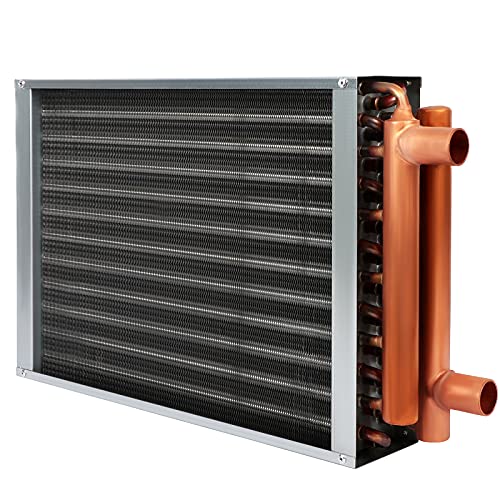
Best for small to mid-sized installations where space is at a premium. This 12×15 model uses a base 306 steel case with 12 aluminum fins per inch and 3/8″ copper tubes to deliver efficient heating or cooling while maintaining a compact footprint. It’s easy to install via four MNPT ports, minimizing required tools and space. Consider this option for limited wall clearance or plenum space but verify that its capacity aligns with your heat load requirements. Limitation: the smaller size reduces peak BTU capability compared to larger units.
Buying Guide
- What capacity do you need? Compare BTU/h ratings and heat transfer area to match your space and climate. Bigger units deliver more heat but require more space.
- What installation space is available? Check footprint, mounting options, and plenum compatibility. Some models offer easy four-port installation for quick setup.
- Material durability and maintenance. Copper tubes provide excellent conductivity; aluminum fins reduce scale buildup but verify corrosion resistance for your environment.
- Operating conditions. Look for a broad temperature range to support both heating and cooling applications and outdoor exposure.
- Ease of integration. Consider models with standard MNPT ports and simple plumbing connections to streamline installation.
- Size vs. performance trade-offs. High-output models (like 24×24) suit larger systems; compact units suit smaller zones but may limit heat output.
FAQ
- What is a finned copper tube heat exchanger? A device using copper tubes with aluminum fins to improve heat transfer between fluids and air, commonly used in heating and cooling systems.
- Which model is best for outdoor wood furnaces? The 24×24 VEVOR model offers the highest output among the listed options, ideal for large installations.
- Do these units require special maintenance? Regular inspection for corrosion, scale buildup, and leaks is recommended; aluminum fins help reduce scale but should be checked periodically.
- Can I install these without tools? Some units are designed for straightforward MNPT port connections, which minimizes special tools, but general plumbing tools are still needed.
- What factors limit performance in compact units? Smaller heat exchangers have lower BTU/h capacity; ensure the unit matches your heating or cooling load.
- Are all units compatible with hydronic systems? Most are designed for air-to-water/hydronic configurations; verify compatibility with your specific furnace or boiler setup.