Answer: For reliable, budget-friendly filling and packaging, consider a mix of automatic and manual machines that cover both liquids and viscous pastes. This guide highlights five top options that fit common needs like tea, seeds, honey, and thin liquids. Each choice is best for specific buyers—commercial setups, home businesses, hobbyists, or small shops seeking precise weight control and versatile output. The table below summarizes the picks and their ideal use cases to help you compare quickly before diving into details.
| Product | Best For | Key Benefit |
|---|---|---|
| XKOPCAL Particle Filling Machine | Small business packaging with precise weights | High accuracy up to ±0.1 g, 13–20 bags/min |
| VEVOR Manual Paste Liquid Filling Machine | Small batches, adjustable volumes | 5–100 ml, dual nozzle options |
| Sumeve Manual Filling Machine 5–55 ml | Liquids and pastes with good flow | CE-certified, shelf-ready design |
| HASANEN Particle Filling Machine | Mid-sized packaging with varied materials | Dual vibration, two outlets |
| BOINES Honey / Viscous Liquid Filler | High-viscosity products | Anti-drip, adjustable weight |
Particle Filling Machine, 10-999G Automatic Weigh Filler
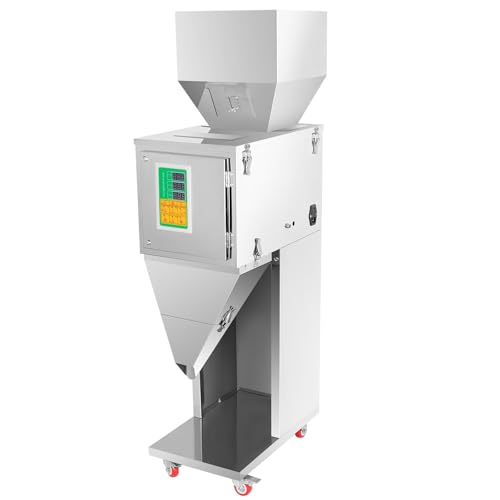
The XKOPCAL filling machine combines dual vibration and magnetic feeding with motor vibration filling. It supports a wide weight range (10-999 g) and offers a high packing speed (13–20 bags per minute) with accuracy up to ±0.1 g. This design uses a pure copper core to maintain stable operation under long-term use. Best for small shops packaging tea, coffee beans, grains, or seeds where precise weight and consistent throughput matter. A potential limitation is the need for frequent cleaning to prevent residue buildup in dense materials.
VEVOR Manual Paste Liquid Filling Machine, 5-100ml

This unit is a manually operated filler with a reinforced handle and smart spring design for durability. It provides precise 5–100 ml filling via a clear scale, making it ideal for small-batch liquid products like milk, water, juice, shampoo, or honey in a home or micro-batch setup. It also features a height-adjustable shelf and two nozzle options, helping to reduce spills. Limitations include manual operation, which may slow throughput for larger runs.
Sumeve Manual Filling Machine 5-55ml

The Sumeve A03 Pro manual filler handles 5–55 ml fill volumes with a scale-based adjustment. It uses a food-grade 304 stainless steel hopper and anti-drip discharge to minimize mess and prevent drips. Suitable for liquids and pastes that flow well and contain no particulates. It also includes a shelf for convenient bottle placement during filling. Choose this if you need precise, repeatable small-batch pours with a simple setup; avoid if materials are thick or particulate-laden.
HASANEN Particle Filling Machine, 0.02-2.2 lbs

HASANEN offers a dual-vibration, intelligent filling system with stainless steel construction and two filling outlets. It supports a broad filling range (0.02–2.2 lbs) and is designed for materials like tea, grains, seeds, or small particulates. It is best for mid-sized packaging tasks and provides clear weight control via an integrated control panel. Be mindful of the need for proper alignment for different container sizes and potential adjustments when switching materials.
BOINES Honey Filling Machine, 1oz-11lb

BOINES provides a high-viscosity filling solution using quantitative weighing. It features an anti-drip design and a flexible power option (AC or DC battery). It is suitable for thick liquids like honey and sauces with a viscosity range into the high CP range. Best for bottling runs where drip-free performance and portability matter. A limitation is that extremely thick products may require waiting between fills for full compression to reach target weight.
Moonshan Liquid Filling Machine, 1-100 Fl Oz

Moonshan focuses on thin, water-like liquids, providing a handheld switch and pedal for flexible operation. It is designed for quick filling of low-viscosity products such as wine, juice, or detergent. A practical feature is the quick connection of tubes for easy cleaning, helping maintain cleanliness between bottle runs. It is not intended for thick creams, lotions, or hot-filled products.
Buying Guide
- Material compatibility: Check if the machine’s hopper and components are food-grade stainless steel to guarantee resistance to corrosion and ease of cleaning.
- Filling range and accuracy: Match the range to your product size and confirm weight precision (e.g., ±0.1 g vs. ±0.5 g) to avoid over- or underfilling.
- Viscosity handling: Thin liquids require simple flow paths; thick pastes may need anti-drip features and higher torque.
- Throughput needs: Consider whether 13–20 bags/min suits your demand or if a manual unit better fits batch-based production.
- Setup and maintenance: Look for clear scales, adjustable nozzles, and easy tube connections for quick cleanup between products.
- Power options: Some models are mains-powered, others offer battery or pedal operation; choose based on workspace and portability.
- Best-for guidance: Use automated units for high-volume, precise packaging; choose manual fillers for small batches or frequent label changes.
Frequently Asked Questions
- What is the difference between a manual and automatic filling machine? Manual fillers require hand operation and are suited for small batches, while automatic fillers use motors and sensors for higher throughput and consistency.
- Which filler is best for viscous liquids like honey? Machines with anti-drip features, high torque, and thicker nozzles are preferable, such as models designed for high-viscosity products.
- Can these machines handle powders or granular materials? Some models are designed for dry powders and small particulates, but most listed are better suited for liquids or pastes. Check the product specifications for material compatibility.
- How important is a food-grade stainless steel build? Very important for hygiene, corrosion resistance, and long-term durability in food and beverage applications.
- Do these machines require professional installation? Most are ready to use with straightforward setup; some may require basic assembly and calibration following the manual.
- Is cleaning complicated? Look for models with accessible nozzles, removable parts, and easy-tube connections to facilitate cleaning.