Whether you’re repairing a boat hull, reinforcing a surfboard, or rebuilding a fiberglass surface, selecting the right fiberglass sheet and resin combo matters. This guide highlights five compatible products that suit hobbyists, DIY renovators, and small-scale marine projects. Each option is chosen for reliable wet-out, ease of use, and practical application with common resins. Read on to find which pairing best fits your project type—from quick seams to full laminations.
| Product | Main Use | Best For |
|---|---|---|
| VIKEYTIM Fiberglass Mat 50 in x 30 ft | Chopped strand mat for fast wet-out | Repairing damaged surfaces; versatile reinforcement |
| J-B Weld Fiberglass Resin – Quart | Two-component resin system | Small to medium holes and gaps; compatible with cloth/mat |
| mychoiii 1.5oz Fiberglass Chopped Strand Mat Tape | Pre-cut reinforcement strips | Seams, cracks, edges; curved surfaces |
| Polymer World Polyester Resin with Chopped Strand Mat | General-purpose marine resin kit | Boat, surfboard, RV, car repairs |
| J-B Weld Fiberglass Cloth 8 sq. ft | Cloth reinforcement for laminated repairs | Thicker, multi-layer repairs; high-strength laminations |
VIKEYTIM Fiberglass Mat 50 in x 30 ft
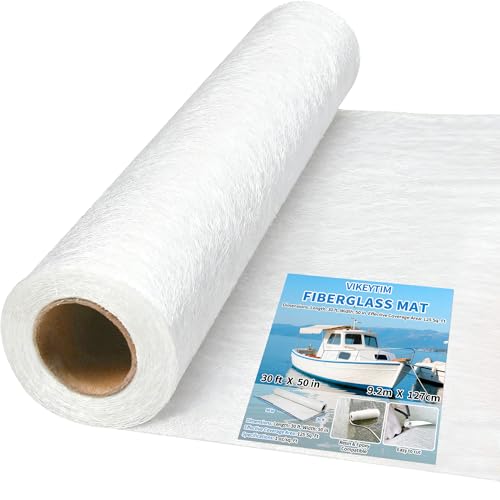
The VIKEYTIM chopped strand mat is designed for uniform strength without directional bias. The roll unfolds flat to cover up to 125 square feet, making it a convenient option for larger surface repairs. It’s especially useful for resin systems that wet out quickly and evenly, helping to form a sturdy, even laminate. Best for hobbyists repairing hulls, roofs, or other flat to gently curved surfaces where consistent resin distribution matters.
Best for: DIYers needing a broad reinforcement area and predictable wet-out. Better for larger patches than bespoke curves. Caution: Unrolling and handling may leave transient folds if the roll isn’t kept taut during application.
J-B Weld Fiberglass Resin – Quart

J-B Weld Fiberglass Resin is a two-component system that cures to a waterproof, durable repair. It is well-suited for sealing holes and gaps in pools, boats, tubs, and showers. This resin integrates effectively with fiberglass cloth or mat to reinforce repairs and extend surface life. Best for: smaller to medium repairs requiring strong bonding and watertight results. Caution: curing time can vary by temperature and mix ratio, which may affect workflow timing.
mychoiii 1.5oz Fiberglass Chopped Strand Mat Tape

This pre-cut reinforcement tape packs 450gsm E-glass into a 4″ x 360″ roll, delivering uniform strength in seams and edges. The random orientation provides isotropic reinforcement, and the open fiber structure speeds resin absorption for faster wet-out with polyester and vinyl ester resins. Best for: edge repairs, seams, or cracks on curved surfaces where a ready-to-use strip saves time. Caution: tape width may require trimming for very tight angles or intricate joints.
Polymer World Polyester Resin With Chopped Strand Mat Kit

This all-in-one polyester laminating resin kit includes MEKP hardener for immediate use. The resin formula wets out fiberglass cloth quickly and evenly, delivering a strong laminate with minimal dry spots. It suits boat decks, hulls, and general repair projects where both resin flow and tackiness matter for layering reinforcement. Best for: builders who want a straightforward kit with fast wet-out. Caution: follow safety and mixing guidelines to ensure optimal cure and avoid excessive heat during exothermic reactions.
J-B Weld Fiberglass Cloth 8 sq. ft

Fiberglass cloth pairs with fiberglass resin for layered laminations. This 8-square-foot cloth is suited for multiple-layer repairs, structural reinforcement, and larger patches on boats or marine gear. Best for: thicker rebuilds and multi-layer applications where fabric-driven strength is key. Caution: ensure proper resin saturation to avoid dry spots and warping on curved surfaces.
Buying Guide
Key considerations help you pick the right fiberglass sheet and resin combination:
- Project type: Choose materials suited for repairs vs. full laminations. For quick patches, chopped strand mat and resin systems work well. For structural repairs, a combination of cloth and resin offers better strength.
- Resin compatibility: Polyester resins typically wet out fiberglass cloth and mat effectively; vinyl ester may be more forgiving on certain substrates. Always confirm compatibility with the chosen reinforcement.
- Surface geometry: Flat or gently curved surfaces benefit from larger rolls or pre-cut tapes, while tight curves may require flexible cloth or smaller segments.
- Wet-out time: Fast-wetting formulations reduce application time but require careful timing to prevent sagging on vertical surfaces. Look for resins described as having good tack and wet-out characteristics.
- Strength needs: For high-stress areas, consider multiple layers of fabric with adequate saturation to build thickness and rigidity.
- Curing and safety: Always follow mixing ratios, temperature guidelines, and ventilation requirements. Use safety gear when handling resins and catalysts.
- Storage and handling: Roll materials should be protected from dust and moisture. Pre-cut tapes offer convenience but may increase waste if not matched to the repair length.
Frequently Asked Questions
- What resin should I use with fiberglass mat? – Polyester or vinyl ester resins are commonly used with chopped strand mat for general repairs and light laminations.
- Can I use fiberglass cloth on curved surfaces? – Yes, especially with a pliable cloth or by applying multiple thin layers to conform to the curvature.
- Is pre-cut fiberglass tape better than full sheets? – Tape speeds up repairs at seams and joints, while full sheets cover larger areas and provide uniform reinforcement.
- How do I know if I saturated the fabric properly? – Proper saturation turns the fabric translucent; avoid dry patches to ensure a strong laminate.
- What safety steps are essential when working with fiberglass resin? – Work in a well-ventilated area, wear gloves and eye protection, and follow the resin’s mixing and curing instructions.
- Can these products be used for non-marine projects? – Yes. They are suitable for boats, surfboards, vehicles, pools, and other repair or fabrication tasks where fiberglass reinforcement is needed.