Answering the most common buyer question: which fiber reinforced plastic (FRP) or polycarbonate panels best protect and illuminate your greenhouse while resisting weather and impact? The following five products are selected for durability, UV protection, and ease of installation. They suit different buyers—from hobby gardeners needing easy-to-cut panels to professional setups requiring thicker, high-impact sheets.
| Product | Best For | Key Benefit |
|---|---|---|
| Hotop 3 Pcs Polycarbonate Greenhouse Panels | Budget-upgrade projects | Durable polycarbonate with cut-to-fit flexibility |
| VEVOR 5 Pack Polycarbonate Panels | All-season durability | 80% light transmission with UV protection |
| Quibbay 8 Pack 8′ X 6′ Panels | Large greenhouses | High transparency and impact resistance |
| Tatuo 6 Pack 4′ X 2′ Panels | Medium-sized setups | Hollow honeycomb design for insulation |
| Hotop 12 Pcs Polycarbonate Panels | Extended coverage | Multiple panels for bigger installations |
Hotop 3 Pcs Polycarbonate Greenhouse Panels

Best for entry-level greenhouse upgrades or small hobby projects. These panels are made from polycarbonate, offering impact resistance superior to glass while remaining lighter and easier to cut. The panels can be trimmed to fit irregular greenhouse shapes, with professional cutting recommended due to their hardness. Clear visibility ensures bright interior conditions for healthy plant growth.
Who it’s best for: gardeners building a small-to-mid-sized greenhouse on a budget who still want UV protection and clear sightlines. Why selected: simple, reliable replacement option that combines toughness with adjustable sizing. Caution: cutting requires care; improper cuts can compromise fit or edge quality.
VEVOR 5 Pack Polycarbonate Greenhouse Panels

Best for year-round growing with strong weather resistance. VEVOR’s panels offer 80% light transmission while blocking 98% of UV rays, helping prevent overheating and maintaining stable temperatures. The double-layer honeycomb design enhances durability against hail and heavy impacts, and the panels are rated for a wide temperature range from -40°C to 120°C.
Who it’s best for: serious greenhouse builders seeking reliable protection against extreme weather and consistent light. Why selected: the combination of high light transmission, UV blocking, and robust construction supports longer growing seasons. Caution: heavier than ordinary panels; ensure frame support and mounting hardware can handle the weight.
Quibbay 8 Pack 8′ X 6′ Panels
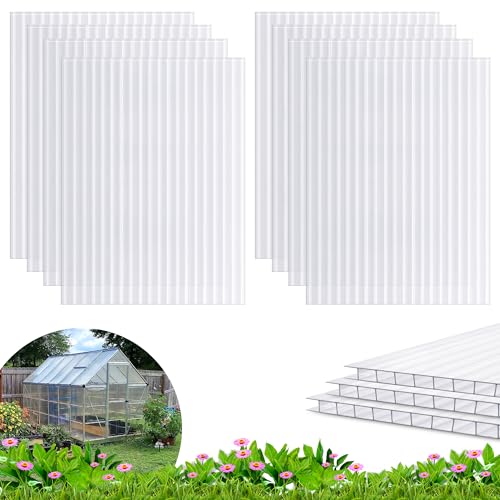
Best for large greenhouse installations needing consistent light and strong insulation. Quibbay panels use high-transparency double-walled polycarbonate with a UV coating that blocks up to 99.9% of UV rays. The twin-wall design provides better insulation, while maintaining a light transmission around 82%, supporting photosynthesis and steady temperatures in summer and winter alike.
Who it’s best for: growers expanding to bigger structures or commercial hobbyists. Why selected: excellent balance of light, insulation, and impact resistance for sizable environments. Caution: larger panels require accurate cutting and secure mounting to prevent wind uplift in exposed locations.
Tatuo 6 Pack 4′ X 2′ Panels

Better for medium-sized gardens needing effective insulation. Tatuo panels employ a hollow honeycomb design that enhances heat retention, while maintaining UV resistance and outdoor durability. The sheets are UV stabilized on both sides and can be cut with a utility knife, making modifications easier during installation.
Who it’s best for: homeowners or small commercial setups that need a practical, thermally efficient option. Why selected: balanced insulation, UV resistance, and ease of cutting offer flexible installation. Caution: work carefully when cutting to avoid finger injuries; use proper tools and safety gear.
Hotop 12 Pcs Polycarbonate Panels

Best for larger coverage needs or professional-grade replacements. This kit expands your options with multiple panels that can be combined for bigger greenhouses or complex roofs. The panels share the same DNA: polycarbonate, high impact resistance, and UV protection. The clear panels promote bright interiors for healthy plant growth.
Who it’s best for: those upgrading larger structures or building new, expansive greenhouses. Why selected: scale and uniform performance across a bigger area. Caution: ensure frame flexibility and support in regions with strong winds or heavy snowfall.
Buying Guide: Key Considerations For FRP And Polycarbonate Panels
- Material and durability: Polycarbonate panels provide high impact resistance and better weight distribution than glass. FRP panels offer corrosion resistance and long service life in challenging environments.
- Light transmission: Look for panels with balanced translucency to promote photosynthesis while avoiding overheating. Most options fall in the 80% range, with UV blocking to protect plants and interiors.
- Insulation and thermal performance: Twin-wall or honeycomb designs improve insulation, helping maintain stable temperatures year-round.
- UV resistance and transparency: UV-protected coatings reduce yellowing and ensure long-lasting clarity for plant growth.
- Cutting and installation: Some panels require professional cutting or precise tools due to hardness. Consider panel thickness and frame support requirements for your structure.
- Weather resistance: Temperature tolerance and impact resistance are critical for outdoor installations in extreme climates.
- Maintenance and replacement: Panels with smooth edges and consistent surface finish ease cleaning and reduce wear over time.
Frequently Asked Questions
- What is the main difference between FRP and polycarbonate panels?
FRP panels focus on corrosion resistance and lower weight for durable, chemical-exposed environments; polycarbonate panels emphasize impact resistance and clarity for greenhouse use. - Are these panels suitable for winter use in cold climates?
Yes, many panels are rated for wide temperature ranges and offer insulation benefits, but thickness and installation quality affect performance. - Can I cut these panels to fit irregular greenhouse shapes?
Most panels can be cut; some require professional cutters or caution due to hardness and edge quality. - Do these panels protect plants from UV rays?
Yes, most listed panels include UV-blocking properties to reduce overheating and protect plant material. - Which panel is best for large greenhouses?
Larger sheet quantities from brands like Quibbay or Hotop with higher coverage kits are typically more cost-efficient for big installations. - What is the best option for budget projects?
Single or small-pack panels from Hotop offer reliable performance at a lower upfront cost while still delivering UV protection and clarity.