Answering the question: the best chains and binders are those that combine strong load capacity, user-friendly operation, and reliable corrosion resistance for common hauling tasks. This guide highlights five top options ideal for truckers, equipment haulers, and agricultural or industrial towing. Each product is best for a specific scenario—heavy flatbed loads, longer reach, or frequent quick-release needs. Use the quick reference table below to compare core specs at a glance.
| Product | Best For | Key Specs |
|---|---|---|
| VEVOR Chain And Binder Kit (3/8″-1/2″) | Heavy loads on flatbeds; multi-use tie-downs | 9200 lbs WLL, 3/8″ x 10′ G80 chain, rubber grip |
| VEVOR 3/8″-1/2″ Ratchet Binder (2 Pack) | Longer leverage and easier operation | WLL 12000 lbs, 40 cm handles, anti-skid grip |
| VEVOR Chain Load Binder (4 Pack, 5/16″) | Compact, economical multi-binder kit | 5,400 lb load capacity; four ratchets with four 21′ chains |
| Tornwell Chain And Binder Kit (3/8″-1/2″) | Longer chains and adjustable hooks | 9200 lbs load; 20′ chains; includes shackle |
| Digank Chain Binder Kit | Industrial/agricultural towing with 2 binders | 6600-9200 lbs WLL; 26,400-27,600 lbs break strength |
VEVOR Chain And Binder Kit, 3/8″-1/2″ Ratchet Load Binders

This kit pairs a 3/8″ to 1/2″ chain with ratchet binders and a 9200 lbs working load limit. The lever-style operation simplifies tightening and releasing cargo, making it suitable for truckers and haulers handling heavy loads. The 3/8″ G80 chain is 10 feet long, providing ample reach for securing long items. A rubber grip on the handle helps prevent slipping during operation. Best for: regular flatbed truckers who need a reliable, all-in-one kit for mid-to-heavy loads. Limitation: the included chain length may require additional slack adjustment for oddly spaced tie-down points, so plan extra chain or hooks if needed.
VEVOR 3/8″-1/2″ Ratchet Chain Binder with Chain, G80 12000 lbs
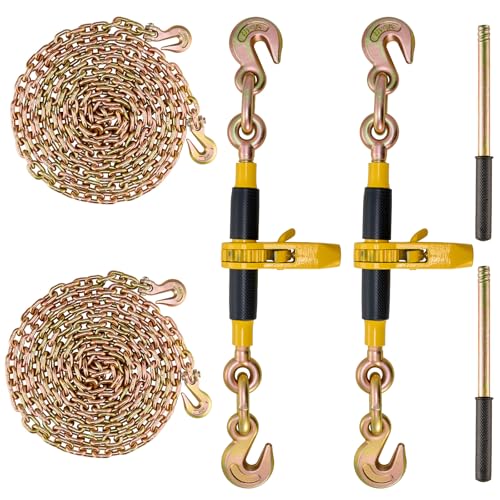
These binders offer a higher 12,000 lbs WLL with longer 40 cm handles for superior leverage and easier tightening. They accept 3/8″ or 1/2″ chains, making them versatile for various loads. The body is cast steel with rust-resistant coating, and handles are knurled for extra grip. Best for: users who need maximum leverage and a robust build for frequent, heavy-duty strapping. Caution: ensure the chain length and hook spacing are compatible with your cargo layout to avoid over-tensioning or misalignment.
VEVOR Chain Load Binder, 5/16″ Kit with 4 Binders

This kit includes four 5,400 lb capacity load binders with two hooks on each end and a 22,000 lb breaking strength chain set. The all-steel construction and powder-coated finish enhance durability in harsh environments. Best for: contractors and fleet operators needing multiple binders for securing diverse loads, particularly when space is at a premium. Limitation: keep track of individual binder spacing to maintain uniform tension across all chains.
TORNWELL 20ft Chain And Binder Kit (3/8in-1/2in)
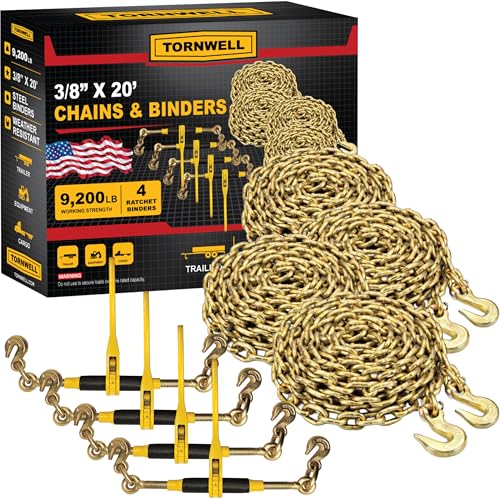
This kit offers 9200 lbs loading capacity with 3/8″ to 1/2″ chain compatibility and 20 feet of chain length. The ratchet binder has a 14″ handle for enhanced leverage and a pawl mechanism to reduce the risk of accidental release. Best for: long-haul operations requiring longer chain lengths and adjustable hook spacing. Caution: the longer chain means more potential snag points; verify clearance around the cargo to avoid tangles during loading.
Digank Chain Binder 3/8″ -1/2″ Kit

Digank offers two binders with two 10″ chains per kit, designed for industrial and agricultural towing applications. The 3/8″ to 1/2″ range and a combined breaking strength around 27,600 lbs make it suited for robust loads. Best for: users who need a straightforward two-binder setup with reliable Grade 70/80 components. Limitation: verify that the chain length and hook spacing fit your specific trailer or truck framework to avoid binding issues.
Buying Guide: Key Purchase Considerations
What size chain and binder do I need? Consider the heaviest load you anticipate and choose a kit with a Working Load Limit (WLL) comfortably above that weight. If you haul long, bulky cargo, longer chains and adjustable hook spacing improve control and fit.
Metal quality and corrosion protection matter. Look for G80 or equivalent high-strength chains and cast steel binders with rust-resistant finishes. In coastal or humid environments, a zinc galvanization or powder coat can extend life.
How important is leverage and ease of use? Ratchet binders with longer handles offer more leverage, reducing effort and increasing tension accuracy. A textured rubber grip helps maintain control in sweaty conditions and during workload spikes.
Is multi-pack vs. single-kit better for you? Multi-pack kits provide a fleet-ready solution for operators who manage multiple trailers or frequent loads. For occasional use, a smaller, focused kit may suffice and reduce storage needs.
Safety considerations: ensure proper hook alignment and avoid overtightening. Train operators to check anchor points and distribute tension evenly to prevent cargo shifting during transit.
FAQ
- Which chain binder is best for long-distance hauling? A binder with a longer handle and longer chain sections offers better leverage and fit for extended runs, such as the TORNWELL or 3/8″-1/2″ VEVOR kits.
- What WLL is necessary for typical flatbed loads? For common flatbed loads, a WLL of 9,200 to 12,000 lbs is common; select chains and binders with matching or higher WLL than the load.
- Should I choose multi-pack kits? Yes, if you operate multiple trailers or handle varied loads, a four- or two-set kit improves efficiency and consistency across jobs.
- Are rust-resistant coatings essential? Yes, coatings protect binders and chains in harsh environments; zinc or powder coatings are widely used protections.
- Can binders prevent chain slip? A good anti-slip grip on handles and properly seated hooks reduce slip risk during tightening and release.
- Is there a risk with over-tightening? Over-tightening can stress chains and anchors; aim for firm tension with visual or audible cues rather than maximum force.