Answering the question “which electric walkie stacker forklift should I buy?” this guide highlights five top options that balance capacity, lift height, and maneuverability for common warehouse tasks. Each selection is best for specific settings: tight aisles, high lifts, or heavy pallet handling. The overview below helps buyers compare capabilities quickly and decide which model fits their space and workflow.
Summary of chosen products
| Product | Capacity | Max Lift Height | Best For | Notable Consideration |
|---|---|---|---|---|
| CareArise Electric Material Lift Pallet Stacker | 660 lbs | 47.24 inches | Small warehouses, garages, tight spaces | Adjustable forks/base |
| VEVOR Full Electric Pallet Stacker | 3300 lbs | 98.42 inches | Medium to large loads, higher stacking | Wide lifting range, sturdy build |
| Tory Carrier Full Electric Pallet Stacker (130″ Lift) | 3300 lbs | 130 inches | Narrow spaces with tall storage | Gel battery, straddle legs |
| SUNMAX PS3300FEAS-3M Fully Electric Pallet Stacker | 3300 lbs | 118 inches | Vertical optimization in warehouses | Fully electric operation |
| APOLLOLIFT Full Electric Stacker | 3300 lbs | 118 inches | Maintenance-friendly stacks, safety-focused | Safety valve and modular design |
CareArise Electric Material Lift Pallet Stacker
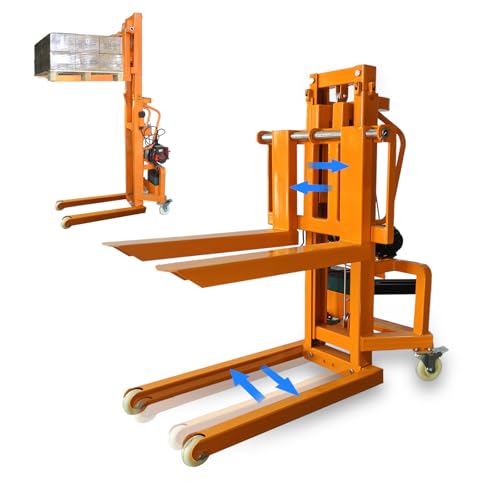
Capacity and features: 660 lbs; 47.24″ max lift height; adjustable forks and base width. This model emphasizes compact design and easy maneuverability. Best for small warehouses, home garages, or logistics setups needing a portable electric stacker with flexible dimensions.
Who it’s best for: buyers needing a compact, relatively low-profile electric stacker to handle varied pallet sizes in tight spaces. Why chosen: adjustable fork width and base width support diverse material handling tasks without a full-size forklift.
Caution: the listed data stresses adjustability; verify actual fork/base dimensions for your pallets before purchase to ensure compatibility.
VEVOR Full Electric Pallet Stacker

Capacity and features: 3300 lbs; adjustable fork width 8.66-31.1″, adjustable leg width, and 70.47-117.72″ mast height; 98.42″ lift height. The design emphasizes high lifting capacity and flexibility for varying pallet sizes across mid to large warehouses.
Who it’s best for: facilities needing substantial lift height and wide adaptability for different pallets. Why chosen: strong motor and broad adjustment range support long-term versatility in storage operations.
Caution: includes a longer turning radius; plan navigation in tighter aisles to avoid collisions in crowded layouts.
Tory Carrier Full Electric Pallet Stacker (130″ Lift)

Capacity and features: 3300 lbs; 130″ lift height; adjustable forks and legs; gel battery. This model targets tall storage needs in narrow spaces and tall racking areas, with a focus on maintenance-free operation and safety features.
Who it’s best for: warehouses needing very tall stacking capability in constrained aisles. Why chosen: tall lift height enables reaching upper racks without a full-sized forklift.
Caution: suitable for flat, even floors; avoid uneven ground or slopes to prevent instability.
Tory Carrier Full Electric Stacker Power Straddle Forklift

Capacity and features: 3300 lbs; 118″ lifting height; 53″ turning radius; straddle legs with adjustable width. This model is tuned for narrow spaces and stable handling of diverse pallet sizes with a strong safety profile.
Who it’s best for: operations requiring a reliable, tall stacker in tight aisles with flat floor requirements. Why chosen: strong safety features and compact turning radius support efficient intra-warehouse movement.
Caution: described as best on flat ground; avoid uneven surfaces or potholes that could compromise stability.
APOLLOLIFT Full Electric Stacker

Capacity and features: 3300 lbs; 118″ max lift height; straddle legs; safety-focused design with explosion-proof valve and warning systems. The modular build supports straightforward maintenance and safer operation in busy warehouses.
Who it’s best for: facilities prioritizing safety, clear operation signals, and easy maintenance. Why chosen: built-in safety features reduce risk during high-lift tasks.
Caution: ensure floor flatness and load stability, as heavier stacks may need additional floor reinforcement in some locations.
Buying Guide: Key Purchase Considerations
- Load capacity vs. pallet size: Choose a model that comfortably handles the heaviest loads you typically move, with some margin for peak operations.
- Lift height needs: If you store pallets on high racks, prioritize models with higher lift heights and stable mast designs.
- Aisle width and turning radius: Narrow aisles benefit from smaller turning radii and adjustable legs; plan floor layout to minimize maneuvering.
- Power and battery type: Gel or maintenance-free batteries offer long runtimes; consider charging options and uptime needs for shifts.
- Fork/legs configuration: Straddle legs provide stable handling for varied pallet widths; adjustable forks help fit non-standard loads.
- Safety features: Look for warning devices, explosion-proof valves, and load containment aids to reduce risk during operation.
- Maintenance and parts availability: Favor models with modular components and readily available spare parts for lower downtime.
Frequently Asked Questions
- What is the typical use case for an electric walkie stacker?
Answer: They move and stack pallets in warehouses, shops, and light manufacturing, combining lift and travel with limited floor space requirements. - How high should a stacker lift height be for tall rack storage?
Answer: Choose a model with a lift height that reaches or surpasses your highest pallet location, considering future storage needs. - Are electric stackers safe on uneven floors?
Answer: Most are designed for flat, smooth surfaces; check the product’s ground requirements and avoid slopes unless specified. - What maintenance does a pallet stacker require?
Answer: Regular inspection of hydraulics, battery health, rollers, and chassis; follow the manufacturer’s service recommendations. - Is a higher capacity always better?
Answer: Not necessarily; choose capacity with a margin over your heaviest loads, balanced with maneuverability and cost. - Do electric stackers use a maintenance-free battery?
Answer: Many do; some models use gel or AGM batteries that minimize maintenance, though charging schedules vary by model.