Finding the right CNC router for aluminum involves balancing rigidity, spindle power, precise motion control, and upgrade paths. The following selections cover metal-capable routers and essential cutting tools that help you machine aluminum, brass, copper, and other metals with confidence. Each pick emphasizes solid build quality, robust guides, and reliable firmware or upgrade options to maximize metalworking efficiency in American shops and hobby setups.
Summary of selected products
| Product | Brand | Key Strengths | Direct Link |
|---|---|---|---|
| AnoleX CNC Router Machine 4030-Evo Ultra 2 | AnoleX | Dual steel linear guides, 800W trim router, GRBL_ESP32 | Amazon |
| AnoleX CNC Router Machine 3030-Evo Max | AnoleX | Upgradeable spindle, dual guides, closed-loop options | Amazon |
| Genmitsu 40pcs End Mills CNC Router Bits | Genmitsu | Nano blue and titanium coatings, varied profiles | Amazon |
| SHARPRO O Flute Upcut Spiral Router Bit | SHARPRO | Aluminum and plastics cutting, smooth finish | Amazon |
| HOZLY CNC Single Flute Router Bits | HOZLY | Economical flap for aluminum, durable carbide | Amazon |
AnoleX CNC Router Machine 4030-Evo Ultra 2

The 4030-Evo Ultra 2 from AnoleX is designed to tackle metal and non-metal materials with a rigid all-metal frame and dual steel linear rails. It features an upgraded Φ65mm trim router with an 800W capacity and an ER11-1/8″ collet, offering six-speed settings from 8000 to 24000 RPM. The included GRBL_ESP32 control board extends capabilities with laser engraving support, a 4th axis option, coolant control, closed-loop motors, and a 3-pin touch probe. This configuration improves stability while cutting aluminum, brass, and other metals, reducing vibration and improving finish quality. The X, Y, and Z axes use dual HGH-15 rails and 1204 ball screws for higher rigidity and load handling, with dust protection enhancements for the moving axes.
With this machine, operators gain a capable entry into small-to-mid-scale metal work, where consistent feed rates and precise toolpaths are essential. The combination of a robust spindle, upgraded rails, and a firmware ecosystem supports both initial experimentation and more advanced projects. Maintenance and component upgrades are typically straightforward due to the modular rail and screw design.
AnoleX CNC Router Machine 3030-Evo Max

The 3030-Evo Max expands on the Evo platform with a larger 30×30 cm work area and a robust all-metal XYZ axis build. It ships with an 800W trim router and supports upgrades to a 1.5kW spindle for higher throughput on aluminum and other metals. Its motion system uses dual MGN-15 guides and optioned 1204 ball screws to maintain rigidity under cutting forces, plus enhanced dust protection around X and Y axes. The machine uses a Nema 17-based stepper setup, with an option for closed-loop motors to reduce missed steps at higher feed rates.
For users who anticipate heavier aluminum work or eventual upgrades to higher spindle power, the 3030-Evo Max offers a scalable path, preserving accuracy and repeatability across different material sets. The combination of upgrade paths, strong guides, and proven GRBL-based control makes it a practical choice for home shops and makerspaces focusing on aluminum fabrication.
Genmitsu 40pcs End Mills CNC Router Bits
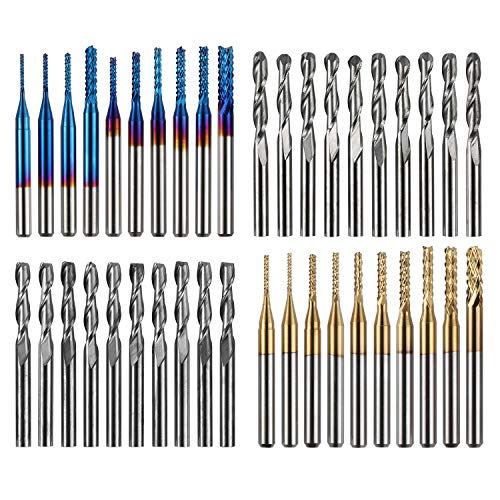
This 40-piece set from Genmitsu provides a comprehensive range of end mills for CNC routing in aluminum and other materials. The tools feature ultra-fine tungsten carbide with Nano Blue and Titanium coatings to enhance hardness, heat resistance, and edge retention. The collection includes multiple profiles like 2-flute flat-nose and ball-nose bits across a spectrum of shank diameters (with 3.175 mm shanks) and cutting diameters from 0.8 mm up to 3.0 mm. Such versatility supports pocketing, contouring, engraving, and finishing tasks on aluminum components and projects that require precise surface finishes with reduced tool wear.
For aluminum work, coating and geometry choices help minimize built-up edge and heat, while the broad size range enables users to optimize cut depths and step-downs. Routine maintenance—like checking runout and securing workholding—remains important for achieving consistent results across diverse aluminum alloys and thicknesses.
SHARPRO O Flute Upcut Spiral Router Bit

The SHARPRO O Flute Upcut Spiral router bit is designed for aluminum and plastics, offering a cutting diameter of 1/4 inch and a 1 inch cutting length with a 2-1/4 inch overall length. The single-flute carbide bit features a 25°–28° helix and a polished surface to minimize sticking. The larger chip space and high precision help with efficient chip evacuation and clean cuts, supporting smoother finishes on aluminum and acrylic while reducing the need for post-cut deburring in many cases.
Quality control and coating depth influence durability in metal work. The upcut geometry excels at clearing away chips and achieving sharp pockets, but practitioners should monitor surface finish in very soft materials or deep cavities to prevent tear-out or chatter at high feeds.
HOZLY CNC Single Flute Router Bits

The HOZLY set comprises 10 solid tungsten carbide end mills with a 1/8 inch shank and 1/8 inch cutting diameter, each with a 17 mm cutting length. DLC-coated for improved hardness and wear resistance, these bits are positioned for aluminum and aluminum-based composites, helping to maintain edge sharpness during prolonged machining. The compact set eases cost concerns for hobbyists and small shops working on aluminum projects such as paneling, extrusions, or light aluminum profiles.
While single-flute designs can be beneficial for clearing chips in softer materials, aluminum work often pairs well with additional flute geometries for balance between finish quality and material removal rate. Consider using slower feed rates and extended entry ramps when starting cuts to minimize deflection and tool wear in thicker aluminum sections.
Buying Guide: Key purchase considerations for aluminum CNC routing
- Machine rigidity and frame design: Aluminum cutting requires a stable, rigid frame with robust linear guides and, ideally, ball screws. A heavy, all-metal construction reduces vibration and improves surface finish and dimensional accuracy.
- Spindle power and speed control: For aluminum, a spindle or router with sufficient wattage and a broad RPM range minimizes rubbing and heat buildup. Consider upgrade paths to higher-power spindles if you plan deeper cuts or larger workpieces.
- Motion system and accuracy: Dual rails and high-precision ball screws improve repeatability. Closed-loop motors can prevent missed steps during aggressive cutting, especially at higher feed rates.
- Firmware and expandability: Firmware with features like laser engraving support, rotary axis, coolant control, and probe functionality adds versatility. Check compatibility with GRBL 1.3a or similar control ecosystems for future-proofing.
- Work area and clearance: Ensure the bed size accommodates your typical aluminum parts, including clearances for clamping, spoilboard, and workholding devices. Larger Z-axis travel helps with tall profiles and flexible toolpaths.
- Tooling selection: For aluminum, coatings (Nano Blue, Titanium) and carbide quality extend cutter life. A mix of end mills (ball-nose, flat-nose, upcut) provides the versatility needed for pocketing, engraving, and contouring.
- Upgrade paths and support: Look for models with upgrade options, such as higher-wrequency spindles, enhanced dust protection, or closed-loop motor packs. Manufacturer support and community resources are valuable for troubleshooting and optimization.
- Safety and maintenance: Proper dust collection, shielding, and regular maintenance of rails and screws help sustain performance and longevity in metal cutting environments.
These considerations help buyers compare similar machines and accessories, ensuring that the chosen CNC router and tooling align with aluminum-focused workflows, whether for hobby projects, small production runs, or prototyping. The selections above provide a spectrum of capabilities—from compact, budget-friendly setups to larger, upgrade-ready systems—so operators can identify the right balance of budget, rigidity, and expandability for aluminum work.