Buyers seeking reliable CIP (Clean-In-Place) tank cleaning solutions want equipment that delivers thorough, uniform cleaning with minimal maintenance. This guide highlights five top CIP spray balls and rotary spray components best suited for sanitary environments across food, beverage, pharmaceutical, and chemical sectors. The selections emphasize compatibility with standard pipe threads, robust stainless steel construction, and proven spray coverage. Ideal buyers include plant operators needing versatile cleaning tools, process engineers optimizing cleanliness cycles, and maintenance teams seeking long-lasting components. A quick comparison table is provided to help you skim key specs at a glance.
- Product reliability: stainless steel (316L or 304 where specified) and corrosion resistance
- Connection type variety: NPT female threads to fit common CIP rigs
- Spray coverage: 360° patterns to avoid dead zones
- Self-cleaning or low-maintenance features when available
| Product | Thread | Diameter | Coverage | Material |
|---|---|---|---|---|
| DERNORD Rotary Spray Ball 3/4″ NPT | 3/4″ NPT Female | 53 mm | 360° | 304 Stainless Steel |
| DERNORD Rotary Spray Ball 1/2″ NPT | 1/2″ NPT Female | 38 mm | 360° | 304 Stainless Steel |
| ChiweiJ G3/8″ Rotary Spray Ball | G3/8″ Female | — | 360° | 316L Stainless Steel |
| Hydravicit 1/2″ NPT Rotary Ball | 1/2″ NPT Female | — | 360° | 304 Stainless Steel |
| DERNORD 5/8″ NPT Rotary Ball | 5/8″ NPT Female | 38 mm | 360° | 304 Stainless Steel |
DERNORD Rotary Spray Ball 3/4″ NPT
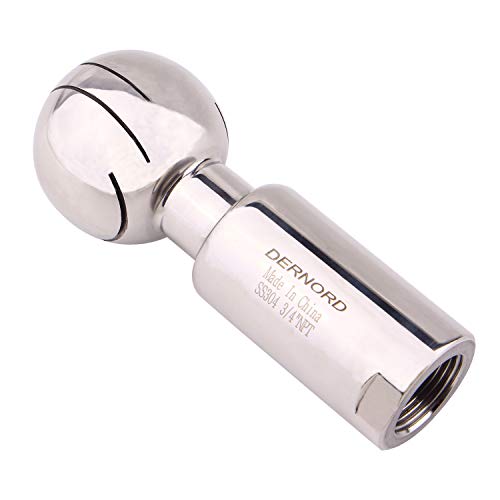
Best for standard CIP rigs with 3/4″ connections, this DERNORD spray ball offers a 360° spray pattern and a relatively large ball diameter for efficient counter-flow cleaning. It is well suited for medium-sized tanks in beverage and food processing where a dependable, mid-size nozzle is advantageous.
Best for: facilities with 3/4″ NPT piping and tanks that require quick, uniform coverage with no dead zones. This model is chosen for its straightforward compatibility and robust stainless steel construction.
Caution: requires minimum operating pressure of at least 0.3 MPa to maintain a consistent spray pattern.
DERNORD Rotary Spray Ball 1/2″ NPT
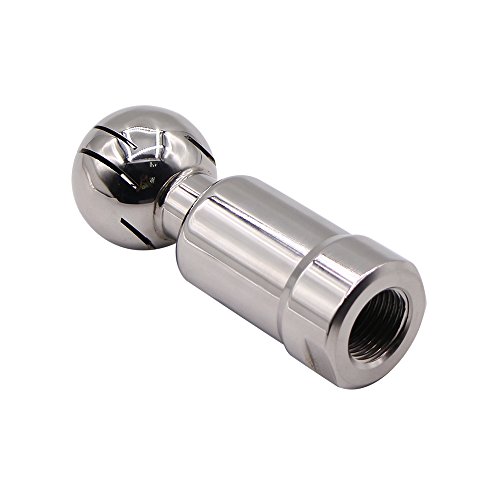
Best for compact CIP systems and smaller tanks, this 1/2″ NPT version uses a compact ball with 38 mm diameter to deliver a tight, 360° clean. It is ideal for smaller stainless steel vessels or pilot plants where space is limited but reliable spray coverage is essential.
Best for: smaller processing lines or pilot plants needing a space-saving solution without compromising 360° coverage. Choose this if your tank has restricted vertical space or you operate at moderate flow.
Caution: ensure the system can achieve the minimum working pressure of 0.3 MPa; insufficient pressure may reduce cleaning effectiveness.
ChiweiJ G3/8 Inch Rotary Spray Ball
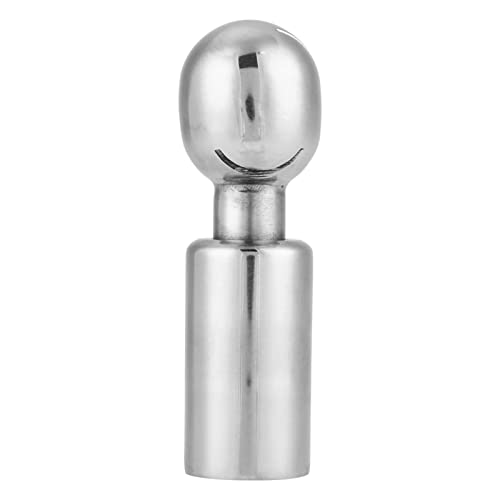
This G3/8″ sanitary spray ball uses 316L stainless steel with a self-cleaning design, providing continuous cleaning of the rotating nozzle. Its 360° spray coverage suits tanks, reactors, and equipment in sanitary environments across pharma, food, and chemical industries.
Best for: facilities needing a self-cleaning mechanism to extend service life and maintain high sanitation standards. The 316L construction is preferred where high resistance to corrosion and easier cleaning are priorities.
Limitation: some installations may require adapters for specific clamp systems or gaskets to ensure a perfect seal in your CIP loop.
Hydravicit 304 Stainless Steel Rotary Ball

Best for medium to larger CIP tanks with 1/2″ NPT connections, this Hydravicit spray ball provides 360° spray coverage and strong cleaning performance at pressures up to 1.6 MPa. The product uses 304 stainless steel suitable for many sanitary applications.
Best for: operations requiring higher operating pressures to achieve deeper cleaning in larger vessels. This model is a solid pick when the cleaning cycle demands robust nozzle performance.
Caution: verify compatibility with your existing NPT fittings and ensure the tank mouth or port can accommodate a 1/2″ thread interface without interference.
DERNORD Rotary Ball 5/8″ NPT

Best for bigger CIP setups with 5/8″ NPT threads, this model balances robust flow and wide coverage for larger tanks. With a 38 mm ball diameter, it provides effective spray over substantial surfaces and can handle higher cleaning demands.
Best for: facilities with larger vessels that need reliable, broad coverage in a single spray ball. Opt for this if your CIP loop requires a higher flow capability without multiple units.
Caution: ensure the nozzle fittings and seals match your existing piping to prevent leaks at higher pressures.
Buying Guide
Key considerations for selecting CIP spray balls and rotary spray devices:
- Tank size and geometry: larger tanks benefit from bigger ball diameters and higher coverage; smaller tanks may be better served by compact connections.
- Connection standard: match thread types (NPT 1/2″, 5/8″, 3/4″, or G3/8) to your CIP system’s ports and clamps.
- Material and sanitation: choose 316L for pharma and food-grade applications; 304 is common for many beverage uses but may have different corrosion resistance needs.
- Spray pattern and coverage: 360° spray is typical for full surface cleaning; verify dead-angle avoidance for your tank shape.
- Operating pressure: confirm minimum and maximum pressures supported to ensure cleaning effectiveness without damaging components.
- Maintenance features: self-cleaning designs reduce downtime and extend service life where applicable.
Frequently Asked Questions
- What is CIP spray ball rotation good for?
It ensures uniform cleaning by distributing cleaning solution evenly across tank interior surfaces. - Do I need 316L or is 304 stainless steel enough?
316L is preferred in pharma and highly reactive environments; 304 is common for many food and beverage uses but may be less resistant to chlorides. - Can a single spray ball clean all tank sizes?
It depends on the tank diameter and port configuration; larger tanks often need multiple or larger-diameter spray balls for complete coverage. - What happens if the pressure is too low?
Cleaning efficiency drops and spray patterns may become inconsistent; verify your system meets the minimum requirements. - Are self-cleaning spray balls worth it?
Yes for high-frequency CIP cycles where maintenance downtime is a concern, but they may come at a higher upfront cost. - How do I choose between NPT and G threaded connections?
Use NPT for standard pipe fittings in most CIP systems; G threads are common in some sanitary fittings and may require adapters.