If you’re searching for reliable plastic tanks or jugs for mixing chemicals, beverages, or solutions, these options are designed to handle diverse contents with durability and safety. This guide highlights five top plastic containers that are well-suited for chemical mixing, storage, and dispensing. It’s ideal for labs, workshops, industrial settings, and food/beverage preparation where non-reactive materials and sturdy construction matter.
Buyer types best served by these picks:
- Facility managers needing large-capacity, durable tanks for chemical storage.
- Laboratories and educational labs requiring HDPE options with secure lids and spigots.
- Restaurants or catering operations seeking reliable mixing and storage containers for beverages or solutions.
- Home workshops and hobbyists who want chemical-resistant, easy-to-clean vessels.
Summary of chosen products:
| Product | Capacity | Material | Best For |
|---|---|---|---|
| Norwesco 16 Gallon Flat Bottom Utility Tank | 16 gallons | HDPE | Medium to large-volume chemical storage and dispensing |
| Eagle 14 Gallon Plastic Drum with Lid | 14 gallons | HDPE | Regulatory-compliant storage and weather-resistant containment |
| AFWFilters Polyethylene 35 Gallon Chemical & Solution Tank | 35 gallons | Polyethylene | High-capacity chemical and solution storage with pump fitting |
| Globe Scientific 50L HDPE Aspirator Bottle | 50 liters (~13.2 gallons) | HDPE | Laboratory-grade aspirator-style storage with spigot options |
| TCP Global Plastic Graduated Measuring and Mixing Pitchers Set | Various (500–5000 ml) | PET | Precise measuring and mixing for smaller volumes and lab tasks |
Norwesco 16 Gallon Flat Bottom Utility Tank
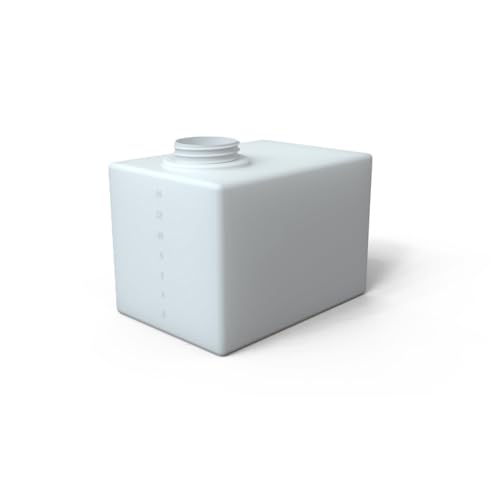
The Norwesco 16 Gallon Flat Bottom Utility Tank uses a one-piece polyethylene construction. Its large 5″ opening supports easy filling and access for pumping or adding tubing. This tank is best for mid-range storage where a flat bottom simplifies stability and stacking. Best for facilities needing a reliable, general-purpose HDPE tank that resists weather and chemicals.
- Best for mid-size chemical storage with simple filling.
- Better for environments where a flat bottom aids stability.
- Avoid if you require a built-in spigot or advanced venting that’s not listed in the specs.
Eagle 14 Gallon Plastic Drum with Lid

The Eagle drum is a durable HDPE container designed for regulatory compliance and weather resistance. It’s a practical option when handling hazardous materials or chemicals that require careful containment and transport. The lid and construction support safe storage of non-leaking materials while remaining lightweight.
- Best for regulatory-compliant storage where lid choices matter.
- Better for weathered environments due to its plastic durability.
- Avoid if you need a large-volume drum beyond 14 gallons for bulk storage.
AFWFilters Polyethylene 35 Gallon Chemical & Solution Tank

This 35-gallon polyethylene tank offers a robust option for larger chemical or solution storage. It features a tall profile with an 18″ diameter and a 32″ height, and it mentions ease of inserting tubing via a top lid. It’s suited for operations that require substantial capacity with straightforward pump integration.
- Best for high-volume storage and dispensing setups.
- Better for applications needing a simple insertion point for tubing and pumps.
- Avoid if space is extremely limited or if a smaller unit is preferred for frequent handling.
Globe Scientific 601666 HDPE Aspirator Bottle

The Globe Scientific 50L aspirator bottle is a heavy-duty HDPE option with spigot inclusion. Built for durability and chemical resistance, it supports laboratory-style storage and aspirator setups. It’s a solid choice for larger-volume collection and controlled dispensing in scientific or industrial contexts.
- Best for laboratory-style storage with a built-in spigot option.
- Better for chemical compatibility with HDPE materials.
- Avoid if you need a fully closed or tightly sealed system without spigot access.
TCP Global Plastic Graduated Measuring And Mixing Pitchers Set
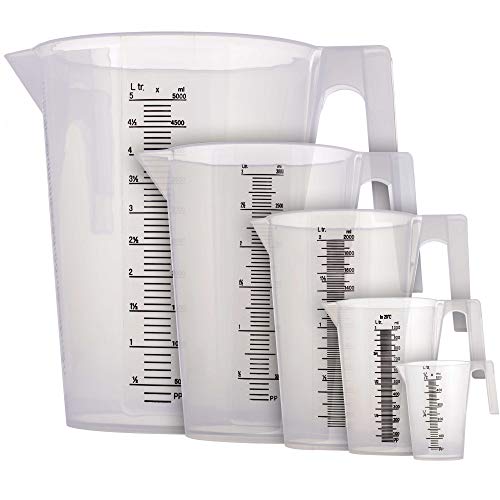
This five-piece pitcher set covers multiple sizes from 500 ml to 5000 ml, with raised measurement marks in both liters and milliliters. The durable PET plastic offers good chemical resistance for a variety of mixing tasks, including paints, resins, epoxies, and kitchen or lab use. It’s ideal for precise measurement and small-to-medium batch mixing.
- Best for precise measurement and mixed-volume tasks.
- Better for small-to-medium batch mixing and general lab work.
- Avoid if you need large-volume storage rather than measurement-focused tools.
Buying Guide: Plastic Tanks For Chemical Mixing And Storage
Key considerations to help you select the right container:
- Capacity: Choose a size that matches your typical batch volume, storage duration, and space constraints. Larger tanks store more but require more space and handling care.
- Material compatibility: HDPE and polyethylene offer good chemical resistance for many acids, bases, and solvents. PET is suitable for general mixing and some chemicals but may have limits with strong solvents.
- Sealing and venting: Lids that secure tightly help prevent leaks and contamination. Consider whether you need a spigot, threaded lid, or venting options for your workflow.
- Ease of filling and cleaning: Larger openings simplify filling and cleaning; flat-bottom designs improve stability and cleaning access.
- Regulatory considerations: Some materials and configurations align with regulatory storage requirements for hazardous materials or specific industries.
- Durability and weight: Heavier-duty plastics resist impacts and weather exposure, while lighter options are easier to transport.
Practical decision questions
- Do you need bulk storage or frequent dispensing? If dispensing often, a built-in spigot and easy-access lid are valuable.
- What volumes will you handle regularly? For large volumes, aim for 16–35 gallons or more; for small volumes, consider 0.5–5 liters.
- Are there strict regulatory storage requirements? Ensure containers meet the necessary material and lid specifications for your contents.
FAQ
- What material is best for chemical resistance? HDPE and polyethylene are widely used for chemical compatibility and durability.
- Can these tanks be used for beverages? Some containers are suitable for beverages, but confirm food-grade suitability and cleaning requirements for your application.
- Is a spigot necessary? A spigot aids dispensing and reduces spills, but not all tanks include one by default.
- How do I choose the right size? Base your choice on your daily volume and how often you plan to refill or transport the contents.
- Are these containers allowed for hazardous materials? Some options support regulatory storage; verify your specific hazmat requirements before use.
- Do these require special maintenance? Regular cleaning with compatible cleaners helps maintain compatibility and longevity.