Choosing the right cement for high-heat environments is crucial for safety, durability, and performance. This guide highlights top high-temperature cements and mortars designed to seal, repair, and restore stoves, fireplaces, and related equipment. Materials below are ready-to-use or easy to mix, formulated to withstand extreme heat without cracking or crumbling. Whether you’re sealing gaps, re-setting firebricks, or attaching stove collars, these products offer reliable bonds and long-lasting results.
style=”display:none;”>Summary Table of Selected Products:
| Product | Brand | Volume | Key Use |
|---|---|---|---|
| Rutland Furnace Cement (16 oz) | RUTLAND PRODUCTS | 16 oz | Metal, cast iron, steel repairs; seals and joints |
| Rutland Refractory Cement (64 oz) | RUTLAND PRODUCTS | 4 Lbs | Firebox gaps, mortar between firebricks |
| ComStar Furnace Cement (1 Quart) | ComStar | 1 Quart | Fireproof, bonds to stone/metal/ceramic |
| Rutland Furnace Cement (32 oz) | RUTLAND PRODUCTS | 32 oz | Metal and masonry joints; seals and repairs |
| ComStar Furnace Cement (1 Pint) | ComStar | 1 Pint | High-temperature bonding; smokeless, acid/gas-tight |
Rutland Furnace Cement, 16 oz

Rutland Furnace Cement is a ready-to-use, high-temperature cement designed to adhere firmly to metal surfaces. Its smooth consistency makes it ideal for metal-to-metal or metal-to-masonry joints, providing reliable seals for stove cracks, firebrick resets, and attaching stove collars. The product is manufactured in the USA and is suitable for repairing wood stoves, boilers, and gas ceramic logs. It resists heat without cracking, enabling durable repairs in everyday stove and furnace use. Consider this option when you need a quick, straightforward repair that restores structural integrity and airtight seals.
Rutland Refractory Cement, 64 Oz
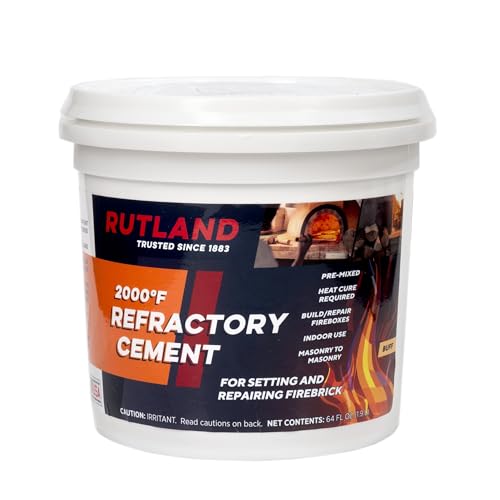
Rutland Refractory Cement comes in a large, fiber-reinforced formulation designed for higher-volume repairs in fireboxes and around firebricks. Its thick, smooth consistency makes it well-suited for filling joints between bricks and for re-facing interior masonry within fireplaces. While designed for interior use, its durable bond supports long-term performance in high-heat environments. This option is ideal for projects that require substantial material coverage, such as rebuilding sections of a wood stove or patching larger gaps in firebox walls.
ComStar Furnace Cement, 1 Quart

ComStar Furnace Cement is pre-mixed for immediate use, eliminating the need for mixing. It bonds to stone, metal, brick, ceramic, and more, making it a versatile choice for sealing flue pipes, attaching stove collars, and resetting firebricks. Engineered to endure extreme heat, it’s described as gas-tight and smokeless, with resistance to acids. This product is well-suited for professional repairs and DIY projects where user convenience and a strong, long-lasting bond are priorities. It provides a robust solution for high-heat repairs across multiple substrate types.
Rutland Furnace Cement, 32 oz

This 32-ounce version of Rutland’s high-temperature cement offers the same ready-to-use performance with greater volume for larger projects. It is designed to firmly adhere to metal, seal joints, and repair cracks around stoves, boilers, and gas fireplaces. The cement’s smooth consistency helps create durable bonds in metal-to-metal and metal-to-masonry joints, and it can be used to reset firebricks or attach stove collars. For homeowners tackling mid-sized repairs or multiple joints, this option delivers a balance of coverage and reliability.
ComStar Furnace Cement, 1 Pint

ComStar’s 1 Pint size provides the same pre-mixed convenience as the quart version but tailored for smaller jobs or targeted repairs. Its formulation offers fast bonding to stone, metal, brick, and ceramic, with a focus on extreme heat resistance (up to approximately 3,000°F in specifications). The cement is described as smokeless and gas-tight, making it a strong choice for sealing leaks and ensuring long-lasting performance in high-temperature environments. This is a good option for precise touch-ups and one-off repairs without excess material handling.
Buying Guide: Key Purchase Considerations
Choosing the right high-temperature cement involves evaluating substrate compatibility, intended use, and application conditions. Here are essential factors to consider:
- Temperature rating: Check the maximum service temperature and ensure it exceeds the operating range of your project. Common high-temperature cements are rated up to 2,000°F to 3,000°F.
- Substrate compatibility: Confirm the cement bonds well with metal, stone, brick, ceramic, and wood components you plan to repair or join.
- Ready-to-use vs. mix-only: Pre-mixed cements save time and reduce handling mistakes, while dry mixes can be economical for larger jobs but require proper water addition and curing.
- Bond strength and durability: Look for formulations described as gas-tight, smokeless, acid-proof, and crack-resistant for long-lasting repairs in stoves and furnaces.
- Interior vs. exterior use: Some products are optimized for interior fireboxes and chimneys, while others tolerate more abrasive or outdoor conditions.
- Ease of application: Consider consistency (smooth vs. thick), tooling needs, and whether you need to reseat bricks or seal joints with precision.
- Health and safety: Ensure proper ventilation during application and follow manufacturer guidelines for curing times and cleanup.
- Brand trust and Made in USA: Familiar brands like Rutland and ComStar provide tested formulations with broad compatibility in home heating systems.
In practice, homeowners often choose a combination of products: a ready-to-use cement for quick fixes and a larger-volume refractory cement for more extensive renovations. Always follow the product’s specific curing and safety instructions, and verify that the repair complies with local safety standards for heating appliances.