Answering buyers who want reliable, battery-powered fencing, this guide highlights five practical options for ranches, homesteads, and gardens. Each charger is evaluated for versatility, battery or solar compatibility, and suitability for different animals. Best for backcountry setups, portable farms, or remote properties, these picks help you protect livestock and deter predators without constant power access.
| Product | Best For | Key Benefit |
|---|---|---|
| FenceMate | Small to medium properties | Flexible power options including battery and solar |
| Parmak MAG12-UO | Long runtimes | Low impedance, built-in performance meter |
| Zareba EDC15M-Z | Remote locations | Up to 15 miles under ideal conditions |
| AgriOtter | 2-in-1 versatility | Battery or AC with 12V vs 110V compatibility |
| Zuomeng 2-Mile Charger | Compact, portable setups | Dual power supply, 0.1 Joule, 2 miles |
FenceMate Battery Powered Electric Fence Charger

Best for flexible power setups, this unit supports three charging methods: AC, DC battery, and solar power. It delivers up to about 10 miles under favorable conditions, with a peak voltage around 10 kV and a low impedance design. The dual-LED indicators help confirm operation and power status at a glance. Suitable for homesteads, poultry farms, and garden protection where power access varies. Caution: effectiveness depends on vegetation management and proper grounding.
Parmak MAG12-UO 12-Volt Magnum Charger
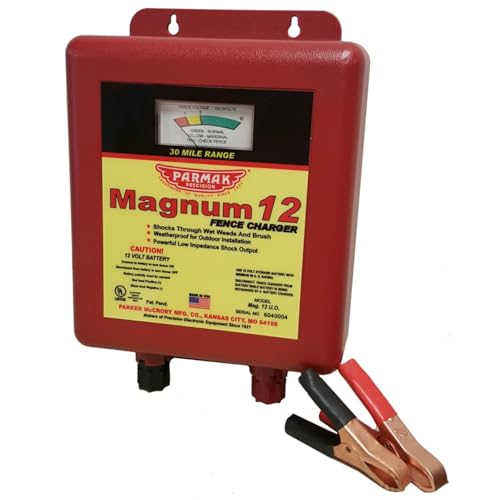
Best for longer runtimes between battery charges, the Parmak MAG12-UO offers a 30-mile range under ideal conditions with a built-in performance meter. This battery-operated unit is ideal for larger parcels where you want to monitor fence status without frequent service. It suits farms with steady power needs and routine maintenance. Caution: performance decreases in high-weed or damp conditions where grounding is challenged.
Zareba 15-Mile Battery Operated Charger

Best for remote locations, this battery-powered charger claims up to 15 miles in ideal conditions and up to 3 miles in heavy weed. It supports a variety of fence types and is designed for medium to larger properties where weed management is a factor. Caution: weed growth and ground moisture can substantially reduce effective range, so vegetation control is important.
AgriOtter Electric Fence Energizer
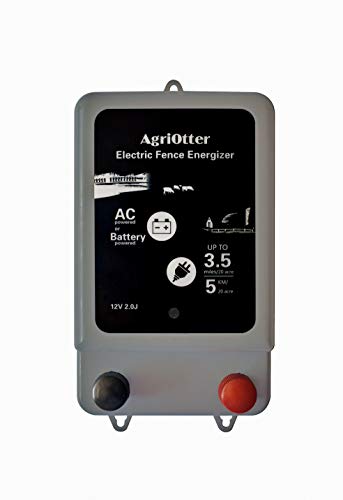
Best for versatile power options, AgriOtter supports battery or AC power, with claims of 12V battery use for extended operation. Its design emphasizes easy setup with large terminal connections, making it suitable for farms seeking a straightforward, reliable energizer. Caution: specific run times depend on battery capacity and installation quality.
Zuomeng 2-Mile Electric Fence Charger

Best for compact, portable setups, this charger delivers up to 5,000 V with 0.1 Joules of energy for fences up to about 2 miles. Dual power supply options (12V battery or 110V adapter) make it adaptable to many sites. Ideal for small yards or seasonal fencing where portability matters. Caution: lower pulse energy means it’s best for smaller animals and lighter containment needs.
Buying Guide: Key Considerations
- Power source flexibility: Decide whether you need battery-only, AC, or solar compatibility. Solar or hybrid models work well in remote sites.
- Fence length and vegetation: Longer fences and dense vegetation reduce effectiveness. Choose a charger rated for your miles and account for weed growth.
- Pulse energy and voltage: Higher joule pulses are better for larger animals; lower levels can be sufficient for poultry or small livestock.
- Grounding and installation: Proper grounding dramatically affects performance. Ensure you have grounded rods and correct wire setup.
- Durability and environment: Weatherproofing and enclosure design matter for outdoor installations.
- Indicator features: LED indicators or meters help monitor status and troubleshooting.
Frequently Asked Questions
- What is a battery-powered fence charger best for?
– It suits remote locations or places without reliable mains power, and it works well for small to mid-sized properties. - Can I use solar power with these chargers?
– Yes, several models support solar panels or battery banks to maintain operation during the day and night. - How important is weed management for performance?
– Very important. Weeds can reduce pulse transmission; regular vegetation control helps maintain range. - Is higher joule always better?
– Not always. Higher joules are more effective for larger animals but may be unnecessary for poultry or small livestock. - What should I check before installation?
– Confirm voltage and pulse rate, ensure proper grounding, verify power source compatibility, and plan for weatherproof mounting. - How do I know if a charger is working?
– Look for LED indicators or status displays and verify fence line response with a test tool or a small animal probe in a safe, controlled way.