Answering buyers who need reliable, energy-efficient compressed air, this guide highlights five top rotary screw air compressors. Each selection suits different scales of work—from small garages to industrial facilities. This overview helps you choose based on power, airflow, tank size, and compatibility with single- or three-phase power. The table below compares core specs to support quick decisions.
| Product | Brand | Power | Air Flow | Tank | Voltage/Phase | Max PSI |
|---|---|---|---|---|---|---|
| 10HP Rotary Screw Air Compressor (DCYL) | DCYL | 10 HP | 38 CFM | 30 gal | 208-230V, 1ph | 116 |
| DAVV Rotary Screw (20HP) | HPDAVV | 20 HP | 81 CFM | Base mounted | 208-230V, 1ph/3ph | 115 |
| 180L Rotary Screw (4.5KW) | Generic | 4.5 KW | — | 48 gal | 220V/380V | 145 |
| 10HP/7.5KW, 39CFM @115 PSI | HPDAVV | 10 HP / 7.5 KW | 39 CFM | Base mounted | 230V, 1ph or 3ph | 115 |
| MechMaxx 20HP Rotary Screw | MechMaxx | 20 HP | 78 CFM | Base mounted | 460V, 3ph | 116 |
DCYL 10HP Rotary Screw With 30 Gallon Tank

Features: 10 HP, 208-230V/60Hz, 38 CFM, 116 psi max, single-phase, 1/2 inch NPT outlet. It uses an inverter screw design for soft start, lower noise, and real-time speed adjustment based on air demand. Installation is straightforward, and maintenance focuses on filters and oil at recommended intervals.
Best for: Small to mid-sized shops needing mobile, single-phase power and a substantial 30-gallon tank. Choose this if you require energy efficiency with adjustable output to match usage.
Limitations: Only 1-phase operation is supported; conversion to three-phase is not possible via a converter.
DAVV Rotary Screw, 20HP, 81 CFM
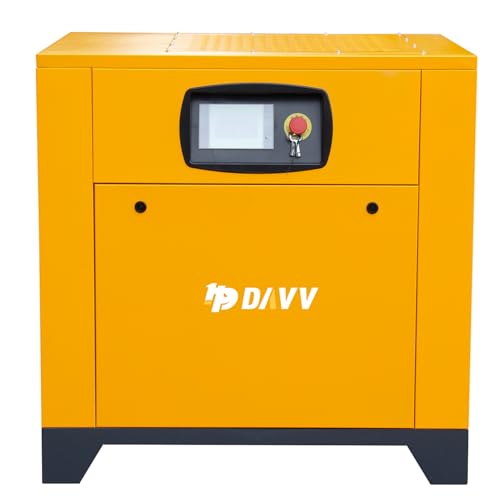
Features: 20 HP variable speed drive, 208-230V, 1ph/3ph, 81 CFM, 115 psi max, built-in oil separator, PLC for scheduling and operation. Easy-to-use microprocessor controllers support efficient operation, and the unit is designed for long-term industrial use.
Best for: Medium to large shops with fluctuating air demands and access to either single- or three-phase power. The PLC and VSD help optimize energy use during varying loads.
Limitations: Higher initial cost and installation complexity than smaller, single-phase units.
180L Rotary Screw Air Compressor (4.5KW)
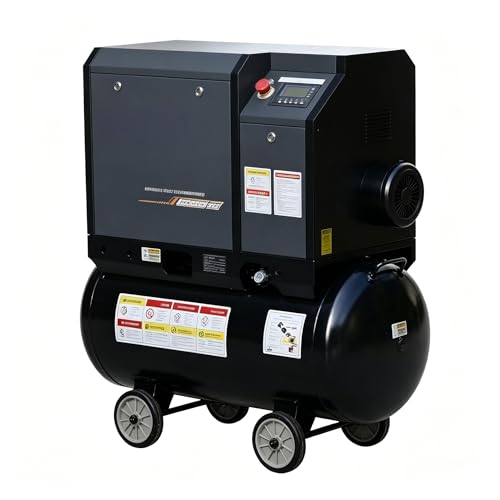
Features: Oil-injected for continuous duty, 145 psi, 48-gallon tank, copper motor, and intelligent control. Quiet operation and a large cooling fan reduce heat buildup during extended use.
Best for: Garages, auto repair shops, or paint-spraying tasks that require continuous duty and ample air for impact wrenches and sprayers.
Limitations: 220V/380V models may require professional electrical setup; data on phase compatibility is model-dependent.
HPDAVV 10HP/7.5KW, 39CFM @115 PSI

Features: 10 HP / 7.5 KW dual-capacity, 230V/60Hz, 39 CFM, 115 psi max, 1ph/3ph compatibility. It uses a permanent magnet variable speed drive to reduce energy use when full capacity is unnecessary.
Best for: Applications with variable air demand and a need to balance power with energy efficiency. Useful where electrical supply can support either phase with minimal changes.
Limitations: Not all models clearly indicate single- vs three-phase behavior; verify configuration before purchase.
MechMaxx 20HP Rotary Screw – 78 CFM
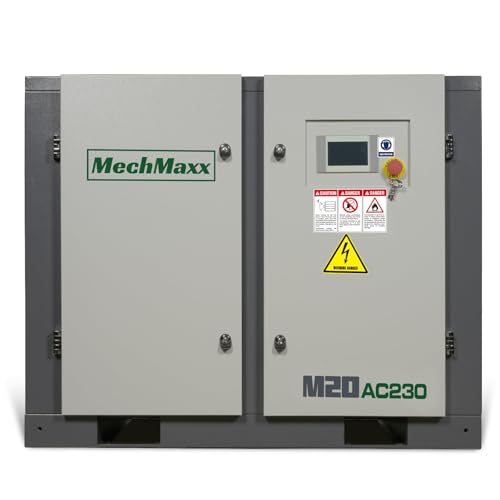
Features: 20 HP, 78 CFM, 116 psi, 460V 3-phase. Strong motor protection, SKF bearings, advanced airend design, and a robust oil-gas separation system to keep oil content below 3 ppm in the output air.
Best for: Large industrial setups requiring high air throughput and durable components for long-running duties. Choose this if you need a high-capacity system with proven reliability.
Limitations: Higher voltage (460V) and 3-phase power demand may limit compatibility with smaller facilities.
Buying Guide
Key considerations help match a rotary screw air compressor to your needs.
- Power availability: Determine if your facility has single-phase or three-phase power. Some units are 1ph/3ph compatible, but conversion is not guaranteed.
- Air demand: Estimate CFM requirements during peak work to select a unit that avoids under- or over-supply.
- Tank size and duty cycle: Larger tanks provide immediate air storage for peak demand and can reduce compressor cycling.
- Energy efficiency: Look for variable speed drives (VSD) or permanent magnet drives to reduce energy use during partial loads.
- Maintenance needs: Consider ease of maintenance, filter/oil change intervals, and accessibility of components like oil separators and airends.
- Installation footprint: Assess space constraints; heavier, base-mounted units require solid foundations and proper ventilation.
- Noise and cooling: In larger shops, quieter operation and effective cooling reduce fatigue and prevent overheating in continuous runs.
Frequently Asked Questions
- What is a rotary screw air compressor?
It is a compressor that uses two intermeshing screws to compress air, enabling smooth, continuous airflow with better efficiency than piston models.
- Do I need one-phase or three-phase power?
Many units support both, but check the model’s specifications and ensure your electrical setup matches the listed voltage and phase requirements.
- What CFM do I need for a shop with impact wrenches?
Impact wrenches typically require higher CFM; consider units in the 40–80 CFM range for auto repair and mid-size shops.
- Is a larger tank always better?
A larger tank helps with peak demand and reduces compressor cycling, but it increases footprint and initial cost. Balance with your usage pattern.
- What maintenance is essential for rotary screw compressors?
Regular filter and oil changes, along with checking the oil separator and ensuring proper cooling, are key to longevity and performance.