When you need reliable pressure relief in hydraulic or fluid systems, an adjustable valve helps you set and retain safe operating pressures. This article highlights five top options for American buyers, focusing on construction quality, adjustable ranges, and compatibility. Each product is suitable for different setups—from pump outlets to water systems and pneumatic lines—and chosen for clear, data-backed reasons.
The following table provides a quick snapshot of the featured valves to help you compare key specs at a glance.
| Product | Port Size | Max Flow (GPM) | Relief Range (PSI) | |
|---|---|---|---|---|
| Wovnet Adjustable Aluminum Pressure Relief Valve | 3/4″ -16 ORB | 20 | 0–3000 | Pump outlets and hydraulic motors requiring high pressure control |
| Summit Hydraulics Relief Valve (2500 PSI) | 3/4″ NPT | 20 | 0–2500 | Inline systems needing hardened seats for durability |
| Summit Hydraulics Relief Valve (2500 PSI, 1/2″ NPT) | 1/2″ NPT | 16 | 0–2500 | Compact, lower-flow circuits needing precise relief |
| Getanye Hydraulic Adjustable Valve with Relief | 1/2″ NPT | 30 | 500–3000 | Higher-flow systems needing broad relief range |
| Otoolling 1/2″ x 3/4″ Poppet Relief Valve | 3/4″ NPT inlet, 1/2″ NPT outlet | — | 100–300 | Water, oil, or air lines with tight pressure control |
Below are five detailed product sections to help you decide which valve fits your application, followed by a practical buying guide and FAQs.
Wovnet Adjustable Aluminum Pressure Relief Valve

Best for high-flow pump outlets and hydraulic circuits that require solid aluminum construction. This valve supports up to 20 GPM and 3000 PSI, with a #8 SAE (3/4-16 ORB) connection. It uses a direct-acting, adjustable relief mechanism to limit pressure at port 1 by releasing to port 2 when the preset pressure is reached. The aluminum shell is anodized for durability and corrosion resistance, making it a good choice for rugged environments.
Who it’s best for: systems where a robust, corrosion-resistant valve is needed at moderate-to-high relief pressures. Use this when you want a straightforward, reliable relief option close to the pump outlet or hydraulic motor. A potential limitation is the larger overall size, which may require adequate mounting space.
Summit Hydraulics Relief Valve, 20 GPM, 2500 PSI

Best for inline mounting with a hardened seat for durability. This valve features a ball spring relief mechanism and 3/4” NPT port size, supporting up to 20 GPM. The inline design makes it suitable for pump discharge lines and hydraulic circuits where precise relief is needed without extra fittings. The hardened seat enhances long-term durability under repetitive cycling.
Who it’s best for: users seeking a durable, easy-to-mount relief valve with a straightforward inline configuration. Choose this if you value a hardened seat for wear resistance. Caution: ensure compatibility with your hose or pipe thread fittings to avoid leakage at common adapters.
Summit Hydraulics 16 GPM, 2500 PSI Valve

Best for compact, moderate-flow hydraulic lines that need reliable relief in a 1/2” NPT configuration. This valve provides inline mounting with a ball spring relief and a hardened seat, rated up to 16 GPM and 2500 PSI. The smaller port size helps when space is limited but the system still requires precise pressure control.
Who it’s best for: smaller hydraulic circuits or budget-conscious installations where space and simplicity matter. Better for systems that don’t exceed 16 GPM. Limitation: the 1/2” port may require additional adapters for some equipment setups.
Getanye Hydraulic Adjustable Valve With Relief

Best for higher-flow systems needing a broad relief range and adjustable relief pressure. This valve offers 30 GPM capacity and supports relief pressure settings from 500 to 3000 PSI via an adjustable relief port. The 1/2” NPT inlet is paired with a 1/2” NPT outlet, making it a flexible option for mid- to high-flow hydraulic lines.
Who it’s best for: applications requiring a wide relief range and stronger relief capabilities, such as machines with varying load demands. Limitation: the broader range can complicate precise setting choices if not calibrated carefully. Verify that the system’s other components can handle up to 3000 PSI.
Otoolling 1/2″ x 3/4″ Poppet Relief Valve
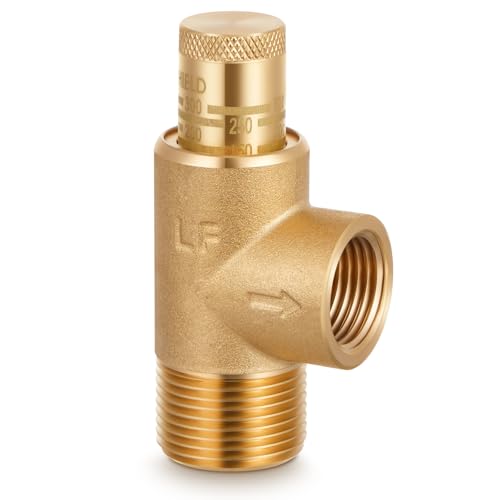
Best for water, oil, or air systems requiring precise 100–300 PSI relief with a poppet design. It uses a calibrated adjustment knob for exact pressure settings, and features a 3/4″ NPT male inlet to 1/2″ NPT female outlet. Brass construction offers corrosion resistance and reliable long-term performance in challenging environments.
Who it’s best for: users needing tight control in low-to-mid pressure water or fluid systems, such as irrigation or process lines. Limitation: maximum relief around 300 PSI may not suit higher-pressure hydraulic equipment.
Sellerocity Brass Pressure Relief Valve

Best for 0–100 PSI adjustable protection in pneumatic and small hydraulic setups. The valve uses a rugged brass body with a stainless steel poppet and spring, plus fluorocarbon O-ring sealing to resist leaks across cycles. It includes a universal 1/4″ NPT installation standard, enabling broad compatibility with air tanks, pumps, manifolds, and other equipment.
Who it’s best for: air and small-volume hydraulic systems that require precise, low-pressure relief with durable seals. Limitation: the 0–100 PSI range may be insufficient for higher-pressure lines or heavy hydraulics.
Summit Hydraulics 0-30 GPM Valve With Relief

Best for systems requiring a combined variable flow control and relief function. This valve combines a pressure-compensating variable flow control with an internal relief valve, adjustable from 0 to 30 GPM, with a preset relief around 1500 PSI. It is suited for hydraulic circuits that need both flow regulation and overpressure protection in one unit.
Who it’s best for: installations seeking integrated control of flow and relief in one compact valve. Limitation: preset relief may require adjustment if system pressures frequently vary beyond the baseline setting.
Buying Guide: Key Considerations For Choosing An Adjustable Hydraulic Pressure Relief Valve
- Pressure range: Match the valve’s maximum relief PSI with your system’s operating pressure to prevent under- or over-relief.
- Port size and threading: Confirm 3/4″ or 1/2″ NPT/ORB compatibility with existing piping and components.
- Flow capacity: Ensure the valve can handle the system’s maximum GPM without causing excessive pressure drops.
- Construction material: Aluminum offers light weight and corrosion resistance; brass provides durability and chemical resistance in some fluids.
- Relief mechanism: Direct-acting valves respond quickly to pressure changes; consider ball spring or poppet designs based on durability and cycling needs.
- Installation orientation: Some valves are designed for inline mounting, others for side or bottom ports—verify your mounting space and connections.
- Leakage considerations: O-rings, seals, and seat hardness affect leakage risk—look for hardened seats and quality seals in rugged environments.
- Calibration and adjustability: Check the ease of setting precise relief pressures and whether locking mechanisms are included to prevent drift.
- Environment and fluid compatibility: Ensure materials resist corrosion from the specific hydraulic oil, water, or air being used.
FAQ
- What is an adjustable hydraulic relief valve used for? — It protects hydraulic systems by limiting pressure to a preset level, preventing damage to pumps, motors, and cylinders.
- How do I choose the right port size? — Match the valve’s port size to your piping and fittings (NPT or ORB) to ensure proper connection and flow.
- Can I install these valves in any orientation? — Many valves are designed for inline or side connections; always follow manufacturer guidelines for orientation and mounting.
- Is a higher GPM rating always better? — Not necessarily. Choose a rating that matches system flow needs without causing excessive relief or pressure drop.
- Do these valves require maintenance? — Periodic inspection for leaks, corrosion, and sealing integrity is recommended, especially in high-cycle or high-pressure systems.
- Can I adjust the relief pressure while the system is running? — Adjustment should generally be performed with the system depressurized to ensure safety and accuracy.