For researchers conducting fluorescence-based assays, choosing the right 96-well plate is essential to minimize background noise, maximize signal, and ensure consistent data. This guide highlights top 96-well plates suited for fluorescence applications, with details on bottom types, materials, sterility, and lid designs. Each option balances optical clarity, uniform well geometry, and compatibility with standard plate readers. Use the quick reference table below to compare key attributes at a glance.
| Product | Brand | Bottom Type | Sterile | Lid | |
|---|---|---|---|---|---|
| Black Clear Bottom 96-Well Plate | BioAssay Systems | Black Clear Bottom | Yes | Yes | Reduces cross-talk in fluorometric assays; single plate. |
| 96 Well Plate – PCR 96 Well Plate 0.2ml | Scienfocus lab | Transparent | Yes | Yes | Polypropylene; gamma-irradiated; suitable for PCR. |
| SPL Culture Plate Black 96 Wells Flat Bottoms | SPL Life Sciences | Black | Yes | Yes | HTS compatible; minimizes light scatter. |
| Weysat 20 Pcs 96 Well Tissue Culture Plates | Weysat | Flat Transparent | Yes | Yes | Clear PS; compact set for classrooms and labs. |
| SPL 96 Well Plate, PS, Flat Bottom | SPL Life Sciences | Flat | Yes | Yes | Alphanumeric labeling; sterile. |
Black Clear Bottom 96-Well Plate

The Black Clear Bottom 96-Well Plate from BioAssay Systems is designed for fluorescence-based cell-based assays. The black exterior minimizes well-to-well light scattering, while the clear bottom allows accurate optical reading for fluorescence and luminescence measurements. Sterile and supplied with a lid, this plate supports high-quality readouts and repeatable results in fluorescence workflows. The combination of optical properties helps reduce background and crosstalk, making it suitable for high-sensitivity assays where signal fidelity matters.
Key Points
- Bottom: Black exterior with clear bottom for optical access.
- Sterile with lid for contamination control.
- Single plate packaging supports easy handling in larger assays.
96 Well Plate – PCR 96 Well Plate,0.2ml-No-Skirt

This 0.2 mL PCR 96-well plate features a thin-walled design for uniform heat transfer, which supports consistent amplification in PCR workflows. Made primarily from polypropylene, it withstands repeated high and low-temperature cycles and can tolerate standard laboratory thermal conditions. The plate includes engraved identifiers for quick sample tracking, aiding data organization in large experiments. While optimized for PCR, its uniform geometry can be advantageous for fluorescence-based assays that require precise optical paths.
Key Points
- Material: Polypropylene; durable across thermal cycling.
- Identification: Engraved alphanumeric marks for fast sample differentiation.
- Top is skirted-free for reduced material usage and compatibility with automation.
SPL Culture Plate Black 96 Wells Flat Bottoms TC Treated

The SPL Culture Plate combines a black bottom with a high-contrast surface ideal for fluorescence assays. Designed to minimize light scattering and cross-talk, these plates are compatible with high-throughput screening and cell-based assays. The inner lid design supports effective gas exchange while preserving sterility. This combination helps maintain sample integrity across long read times, with stable fluorescence signals and clear data interpretation.
Key Points
- Black bottom reduces cross-talk; flat black exterior minimizes background.
- HTS compatible; sterile with lid for convenient workflow.
Weysat 20 Pcs 96 Well Tissue Culture Plates
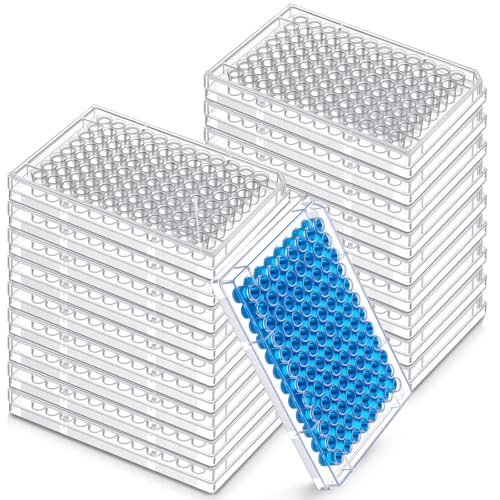
The Weysat set includes 20 flat-bottom tissue culture plates constructed from clear polystyrene. The plates are designed for teaching labs and routine research, offering good optical clarity for readouts and precise sample distribution due to even well geometry. The lightweight, compact design reduces replacement purchases, while the sterile packaging supports contamination control. These plates are suitable for a broad range of fluorescence and colorimetric assays where sample visualization is critical.
Key Points
- Clear PS material provides high optical clarity for fluorescence reading.
- Flat-bottom geometry supports even distribution and measurement accuracy.
- Individually packaged and sterile with lids for controlled experiments.
SPL 96 Well Plate, PS, Flat Bottom, Sterile

This SPL plate features a flat bottom with sterile, single-direction lids designed to minimize spillage and contamination. The best-suited features for fluorescence assays include uniform well geometry, alphanumeric labeling for easy cataloging, and a light-optimized bottom that supports consistent fluorescence readings. These plates are compatible with a variety of fluorescence instruments and high-throughput workflows, ensuring reliable data across multiple experiments.
Key Points
- Flat bottom with reliable lid design for contamination control.
- Alphanumeric labeling supports sample organization in large studies.
96-Well Polystyrene U-Bottom Microplate

The Kashi Scientific U-bottom microplate offers a clear, durable polystyrene structure with lids and sterile packaging. The U-bottom geometry can improve sample mixing in certain fluorescence assays where uniform mixing and distribution are beneficial. The pack contains 100 plates, designed for long-term usage in busy labs, with pre-sterilized single-direction lids that simplify handling and reduce spill risk. This layout supports a wide range of application needs, including fluorescence-based readouts.
Key Points
- U-bottom design can aid in certain assay setups requiring enhanced mixing.
- Durable PS material; single-direction sterile lids streamline handling.
96-Well Polystyrene Flat-Bottom Microplate, White

The white 96-well plate from Kashi Scientific provides a flat-bottom design with a bright, reflective surface that can enhance luminescent or fluorescence signals depending on assay design. Like its peers, it comes in sterile packaging with lids, ensuring contamination control and ease of use in multi-well workflows. The white color can be advantageous for certain fluorescence measurements that benefit from background contrast, making it a versatile option for imaging-based readouts.
Key Points
- White bottom enhances signal visibility for certain fluorescence assays.
- Sterile with single-direction lids; durable polystyrene construction.
Buying Guide: Key Purchase Considerations
When selecting 96-well plates for fluorescence, consider the following factors to ensure compatibility with your workflows and readers:
- Bottom color and material: Black or white bottoms reduce background and improve signal-to-noise ratio. Clear bottoms enable imaging or reading from below in some instruments.
- Bottom geometry: Flat, U-shaped, or V-shaped bottoms affect sample mixing, uniformity, and optical properties. For fluorescence, uniform depth and surface finish minimize reading variability.
- Opacity and cross-talk: Black or highly opaque bottoms help minimize well-to-well cross-talk, especially in high-sensitivity fluorometric assays.
- Sterility and packaging: For high-throughput or regulated contexts, prefer sterile, individually wrapped plates with reliable lids to reduce contamination risks.
- Lid design and gas exchange: Lids that balance seal integrity with adequate gas exchange support cell viability in culture-based fluorescence readouts.
- Compatibility with instruments: Check plate reader compatibility, including well volume, plate height, and the presence of alphanumeric labeling for assay tracking.
- Cost and supply: Packs of plates with consistent lot quality reduce variability; consider supplier options offering regular restocks for ongoing projects.
- Durability and reusability: Some plates are single-use, while others tolerate repeated handling in certain experimental setups; verify compatibility with your cleaning and reuse policies if applicable.
In fluorescence workflows, the plate’s optical properties often influence the detection thresholds and the precision of readouts. When possible, align plate choice with your assay type (cell-based vs. plate-based biochemical assays) and your instrument’s optical path to maximize data reliability and throughput.