Looking for the best 3D laser scan survey tools to capture precise geometry for reverse engineering, metrology, or industrial inspection? This guide highlights five top options that balance accuracy, speed, and versatility. Each entry is suitable for specific buyers—engineers needing tight-tolerance measurements, hobbyists seeking fast color scans, or professionals needing marker-free workflows. Read on to compare features, ideal use cases, and any limitations to help you choose the right scanner for your projects.
| Product | Best For | Key Benefit |
|---|---|---|
| Revopoint MetroY Ultra | Industrial-grade users, tight tolerances | 0.01 mm single-frame precision; multiple scanning modes |
| Creality CR-Scan Raptor Pro | Medium to large objects, color capture | 0.02 mm accuracy; fast 60 fps; powder-free scanning |
| Revopoint MetroX Pro | Reverse engineering, automotive modeling | 0.01–0.02 mm accuracy; 62-line full-field mode |
| Creality CR-Scan Raptor | Budget-friendly, versatile scanning | 0.02 mm accuracy; 60 fps; multi-mode scanning |
| Revopoint MetroX | Metrology-grade scans, Windows/macOS | 0.01–0.02 mm accuracy; GPU-accelerated modes |
Revopoint MetroY Ultra Laser 3D Scanner

The MetroY Ultra uses advanced blue laser technology to deliver industrial-grade accuracy with up to 0.01 mm single-frame precision and 0.015 + 0.04 mm x L (m) volumetric accuracy. It supports 34 laser cross-lines, 15 parallel lines, a single-line mode for deep holes, full-field blue structured light, and one-click turntable scanning. Best for engineers needing tight tolerances and rapid large-area data capture.
Best for: reverse engineering, aerospace, automotive components, and precision measurement tasks where accuracy and speed matter. Caution: MetroY Ultra uses a Class 2M laser projector; avoid looking directly at the beam at close range.
Creality CR-Scan Raptor 3D Scanner

This scanner combines 7 parallel blue lasers with additional NIR scanning to deliver up to 0.02 mm accuracy and 24-bit color. It scores well for scanning medium to large objects (5 mm to 2000 mm) and supports marker-free scans with infrared mode. Best for color-rich captures and environments where marker setup is impractical.
Best for: colorized models, mid-to-large parts, and applications where quick, marker-free scans are preferred. Limitation: safety requires avoiding direct eye exposure to blue light and IR mode usage considerations in bright environments.
Revopoint MetroX Pro 3D Scanner
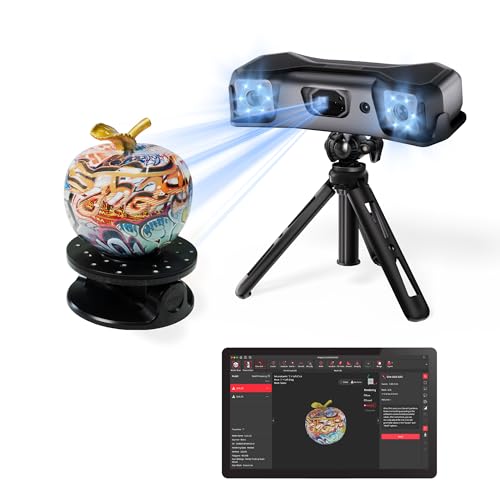
The MetroX Pro emphasizes industrial-grade precision with single-frame accuracy around 0.02 mm and volumetric accuracy of 0.02 mm + 0.04 mm × L (m). It offers four scanning modes, including a 62-line full-field blue structured light and an auto turntable. It supports real-time PC-to-mobile streaming via Revo Mirror for a flexible workflow.
Best for: metrology-oriented workflows, professional modeling, and environments where continuous monitoring of scans is beneficial. Caution: Verify GPU compatibility when using GPU-accelerated modes for faster performance.
Revopoint MetroY Ultra Laser 3D Scanner & 3D Magnetic Markers Bundle

This bundle pairs the MetroY Ultra with 3D magnetic markers and maintains the same base accuracy and speed benefits as the standalone MetroY Ultra. It is designed for users who want improved alignment, repeatable scans, and easier marker-based setups for complex assemblies. Best for: industrial teams needing quick registration and robust scanning across multiple sessions. Limitation: bundle features are focused on enhancement rather than core capability changes.
Buying Guide: How to Choose a 3D Laser Scan Survey Tool
- Accuracy requirements: If you need sub-0.02 mm precision for metrology, prioritize scanners with single-frame precision at 0.01–0.02 mm and strong volumetric accuracy.
- Object size and scanning range: For large parts, look for high scan speed and robust multi-scan modes, including full-field blue structured light and auto turntables.
- Surface handling: Some devices excel on dark or shiny surfaces, while others require spray powder or marker markers. Consider marker-free options if you work with varied finishes.
- Data workflow: If you need real-time streaming or easy integration with PC-to-mobile workflows, choose models that support Revo Mirror or similar software ecosystems.
- Safety and environment: Blue laser and NIR modes have safety considerations. Ensure proper eye protection and follow safety recommendations in your workspace.
- Accessories and expandability: Magnetic markers and turnkey bundles can improve alignment and repeatability for industrial applications.
- Budget and total cost: Consider not only the base scanner but also markers, software, and potential upgrade paths as your scanning needs grow.
Frequently Asked Questions
- What is the typical accuracy of these 3D laser scanners? Most top models offer single-frame precision around 0.01–0.02 mm, with volumetric accuracy depending on the object size and mode used.
- Can these devices scan color as well as geometry? Some models provide 24-bit full-color capture, which is useful for visual inspection and texture mapping.
- Are these scanners safe to use around eyes? Blue light is used in several scanners; follow the manufacturer’s safety guidelines and avoid direct exposure to the light source.
- Do I need markers to scan objects? Many scanners offer marker-free scanning in at least one mode, but markers can improve alignment in complex assemblies.
- Is real-time streaming available? Some models support PC-to-mobile streaming via companion apps, which can speed up workflow and review during scanning sessions.
- Which scanner is best for automotive modeling? Scanners with high accuracy, fast scan speeds, and robust auto-turntable features, such as the MetroX Pro and MetroY Ultra variants, are well-suited for automotive parts and assemblies.