When selecting a hydraulic hose for high-pressure systems, reliability, compatibility, and safety are paramount. This guide highlights five strong options suitable for tough tasks, including construction, agriculture, and industrial machinery. Each pick is evaluated for who benefits most, what makes it strong, and a practical caveat to consider before buying. If you need a rugged hose that handles demanding environments, these choices aim to balance performance with value.
| Product | Best For | Key Benefit |
|---|---|---|
| VEVOR 3/8″ x 100 ft, 4800 PSI | Heavy-duty, long runs | Two steel wire braids plus durable rubber construction |
| VEVOR 1/2″ x 100 ft, 4000 PSI | General hydraulic work with higher flow | Robust material and versatile usage |
| Buyers Products 1/4″ x 38″ 3000 PSI | Direct replacement for specific trucks or plows | Precise dimensions and compatibility |
| Autovo 1/2″ NPT x NPT 36″ 3988 PSI | Compact setups with standard fittings | Two-ended crimped assembly for easy installation |
| Racewill 3/8″ x 33 ft, 7687 PSI | High-pressure, compact installations | 2‑wire braid with broad fittings included |
Hydraulic Hose 3/8 Inch x 100 Ft, 4800 PSI Coiled
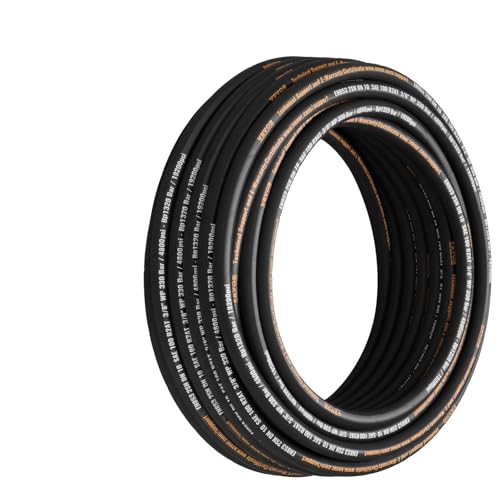
Best for long runs where a 3/8 inch inner diameter supports good flow under high pressure. The hose uses two steel wire braid reinforcements and a synthetic rubber core with an abrasion-resistant outer layer, making it suitable for challenging outdoor or workshop environments. The 100-foot length reduces the need for frequent splices in extended hydraulic circuits. Best for professional builders and mechanics who prioritize durability and flexibility. A potential limitation is its length; handling and storing a 100-foot coil may require adequate space and careful management to prevent kinking when coiled tightly.
Flexible Hydraulic Hose 1/2″ x 100 ft, 4000 PSI
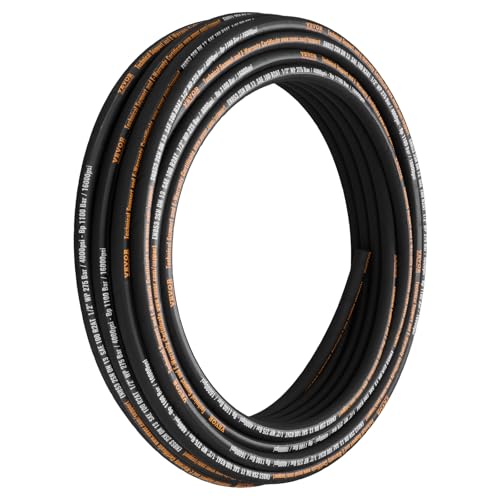
This option is well-suited for general hydraulic tasks requiring a stronger 1/2 inch line with good flexibility. It features two high-tensile steel wire braids and a synthetic rubber core, offering resistance to oil and chemicals and weathering. Choose this if you need a versatile hose for common hydraulic systems in construction or maintenance tasks. Caution: ensure the exact matching outer diameter and fittings for your equipment to avoid leaks or misfit connections.
Buyers Products 1/4″ x 38″ 3000 PSI

Best for direct replacement in snow plow and truck hydraulic systems where a precise 38-inch length is required. It’s rated for up to 3000 PSI and designed to match Western part compatibility. The shorter length helps keep lines tidy and reduces the risk of interference with moving components. Limitation: due to its compact length, this hose is less suitable for long runs or higher-demand systems that demand more than 3000 PSI.
Autovo Hydraulic Hose 1/2″ 36″ Long 3988 PSI

Best for setups with male NPT fittings on both ends and a need for a compact 36-inch hose. It features a two-layer steel wire braid reinforcement and an outer synthetic rubber layer for oil resistance and durability. Choose this if your hydraulic system has standard NPT connections and a tight installation space. Caution: verify that the 1/2-inch diameter matches your system’s port size and clearance, as mismatches can cause leaks or improper sealing.
Racewill 33Ft 3/8″ Hydraulic Hose, 7687 PSI

Best for high-pressure applications in a compact length, offering a working pressure up to 7687 PSI. The hose uses a two-wire braid design and includes a broad set of fittings (JIC and NPTF) to accommodate different systems. Choose this if you need a high-pressure hose that fits tight spaces without sacrificing burst resistance. Limitation: the shorter 33-foot length may require more connections if your setup spans longer distances, which can introduce additional leak points if not properly secured.
Buying Guide
- Pressure rating: Match the hose to your system’s operating pressure. Higher ratings offer a safety margin but must be compatible with your fittings.
- Diameter and flow: Inner diameter affects flow rate. Common options are 3/8″ and 1/2″; choose based on required volume and stroke speed.
- Length and layout: Longer hoses reduce joints but are heavier and harder to manage. Consider storage space and routing to avoid kinks.
- Fittings and ends: Verify thread types (NPT, JIC, etc.) and whether the hose is pre-crimped. Mismatched fittings cause leaks and downtime.
- Material and construction: Look for synthetic rubber cores with steel wire braids for durability, oil resistance, and abrasion protection.
- Environmental conditions: Temperature and exposure to sun, ozone, or chemicals affect hose life. Select hoses with appropriate outer covers.
Frequently Asked Questions
- What does PSI mean for hydraulic hoses? — PSI indicates the maximum pressure the hose is designed to handle safely during operation.
- Can I use a higher PSI hose in a lower-pressure system? — Yes, higher-rated hoses can be used in lower-pressure systems, but ensure fittings and dimensions match to avoid leaks or compatibility issues.
- Why are two steel wire braids common in hydraulic hoses? — Dual braids improve strength, kink resistance, and burst protection in demanding environments.
- How do I choose the right length? — Consider the distance between your pump and actuator, excluding potential bend radii and future routing changes.
- What fittings should I expect with these hoses? — Fittings vary; some hoses come crimped with specific ends. Always verify matching threads and standards for your equipment.
- Is a longer hose always better? — Longer hoses provide flexibility but add weight and potential for excessive bending. Balance length with routing practicality.