Looking for a reliable 3 jaw self-centering chuck to handle a range of workpieces with quick setup and solid accuracy? This guide highlights five top Amazon selections ideal for lathes, mills, and small CNC machines. Each option offers a distinct clamping range and size to suit different projects. Best for hobbyists needing versatility, best for workshop pros machining larger parts, and better for users switching between internal and external gripping. A concise buying table follows, then detailed product insights to help you compare at a glance.
| Product | Clamping Range | Diameter | Backing Plate / Mount |
|---|---|---|---|
| VEVOR 6″ (0.14–6.3 in / 3.5–160 mm) | 0.14–6.3 in | 6 in | 0.0 |
| VEVOR 8″ (0.16–8 in / 4–200 mm) | 0.16–8 in | 8 in | With T-key |
| maXpeedingrods 8″ K11-200A | 4–85 mm internal; 65–200 mm external | 8 in | 180 mm bolt circle |
| VEVOR 10″ (0.24–9.84 in / 6–250 mm) | 0.24–9.84 in | 10 in | With T-key |
| WFLNHB 4″ K11-100 | 2–90 mm inner; 30–80 mm outer | 4 in | Complete set |
VEVOR 6-Inch Self-Centering 3-Jaw Lathe Chuck

The 6″ VEVOR self-centering chuck uses HT300 cast material with 20Cr steel jaws and 40Cr steel scroll, hardened for rust resistance and stable performance. Bearing tolerance is ≤0.05 mm. Dual native jaws enable both internal and external clamping, expanding its ability to grip small to mid-size parts. Clamping range spans 0.14–6.3 in (3.5–160 mm). This model is best for general machining tasks where a compact chuck is preferred and internal/external grip versatility is desired. A caution: the external jaws extend clamping capacity but may require careful setup to avoid over-tightening.
Best for: small-to-mid workpieces in hobby or education shops where quick setup matters. Better for: applications needing internal and external workholding in one unit.
VEVOR 8-Inch Self-Centering 3-Jaw Lathe Chuck

This 8″ chuck shares the HT300 construction and 53HRC/45HRC component hardness. It features a dual-use jaw system for internal and external grips and a clamping range of 0.16–8 in (4–200 mm). The self-centering design supports precise machining with a backward-compatible T-key mounting, making it suitable for mid-to-large parts on lathes or CNC centers. Limitation: larger size means more weight and potentially slower changes between setups.
Best for: mid-to-large parts and users needing robust gripping across a wider size range. Choose this if: you frequently switch between internal and external clamping on bigger components.
maXpeedingrods 8″ 3-Jaw Lathe Chuck K11-200A
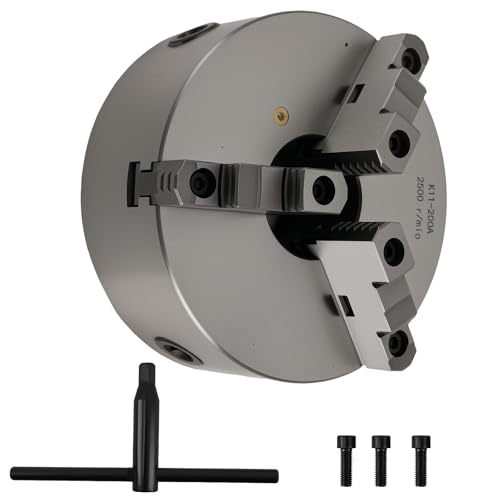
The K11-200A is an 8″ self-centering chuck with a wide clamp range: internal 4–85 mm and external 65–200 mm. It uses hardened steel jaws with a tongue-and-groove design and a high-precision scroll mechanism, delivering low runout and stable performance. The L-shaped jaws are reversible for versatility in handling various shapes. This model suits users needing broad handling without swapping jaws. A caveat: the extended external range may require careful alignment when handling short workpieces.
Best for: projects involving shafts, discs, or hex bars requiring both internal and external holding. Better for: users prioritizing repeatable centricity at higher speeds.
VEVOR 10-Inch Self-Centering 3-Jaw Lathe Chuck

This 10″ chuck boasts HT300 construction with high-hardness jaws (≥53 HRC) and a scroll plate of ≥45 HRC. It features a built-in self-centering function for straightforward operation and a 0.24–9.84 in (6–250 mm) clamping range. The 1 1/2 in-8 threaded backing plate delivers sturdy machine compatibility, and the chuck body measures 45 mm inner bore and 250 mm outer diameter. Best for larger workpieces that demand reliable concentricity and a broad clamping window. Limitation: heavier and potentially slower to maneuver in tight setups.
Best for: larger lathes or milling centers needing dependable grip on sizable parts. Choose this if: you routinely work with bigger diameters and require robust rigidity.
VEVOR 6-Inch Lathe Chuck With 1 1/2 In-8 Thread

This 6″ chuck uses HT300 cast iron and features a robust hardness profile (jaw ≥53 HRC, scroll ≥45 HRC). It has a 1 1/2 in-8 threaded backing plate for quick mounting and clamps from 0.12–5.71 in (3–145 mm). Its self-centering design helps maintain clamping stability across varying workpiece sizes. Best for wood or metal lathes requiring a compact, durable chuck. Caution: ensure compatible backing plate threading with your machine to avoid mismatch.
Best for: wood or metal lathes needing a compact, durable self-centering solution. Better for: setups where quick changeovers are common and space is limited.
Buying Guide: 3-Jaw Self-Centering Chucks
When selecting a 3 jaw self-centering chuck, consider these practical factors:
- Clamping range: Match the smallest and largest diameters you work with most often. Internal and external jaws expand versatility but can complicate setup.
- Jaw material and hardness: Higher hardness improves wear resistance and longevity, especially for high-speed or heavy-duty use.
- Backplate compatibility: Verify thread size (e.g., 1 1/2 in-8) and bolt circle with your machine’s spindle to avoid mounting issues.
- Runout and precision: Look for low radial runout claims (such as ≤0.05 mm / 0.002 in) to ensure concentricity in turning and drilling applications.
- Jaw configuration: Dual-use jaws (internal and external) offer the most flexibility, but be mindful of clamping force distribution and potential jaw replacement needs.
- Ease of use: Self-centering features reduce setup time, while included tools (T-keys, wrenches) speed changes between jobs.
Frequently Asked Questions
- What is a 3-jaw self-centering chuck best for?
Best for generally round or hex workpieces where quick centering and repeatable holding are desired. - Can I use these chucks on a wood lathe?
Yes, several models are described for both wood and metal lathes; verify the backing plate and clamping range compatibility with your machine. - What limits concentricity in 3-jaw chucks?
Jaw alignment, wear, and runout tolerance determine concentricity; look for low runout specs and hardened components. - Why would I choose a larger 8″ or 10″ chuck over a 6″ chuck?
Larger chucks handle bigger diameters and heavier workpieces, but are heavier and slower to adjust for small parts. - What maintenance is needed for life and accuracy?
Regular cleaning, proper lubrication of scroll gears, and avoiding over-tightening will help maintain accuracy and service life. - Are external jaws always necessary?
No, internal jaws suffice for many tasks, but external jaws enable clamping larger diameters and certain shapes.