Answering the need for powerful, reliable lifting in automotive and light industrial work, a 20 ton hydraulic jack offers the capacity to lift trucks, SUVs, RVs, and heavy equipment with relative ease. This guide highlights five top models, describing who they suit best, why they were selected, and practical considerations for choosing. It helps buyers compare lifting range, operation mode, and build quality so you can pick the right jack for shop or field use.
| Product | Lifting Range | Power | Best For |
|---|---|---|---|
| VEVOR Air Hydraulic Bottle Jack | 10.2″ – 19.7″ | 20 tons; pneumatic/manual | Quick lifts in a shop or field, mixed air/hydraulic use |
| VONLX Hydraulic Bottle Jack with Color Box | 9.21″ – 17.91″ | 20 tons | Versatile auto repair with adjustable height |
| VEVOR Hydraulic Bottle Jack (7.5″–14″) | 7.5″ – 14″ | 20 tons | Compact, lower-profile lifting for diverse vehicles |
| VEVOR Hydraulic Bottle Jack (6.69″–12.6″) | 6.69″ – 12.6″ | 20 tons | Low-profile lifting and compact storage |
| Torin AT92003BB | 9.45″ – 17.75″ | 20 tons | Heavy-duty residential/commercial use with solid saddle |
VEVOR Air Hydraulic Bottle Jack, 20 Ton/40000 LBS

The VEVOR air-assisted model combines pneumatic lifting with manual control, delivering rapid up-lift when air is available and precise height adjustments via a 2.6″ screw for fine positioning. It is rated at 20 tons, suitable for box trucks, RVs, and larger SUVs. This jack is best for users who frequently switch between quick lifts and controlled, exacting setups in garages or on job sites. Caution: Air supply is required for pneumatic mode; without air, use manual operation.
VONLX Hydraulic Bottle Jack, 20 Ton Capacity

The VONLX model provides a 9.21″ to 17.91″ lifting range with an adjustable top extension that adds height as needed. Its 20-ton capacity makes it well-suited for tire changes, routine repairs, and lifting SUVs or pickups. The product emphasizes a robust forged alloy steel build with reinforced stress points. Best for professionals and serious DIYers who need a versatile lift height in a single unit. Limitation: Some users may require an adapter or stands for higher loads at full extension.
VEVOR Hydraulic Bottle Jack, 20 Ton, 7.5–14″ Range

This jack offers a compact footprint with a 7.5″ to 14″ lifting range, enabling use on sporty sedans up to light trucks. Its sturdy welded construction and 2-piece handle provide leverage without excessive space. It’s best for garages with limited vertical space or tight work areas. Consideration: Lightweight components may limit some long-term heavy usage in rugged environments.
VEVOR Hydraulic Bottle Jack, 20 Ton, Low Profile

This low-profile jack lifts from 6.69″ to 12.6″ and uses a three-section handle for improved leverage. It is especially suitable for vehicles with low chassis clearance and for jobs requiring a compact tool that still delivers 20 tons of capacity. Best for cars with tight ground clearance or when tool storage space is at a premium. Limitation: Lower maximum height may require additional stands for higher axle access.
Torin 20 Ton Hydraulic Welded Bottle Jack AT92003BB
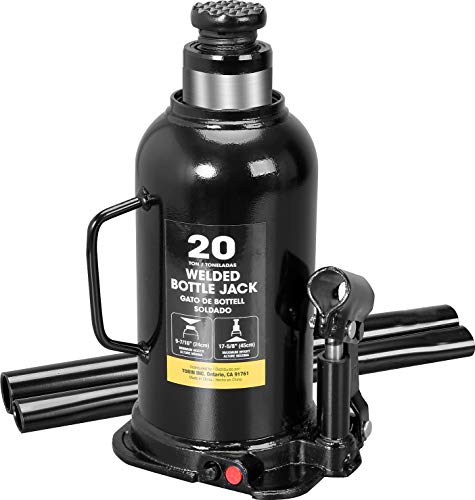
The Torin AT92003BB is engineered for reliability in both residential and commercial settings. It features a serrated saddle for a secure grip, a lifting range from about 9.5″ to 17.6″, and a 20 ton capacity with a durable forged steel build. It’s best for heavy-duty, frequent lifting tasks where stability and longevity matter. Limitation: Heavier unit which may be harder to maneuver in tight spaces.
Buying Guide: Key Considerations For 20 Ton Hydraulic Jacks
- Capacity vs. vehicle type: All selected models are rated for 20 tons, making them suitable for light to medium trucks, SUVs, and RVs. Assess your most common vehicles to confirm compatibility.
- Lifting range and height: Compare minimum and maximum lift heights to ensure the jack clears chassis components and allows access for stands and wheels.
- Power source: Pneumatic (air-assisted) options lift faster but require an air supply. Manual or hydraulic-only units are more portable in remote locations.
- Build quality: Look for welded frames and reinforced stress points. A serrated or textured saddle improves load stability during lifts.
- Leverage and handle design: Longer or multi-section handles reduce effort. Ensure the handle storage is convenient for your workspace.
- Stability and safety features: Check for integrated safety valves and proper base design to prevent tipping under heavy loads.
- Storage and portability: Consider weight and dimensions, especially for trunk storage or small garages.
- Maintenance needs: Oil seals, leakage risk, and lubrication points affect long-term reliability.
Frequently Asked Questions
- Q: Can I use a 20-ton hydraulic jack on a passenger car? A: Yes, for most passenger cars, provided the lifting height and saddle fit the vehicle’s jacking point. Always use jack stands for support after lifting.
- Q: Is a pneumatic option worth it for a home shop? A: It can significantly speed up lifts, especially in professional settings. Ensure you have a reliable air source and plan for maintenance of air lines.
- Q: What should I check before buying a 20-ton jack? A: Verify lifting range, base stability, saddle design, and whether the unit includes a long or multi-section handle for leverage.
- Q: Are all 20-ton jacks the same height when collapsed? A: No. Low-profile variants exist to handle vehicles with lower clearance; check the minimum height to know if the jack fits under your vehicle.
- Q: Do I need additional accessories? A: Wheel chocks, jack stands, and a compatible handle or extension may improve safety and usability.
- Q: How do I avoid oil leaks in a welded bottle jack? A: Regular inspection of seals and proper oiling per the manufacturer’s guidelines can reduce leaks and extend life.
Summary of chosen products at a glance: The five models cover a spectrum from fast pneumatic operation to compact low-profile lifting, with reliable welded construction and high load capacity. Each is suited to different workspace needs, vehicle types, and lifting tasks. Choose the model that best aligns with your typical workload, vehicle clearance, and preferred power source.