Answering the top buyer question: these 20 HP phase converters are designed to convert single-phase Power to reliable three-phase power for heavy-duty machines. They’re ideal for CNCs, pumps, fans, and other demanding loads where a true 3-phase supply is needed. This guide highlights five suitable options and explains who they’re best for, along with practical buying considerations.
| Product | Best For |
|---|---|
| Rotary Phase Converter AD20 – 20 HP Digital Controls Heavy Duty | 10 HP loads with a 20 HP capability for mixed duty |
| ADX20-20 HP Digital Smart Series Extreme Duty | High inertia loads and 10 HP CNC setups |
| American Rotary AR20-20 HP | General purpose, light to moderate loads |
| DPS 20HP MY-PS-20 | Single-phase to three-phase conversion for 15 HP motors |
| American DPS Single Phase to 3 Phase Converter, 25HP | Higher horsepower applications with 20 HP motors |
Rotary Phase Converter AD20 – 20 HP Digital Controls Heavy Duty
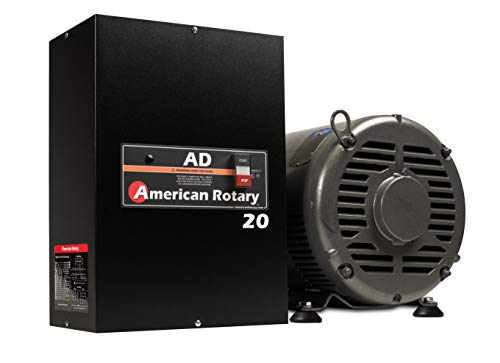
The AD20 is best for 10 HP loads with robust capacity for occasional higher demands. It supports resistive, rectified, and computer loads commonly found in CNC, VFD, EDM, and battery charging applications. This model is suited for users who need reliable single-to-three-phase conversion with strong startup performance. It’s especially appropriate for shops running mixed equipment where a single converter handles diverse loads.
Who it’s best for: small to medium-sized workshops that run CNC machines or heavy electronics requiring stable phase balance. Why selected: the AD20 is known for dependable digital controls and a compact footprint relative to its 20 HP rating. Caution: for continuous 20 HP loads, consider the higher-capacity AD40 variant to maintain stable performance.
DPS Sinlge Phase to 3 Phase Converter, 20HP

This DPS model converts single-phase 200V-240V to three-phase 200V-240V and emphasizes easy installation and use. It’s compact enough for small workspaces while delivering 20 HP capabilities for motors up to around 15 HP in typical loads. It’s a solid choice when space matters and installation simplicity is a priority.
Best for: shops needing a straightforward, space-saving solution for 15 HP class motors. Why chosen: its simple setup and compact design reduce installation time. Caution: verify the motor’s load profile; some high-inertia loads may demand a larger or more specialized unit.
American Rotary AR20-20 HP 1 to 3 Phase

The AR20 is best for 10 HP general-purpose motor loads and light-to-moderate combinations. It’s appropriate for shops that run a mix of tooling and equipment with demanding but not extreme start-up requirements. This model emphasizes reliability for everyday 3-phase needs without pushing the limits of the load.
Why selected: balanced performance across typical workshop loads. Caution: for heavy continuous 20 HP demands, consider ADX40 or other higher-capacity options to prevent strain during peak starts.
DPS 20HP MY-PS-20 Used for 15HP(11kW) 45A Motor

This DPS model supports single-to-three-phase conversion for motors around 15 HP and 45 A. It’s compact and light, making it easier to install in smaller shops or basements where space is at a premium. It’s best for users who need a straightforward conversion path for mid-range motors.
Best for: small workshops with occasional higher torque starts. Why: the unit’s small size aids in quick deployment. Caution: ensure the motor’s peak current stays within the unit’s UL-listed rating to avoid overloading.
American DPS Single Phase to 3 Phase Converter, 25HP

This 25 HP DPS unit targets higher horsepower applications while converting single-phase to three-phase, suitable for 20 HP motors and slightly larger loads. It emphasizes ease of setup and a compact footprint, making it a practical choice for expanding shops that anticipate growth beyond 20 HP needs.
Best for: growing shops that anticipate higher loads or future expansion. Why: the extra capacity allows handling peak demands without overloading. Caution: larger units require more space and a sturdier electrical feed; ensure your workspace can accommodate the installation requirements.
Buying Guide: Key Considerations For 20 HP Phase Converters
- Load profile matters. Heavier start-up loads may benefit from digital controls and higher peak torque ratings. Assess whether your primary loads are resistive, CNC-related, or mixed.
- Horsepower versus motor size. A converter labeled 20 HP may be best for a 10 HP or 15 HP motor in practice due to startup surges. Match to your most demanding motor.
- Phase balance and ripple. Look for converters with active balancing, soft-start features, and stable output to protect sensitive equipment like CNC controllers.
- Control strategy. Digital controls can improve start-up reliability and monitoring. Consider units with diagnostics and easy-to-use interfaces.
- Space and installation. Compact models fit tighter spaces, but installation may require a dedicated electrical feed and appropriate enclosure.
- Safety and compliance. UL-listed models provide baseline safety assurances. Verify local electrical codes for your workspace.
Frequently Asked Questions
- What does a 20 HP phase converter do?
– It converts single-phase power to three-phase power to run 3-phase motors up to or around 20 HP, depending on load and startup demands. - Can I run a CNC machine on a phase converter?
– Yes, many CNC machines can run on a phase converter, especially models designed for CNC-grade loads, but ensure the converter supports the CNC’s startup and running torque. - Is digital control better than a traditional rotary phase converter?
– Generally, digital controls offer better startup stability, diagnostics, and protection for sensitive equipment. - What should I consider when choosing between 20 HP and 25 HP units?
– Consider peak load, future expansion, space, and the motor’s startup current. A unit with a small excess capacity provides headroom for peak surges. - Are there risks using a phase converter with high-inertia loads?
– High-inertia loads require stable starting torque; verify the converter’s torque specs and consider a higher-capacity model if starting torque is marginal.