When selecting a 30-plate heat exchanger, choose models designed for water-to-water transfer, high-pressure resistance, and easy installation. This guide highlights five solid options suited for floor heating, water heating, snow melting, and industrial cooling. The best picks balance high BTU capacity, robust 316L stainless steel construction, copper brazing at edges, and practical port sizes. This article targets buyers seeking reliable, compact units that deliver efficient heat transfer with straightforward connections.
Summary table of selected products
| Product | Best For | Key Benefit | BTU Range |
|---|---|---|---|
| AB Plate Heat Exchanger, 4″x12″ (30 Plates) | Residential floor heating | High durability with 316L stainless steel and copper edging | 250,000–330,000 |
| VEVOR Brazed Plate Exchanger, 5″x12″ (30 Plates) | Floor heating & water heating | Efficient herringbone pattern for strong heat transfer | 260,000–360,000 |
| Alecoil 4″x12″ (30 Plates) | Commercial kitchens and heating systems | Asymmetric fish-bone design reduces secondary pressure drop | 363,000 |
| AB Plate 3″x8″ (30 Plates) | Compact spaces and smaller installations | Similar premium build in a smaller footprint | 200,000–280,000 |
| AB Plate 5″x12″ (30 Plates) | Large capacity heating projects | Higher BTU capability with robust construction | 270,000–380,000 |
AB Plate Heat Exchanger, 4″x12″ 30 Plates

Best for mid-sized residential heating projects. This unit uses 316L stainless steel plates brazed with copper at the edges to form a durable, leak-resistant block. The smooth-thread connections simplify hookups, and the 30-plate configuration supports solid heat transfer across typical floor heating and water heating tasks. Best for buyers prioritizing durable materials and straightforward installation. A potential limitation is the larger size for very compact spaces, where a smaller model might be preferred.
VEVOR Brazed Plate Heat Exchanger, 5″x12″ (30 Plates)

Better for higher capacity needs in floor heating or water heating systems. The unit uses 316L stainless steel plates with copper brazing and features a high-conductivity plate pattern for efficient heat transfer. It is UL and CE certified, enhancing reliability for varied installations. Consider this option if you need a robust exchanger with strong heat transfer efficiency; note that it may be bulkier and require adequate space for installation.
Alecoil 4″x12″ 30 Plates Heat Exchanger

Choose this if you need a compact 4″x12″ model with strong heat transfer. Its asymmetric fish bone plate design drives turbulence, increasing transfer efficiency while reducing secondary-side pressure drop. This can lower pump power requirements and overall operating costs. Best for tighter installations where space is at a premium; beware that the 4″x12″ footprint limits maximum BTU compared with larger 5″x12″ styles.
AB Plate Heat Exchanger, 3″x8″ (30 Plates)

Best for tight spaces or smaller projects needing reliable water-to-water transfer. The 3″x8″ format with 30 plates provides a compact solution while preserving the copper-brazed, high-quality 316L stainless construction. This unit is suitable for smaller floor heating or localized heating tasks. Limitation: lower single-unit BTU range than larger 4″x12″ or 5″x12″ models, so for very high-demand systems a bigger plate count or multiple units may be required.
AB Plate Heat Exchanger, 5″x12″ (30 Plates)
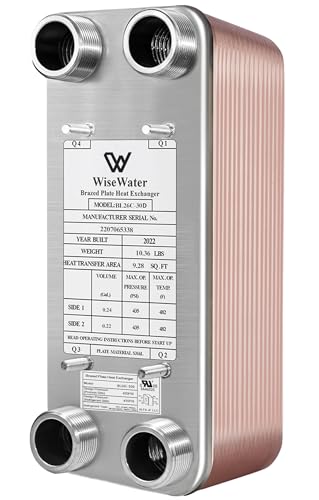
Best for larger capacity heating projects or radiant floor systems requiring higher BTU throughput. This unit uses 316L stainless with copper edges for durability and strong heat transfer. The 5″x12″ plate size supports up to 380,000 BTU per hour in some configurations, making it a good choice where space permits and demand is high. Limitation: size and weight may necessitate additional mounting considerations in some installations.
BRAZETEK 30-Plate Heat Exchanger

Best for hydronic heating and radiant floor systems requiring robust stainless steel with copper brazing. The 30-plate design uses 1″ MNPT ports to support higher flow rates and reduce pressure drop. This is a strong all-around option for both residential and light commercial heating. Caution: ensure port sizing matches your pump and piping to avoid pressure issues.
Buying Guide
What matters most in a 30-plate heat exchanger?
- Material quality: Look for 316L stainless steel plates with copper brazing for durability and leak resistance.
- BTU capacity: Choose a unit that matches your heating or cooling load. Higher BTU means more heat transfer but larger physical size.
- Plate count and size: 30 plates provide a balance of compact size and heat transfer; 3×8, 4×12, and 5×12 footprints have different space and flow implications.
- Port size and MPT/MNPT: Ensure compatibility with your piping and pumps. Larger ports reduce pressure drop but require more space.
- Thermal design: Look for efficient plate patterns (fish bone or herringbone) that maximize turbulence and heat transfer.
- Installation needs: Consider weight, mounting options, and space for service access.
Should you pick smaller or larger 30-plate exchangers?
Smaller footprints (3″x8″) are ideal for tight spaces and modest heat loads. Medium (4″x12″) strikes a balance between size and BTU capacity. Larger (5″x12″) units deliver higher BTU per hour and are better for bigger radiant floor or heating systems. Choose based on total heat load, space, and pump power requirements.
What about efficiency and operating costs?
Exchangers with a high-contrast plate design and copper brazing improve heat transfer efficiency and can reduce pump energy consumption. Asymmetric plate designs can lower secondary-side pressure drops, allowing smaller pumps and lower electricity use over time.
Are these suitable for floor heating?
Yes. Many models are designed for floor heating, radiant systems, and snow-melt applications, with capacities well into the hundreds of thousands of BTUs per hour. Confirm compatible operating temperatures and pressure ratings before integrating into a system.
Maintenance considerations
Keep ports clean and check for leaks periodically. Brazed units are typically sturdy, but correct installation and proper anti-corrosion practices extend lifespan in variable water conditions.
FAQ
- What is a 30-plate heat exchanger best used for?
For water-to-water transfer in heating, cooling, snow-melt, and radiant floor systems with moderate to high heat loads. - What material are these made from?
Most use 316L stainless steel plates with copper brazing for edges, offering durability and leak resistance. - Do these require electricity to operate?
No, heat transfer occurs through the plates; pumps may be needed to circulate water. - Can I install a 30-plate exchanger in a tight space?
Yes, but verify the footprint (3×8, 4×12, or 5×12) and ensure adequate clearance for connections and service. - What should I consider about BTU ratings?
Match the unit’s BTU/h to your system’s heat load; oversizing can increase costs and underutilize the exchanger. - Are these exchangers leak-proof?
High-quality brazed units with copper edges are designed for leak resistance under typical operating pressures.