Answering the search for reliable stainless steel vacuum chambers, this guide highlights five top options well-suited for resin degassing, wood stabilization, silicones, epoxies, and related crafts. Each pick targets different buyer needs—from compact 3-gallon kits to larger 5-gallon setups—so you can choose based on capacity, lid design, and pump power. Best for hobbyists needing straightforward setup; better for small studios needing flexibility; choose this if you require precise vacuum measurement and durable materials.
| Product | Chamber Size | Best For | Why Selected |
|---|---|---|---|
| VEVOR 5 Gallon Vacuum Chamber | 5 Gallon | Medium to large scale degassing | Robust 304 stainless steel, upgraded glass lid, strong airtight seals |
| BACOENG 5 Gallon Tempered Glass Lid | 5 Gallon | Wood stabilization and volatile materials | Tempered lid, good seal, high vacuum compatibility |
| BACOENG 3 Gallon Tempered Glass Lid | 3 Gallon | Smaller projects and portables | Integrated pump option, compact footprint, reliable gasket |
| VEVOR 3 Gallon Vacuum Chamber | 3 Gallon | Versatile bench setup | Same durable construction, tempered lid, strong seal |
| PB Motor Tech 3 Gallon Stainless Steel | 3 Gallon | Low-noise operation and precise vacuum | Premium stainless steel, two silencers, accurate glycerin gauge |
VEVOR 5 Gallon Vacuum Chamber

The VEVOR 5 Gallon model uses a 304 stainless steel chamber with a corrosion-resistant glass lid. It supports degassing for resin, silicone, polyurethane, and wood stabilization. The lid gasket and threaded valve connections enhance airtightness, achieving up to -29 inHg. This chamber is best for hobbyists and small shops needing a larger interior for purer, bubble-free results. Caution: glass lid is breakable if handled roughly or dropped.
BACOENG 5 Gallon Tempered Glass Lid Vacuum Chamber

This 5-gallon BACOENG chamber emphasizes a tempered glass lid and a silicone gasket for excellent sealing during degassing. It supports damping volatile materials like silicones and essential oils and reaches up to 29 inHg at sea level. It’s a strong choice for wood stabilization and resin work when a larger interior is beneficial. Best for: users who need a reliable, seal-tight unit with visible process observation. Limitation: glass lid requires careful handling to avoid cracking.
BACOENG 3 Gallon Tempered Glass Lid Vacuum Chamber
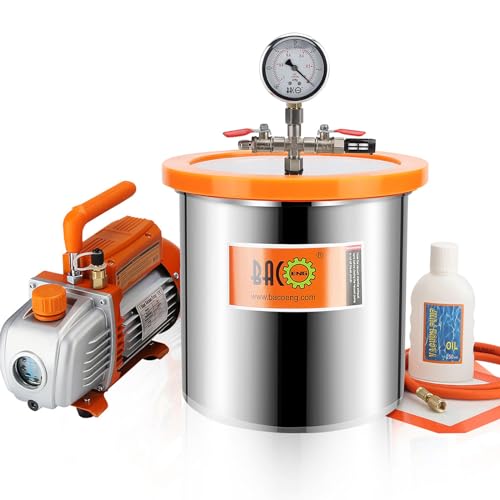
This 3-gallon system provides a compact option with a tempered lid and silicone gasket. It includes a 3.6 CFM pump with up to -29.92 inHg, making it suitable for smaller batches of resin, silicone, or epoxy. Choose this for tight spaces or portable setups. Caution: smaller chamber means less work-in-progress capacity and may require more frequent degassing for larger batches.
VEVOR 3 Gallon Vacuum Chamber
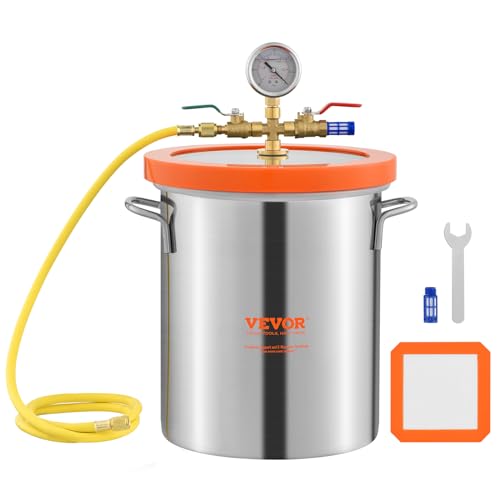
This 3-gallon model mirrors the VEVOR 5G’s rugged build but in a smaller size. It uses a glass lid with a gasket and threaded valve connections for dependable airtight sealing. Best for: those who require a durable, easy-to-clean chamber for smaller resin or wood stabilization projects. Limitation: smaller interior may limit batch size and throughput.
PB Motor Tech 3 Gallon Stainless Steel Vacuum Chamber

The PB Motor Tech 3G model emphasizes premium stainless steel construction with a tempered glass lid and two silencers for quieter operation. The glycerin-filled gauge improves measurement stability and reduces readout flutter, offering precise vacuum control. This is best for users prioritizing quiet operation and accurate vacuum monitoring. Caution: data notes do not specify warranty details.
Buying Guide
What size do you need? If you work with larger resin pours or wood stabilization, a 5-gallon chamber provides more space and higher potential throughput. For tabletop tasks or small batch projects, a 3-gallon unit often suffices and saves space and cost.
How strong should your seal be? Look for glass or tempered-glass lids with silicone gaskets and threaded connections on the vacuum valve for consistent airtight performance. A leak rate under 5% over 12 hours is a practical benchmark in many setups.
Which pump features matter? Pumps vary from 3.6 CFM to 4.5 CFM single-stage units. Higher CFM offers faster degassing, but ensure the chamber’s interior and gasket can withstand sustained pressure.
What about gauges and visibility? Glycerin-filled gauges reduce vibration-related drift. Clear lids or acrylic observation windows help monitor defoaming progress without opening the chamber.
What are maintenance considerations? Stainless steel chambers resist corrosion, but gaskets and seals require inspection and occasional replacement to maintain airtightness. Consider models with gaskets rated for thousands of uses.
FAQ
- What is a typical vacuum level for degassing chambers? Most units aim for up to -29 to -30 inHg at sea level.
- Are tempered glass lids necessary? They help with visibility and can handle volatile materials, but require careful handling.
- Can I degas epoxy and resin in the same chamber? Yes, many chambers support multiple materials including silicones and polyurethane.
- What maintenance is needed over time? Inspect gaskets and seals regularly; replace worn gaskets to maintain airtightness.
- Is a higher CFM pump always better? Higher CFM speeds degassing, but the chamber must tolerate the pressure without deformation.