For professionals needing reliable, high-precision flow regulation in water, oil, gas, and other media, stainless steel needle valves are a top choice. This guide highlights five durable, commercially available options that balance performance, corrosion resistance, and ease of use. The featured products are suitable for lab setups, industrial lines, maintenance systems, and instrumentation work. The buyer intent is to find robust, precise valves that perform consistently under pressure and across varying media. A quick summary table is included to compare core specs at a glance.
| Product | Material | Connection | Best For |
|---|---|---|---|
| YACO VALVE Stainless Steel Needle Valve | 304 Stainless Steel | 1/2″ NPT | High pressure regulation, durable sealing |
| TAISHER 304 Stainless Steel Straight Needle Valve | 304 Stainless Steel | 1/4″ Female NPT | Compact flow control for small lines |
| Angry Pony 1/2 NPT Needle Valve | 304 Stainless Steel | 1/2″ NPT | Precise adjustment for lab and industrial use |
| TAISHER 316 Stainless Steel Compression Tube Needle Valve | 316 Stainless Steel | 3/8″ OD Compression | Heavy-duty, leak-resistant connections |
| TAISHER 304 Stainless Steel High Pressure Straight Valve | 304 Stainless Steel | 1/2″ Female NPT | High-pressure flow control |
YACO VALVE Stainless Steel Needle Valve 1/2″ NPT

Best for high-pressure setups that demand robust sealing and repeatable settings. The solid barstock body, CNC-machined from 304 stainless steel, offers superior durability and leak resistance up to 2000 PSI. The T-handle design provides better leverage for fine adjustments and easy tracking of turns, which is valuable in processes where precise flow settings must be reproduced. This valve is a strong choice for instrumentation lines, hydraulic rigs, or systems requiring consistent, leak-free operation under pressure. Caution: the valve requires a firmer turn than light-duty models to achieve a precise seal, reflecting its precision-fit design.
TAISHER 1PCS 304 Stainless Steel Straight Needle Valve 1/4″ Female NPT

Best for compact systems where space is limited but reliable control is essential. This 1/4″ female NPT needle valve is forged from 304 stainless steel, offering strong corrosion resistance and dependable sealing for water, gas, and oil flows. The product supports precise regulation and is suitable for industrial connections where standard 1/4″ NPT threads are used. Limitation: data indicates general use in medium-level pressure rather than ultra-high-demand environments.
Angry Pony 1/2 NPT Needle Valve, 304 SS

Best for medium-to-heavy duty applications requiring precise flow adjustment. Made from 304 stainless steel, this 1/2″ NPT valve provides repeatable regulation for water, oil, and gas in lab or field environments. It excels when stable, incremental control is needed to fine-tune system performance. A potential limitation is that the valve’s design emphasizes precision and metal-to-metal sealing, which can require deliberate adjustments and may feel stiffer than lighter-duty models.
TAISHER 316 Stainless Steel Compression Tube Needle Valve 3/8″ OD
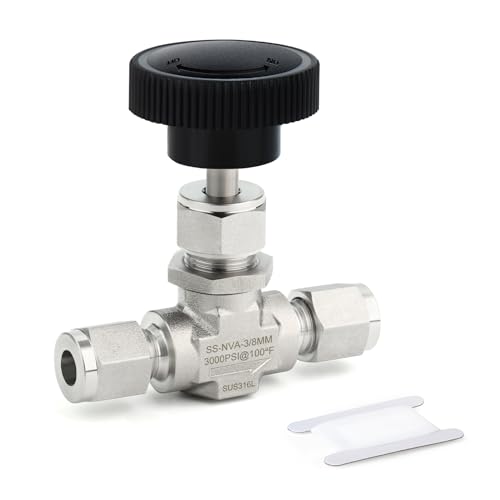
Best for systems using compression tube fittings and environments needing excellent corrosion resistance. The 316 stainless steel construction provides superior resistance to chloride corrosion and high-temperature endurance, making it suitable for challenging water, gas, and oil lines. The valve is designed to connect stainless steel, copper, rigid, and semi-rigid plastics at the same diameter, ensuring a tight seal with a hex nut construction. Limitation: compression-tube connections require compatible tube ends and proper assembly to ensure leak-free performance.
TAISHER 304 Stainless Steel High Pressure Straight Needle Valve 1/2″ NPT

Best for high-pressure flow control where robust, dependable operation is required. The valve uses 304 stainless steel for corrosion resistance and features a 1/2″ female NPT connection suitable for many standard lines. It supports precise, repeatable adjustments, making it appropriate for lab benches, maintenance lines, and industrial processes. Caution: ensure compatible fittings and seals to maintain long-term leak-free performance under high pressure.
Buying Guide: How To Choose A Stainless Steel Needle Valve
- Application and media: Confirm compatibility with water, oil, gas, or other fluids. Stainless steel grades (304 vs 316) offer different corrosion resistance, with 316 performing better in chloride-rich environments.
- Connection type and size: Match NPT or compression tube connections to your system. Consider space constraints and whether a straight or angled body fits best.
- Pressure rating: For high-pressure systems, choose valves rated for thousands of PSI. Account for system surge and temperature ranges when selecting material and seat design.
- Material and finish: Solid barstock bodies typically provide better durability than cast bodies. Look for corrosion-resistant seating and sealing surfaces to minimize leaks over time.
- Adjustment feel: T-handle designs often offer finer controllability and easier tracking of turns, which helps in achieving repeatable flow settings.
- Installation and maintenance: Ensure the valve can be disassembled or serviced if needed. Check availability of compatible seals and spare parts.
Frequently Asked Questions
- What is a needle valve used for?
Answer: A needle valve provides precise regulation of fluid flow by moving a needle-shaped plunger into a matching seat, enabling fine metering, especially in lab and instrumentation work. - Which stainless steel grade is best for aggressive fluids?
Answer: 316 stainless steel offers better corrosion resistance in chloride- or salt-rich environments than 304, making it a better choice for many industrial fluids. - Are compression-tube needle valves easier to install?
Answer: Compression-tube valves can be straightforward when tube ends are properly prepared, and they reduce the risk of overtightening threading compared to some NPT connections. - Can needle valves handle high pressures?
Answer: Yes, many needle valves are designed for high-pressure applications, but always verify the maximum working pressure for your specific model and temperature range. - How do I maintain a needle valve for longevity?
Answer: Regularly inspect seals, ensure clean, contaminant-free media, and follow manufacturer guidance on lubrication or replacement of seals to maintain tight shutoff and precise adjustment.