Choosing the right skid steer cement mixer attachment can boost productivity on construction, landscaping, and farming projects. This guide highlights five reliable options, detailing who they’re best for, what they excel at, and practical considerations. Whether you need large-capacity mixing, versatile discharge options, or rugged durability, these attachments help you mix, transport, and pour concrete efficiently with a skid steer.
Quick comparison at a glance (top picks):
| Product | Best For | Key Advantage | Limitations |
|---|---|---|---|
| FORGLO 92 Gallon Skid Steer Concrete Mixer Attachment | Heavy-duty sites, farms, landscaping | Large 350L capacity, reinforced blades | May require compatible hydraulic setup |
| MIVA Skid Steer Concrete Mixer Attachment (350L) | General construction, utility work | Removable screen, solid durability | Electric wire model has extra wiring considerations |
| Wolfequip 66-80 GAL Skid Steer Mixer | Projects needing flexible discharge | Multiple discharge options, center chute | |
| LandHonor Concrete Mixer Double Discharge (66 GAL) | Precise side and center pours | Dual discharge modes | Compact capacity may require more trips |
| Geelife Self-Loading Skid Steer Mixer | Remote sites with quick loading needs | Built-in bag breaker, easy loading | Self-loading feature can affect balance on some setups |
FORGLO 92 Gallon Skid Steer Concrete Mixer Attachment
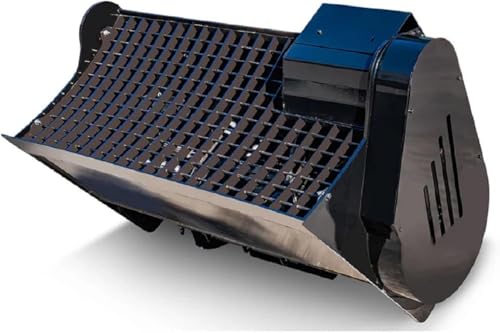
Best for heavy-duty sites requiring large batch capacity. The 350L bucket loads loose materials efficiently, blends concrete uniformly, and discharges precisely through a hydraulic central outlet or tilt-dumping. Reinforced wear-resistant blades and a thickened base plate support longevity in construction, farming, and landscaping jobs. A hinged front safety grid allows quick interior cleaning, balancing operator safety with uptime. Ideal when you need steady pours and robust durability in tough environments.
Who it’s for: contractors and farmers who regularly pour sizable concrete sections and value extended service life. Limitations: installation may require compatible hydraulic components and mounting alignment to ensure consistent discharge.
MIVA Skid Steer Concrete Mixer Attachment (350L)

Best for general construction tasks requiring a reliable, durable mixer with thoughtful features. The 350L bucket blends materials uniformly and delivers pours via hydraulic central outlet or tilt-dumping. The unit uses reinforced wear-resistant blades and a thickened base plate to resist wear and corrosion, supporting long-term performance in busy sites. The hinged safety grid simplifies interior cleaning and maintenance.
Who it’s for: crews needing consistent mixing with a straightforward discharge workflow. Caution: ensure wiring and hydraulic connections align with your skid steer model for optimal operation.
Wolfequip 66-80 GAL Skid Steer Concrete Mixer

Best for projects needing flexible discharge options. This heavy-duty mixer supports front bulk pouring, a manual side chute for controlled side discharge, and a hydraulic center chute with hose for precise placement. It also doubles as a sandbag filler, expanding its usefulness in utility work and flood control scenarios. The multiple discharge paths provide adaptability on uneven sites or when you must place concrete in hard-to-reach areas.
Who it’s for: operators who need versatile pour control and the option to repurpose the unit for sandbag filling during other site tasks. Caution: the center chute hose setup can require careful setup to prevent clogging during long pours.
LandHonor Concrete Mixer Double Discharge (66 GAL)

Best for precise dispensing and efficient travel-mix workflows. This mixer features both a manual side chute and a hydraulic center chute with a hose, enabling precise side pours or center distribution to reach difficult areas. It’s designed to stay productive during long shifts by enabling scooping, mixing en route, and immediate pouring. The high-strength drive system supports demanding workloads and aggregrate capacity up to 1.25 inches.
Who it’s for: construction crews needing dual-discharge flexibility and reliable on-the-go mixing. Limitation: at 66 gallons, it may require more trips for very large pours compared to bigger cylinders.
Geelife Self-Loading Skid Steer Concrete Mixer Bucket

Best for sites seeking fast, self-loading capability. The Geelife unit emphasizes effortless loading, mixing, and delivery with a built-in bag breaker for quick cement powder addition. A hydraulic bottom opening and detachable unloading pipe enable precise control and targeted pours, reducing manual handling on busy sites.
Who it’s for: teams that value fast loading and convenient unloading. Caution: self-loading features can affect balance on smaller skid steers; verify compatibility with your machine’s lifting capacity and mounting points.
MIVA Skid Steer Concrete Mixer Attachments 350L (Second Model)

Best for a familiar 350L capacity with a reliable hydraulic discharge system. This model mirrors the standard MIVA mixing approach with reinforced blades and a robust base plate for heavy duty work, paired with a safe front grid for maintenance. It’s suitable for contractors who want consistent performance with straightforward operation and replacement parts availability.
Who it’s for: users who prefer a familiar 350L platform with predictable performance. Limitation: ensure the hydraulic system and wiring on your skid steer are compatible with this unit’s control scheme.
Buying Guide: Key Considerations for Skid Steer Cement Mixer Attachments
What capacity do you need?
Batch size matters. Larger capacities reduce trips but require more powerful hydraulics and stable mounting. For frequent small pours, 66–80 gallon models can be more maneuverable.
What discharge options matter?
Central hydraulic discharge is common for uniform pours. Side chutes are useful for reaching tight spots, while manual or hydraulic center chutes offer precision placement. Some models also double as sandbag fillers for utility work.
How important is durability?
Look for reinforced blades, thickened base plates, and corrosion-resistant materials. Heavy-duty attachments tend to last longer in harsh environments like construction sites and farms.
What about maintenance and safety?
Hinged safety grids enable quick interior cleaning. Easy access to the interior reduces downtime. Ensure the unit has straightforward maintenance routines compatible with your shop’s workflows.
Compatibility and installation considerations
Confirm your skid steer model’s hydraulic flow, mounting pattern, and available power. Some attachments need specific hydraulic circuits or quick-attach interfaces to fit your machine properly.
Bottom line on choosing
For large-capacity projects on tough sites, FORGLO stands out for durability and throughput. If you want flexible discharge and multi-use capability, Wolfequip or LandHonor offer versatile options. For quick loading and construction-site efficiency, Geelife’s self-loading feature provides value. Consider your capacity needs, pour precision, and machine compatibility to select the best attachment for your workflow.
FAQ
- What is a typical skid steer cement mixer attachment capacity? Most common capacities range from 66 to 350 liters (roughly 66–80 gallons for standard units; some large-capacity models exceed 300 liters).
- Can I use any skid steer mixer with my machine? Compatibility depends on mounting (quick-attach, bolt-on), hydraulic flow, and weight. Check your machine’s load rating and hydraulic spec before purchase.
- Which discharge option is best for tight work areas? Side or hydraulic center discharge provides greater reach and precise placement in restricted spaces.
- Are these mixers suitable for sandbags as well? Some models feature center discharge or dedicated sandbag filler modes; confirm the product’s stated capabilities.
- Do I need extra maintenance tools? Basic tools for checking hydraulic fittings, cleaning grids, and greasing moving parts are usually sufficient; follow the manufacturer’s maintenance schedule.
- What should I consider for safety on rough terrain? Look for robust steel construction, protective grids, and secure mounting to minimize vibrations and movement during operation.