Choosing the right rubber coating for concrete surfaces helps prevent water intrusion, cracking, and deterioration. This article highlights five high-performance options from trusted brands, focusing on elasticity, adhesion, and long-term protection for basements, foundations, and outdoor concrete. Each product section includes a concise overview, practical uses, and key features to compare at a glance.
| Product | Brand | Type | Best For |
|---|---|---|---|
| Liquid Rubber Basement and Foundation Repair Sealant (5 Gal) | Liquid Rubber | Flexible Waterproof Sealant | Basements & Foundations |
| Liquid Rubber Basement and Foundation Repair Sealant (1 Gal) | Liquid Rubber | Flexible Waterproof Sealant | Basements & Foundations |
| Liquid Rubber Waterproof Sealant (5 Gal) | Liquid Rubber | Flexible Protective Membrane | Roofs, Foundations, Gutters |
| Ames Block & Wall Liquid Rubber Waterproofer (1 Gal) | AMES | Waterproofer Coating | Basements & Foundations |
| Ames Maximum Stretch Waterproof Sealant Membrane (4.6 Gal) | AMES | Elastomeric Sealant | Roofing & Concrete |
Note: The following sections present five selected products with brief usage guidance and technical highlights to aid a practical comparison. No prices are displayed here, and all links open to the official Amazon listing for each product.
Liquid Rubber Basement And Foundation Sealant (5 Gal)

Designed as a permanent waterproof membrane, this sealant provides high elongation (900%) to accommodate structural movement and temperature changes. It’s suitable for basement waterproofing, foundation leak repair, shower liners, and planter boxes, offering a complete sealing system beyond basic concrete paints or standard sealants. Its adhesion extends to concrete, masonry, wood, metal, and foundation surfaces, making it a versatile option for DIY or professional projects.
Key features: permanent waterproof membrane, 900% elongation, compatible with self-leveling concrete, broad substrate adhesion, ideal for active leaks and moisture protection.
Liquid Rubber Basement & Foundation Sealant (1 Gal)

This one-gallon variant delivers the same professional-grade waterproofing membrane for basement leaks and foundation repair as its larger counterpart, with 900% elongation for enduring flexibility. It’s designed to seal against active leaks and moisture, and it remains compatible with self-leveling concrete applications. The product emphasizes strong adhesion to multiple substrates, supporting DIY cement work and foundational repairs with reliable performance.
Key features: 900% elongation, durable membrane, excellent substrate adhesion, suitable for continuous moisture exposure, compatible with self-leveling concrete.
Liquid Rubber Waterproof Sealant (5 Gal) For Roofs & Foundations

This industrial-strength bitumen-based formula creates a seamless waterproof membrane across flat roofs, metal roofs, low-slope roofs, foundations, and gutters. It offers superior flexibility with 950% elongation, maintaining adhesion through movement and temperature shifts. The coating resists cracking, peeling, and UV damage, delivering a durable rubberized layer that protects multiple substrates, including concrete and metal, in various climates.
Key features: 950% elongation, versatile surface compatibility, UV resistance, long-lasting protection, suitable for roof and foundation applications.
Ames Block & Wall Liquid Rubber Waterproofer (1 Gal)
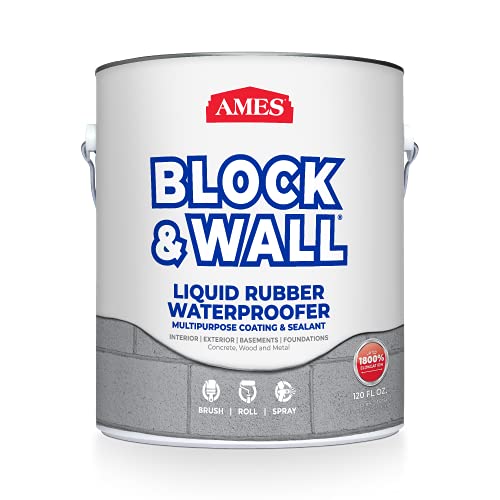
Designed as a versatile waterproofer for basements and foundations, this white liquid rubber coating provides a straightforward solution for concrete sealant needs. While listed with basic product details, it serves as a practical option for DIY projects where an easy-to-apply waterproof layer is desired. It’s suitable for interior basement walls and external foundation surfaces where moisture protection is required.
Key features: White color option, suitable for concrete sealing, simple application, American-made emphasis on quality and reliability.
Ames Maximum Stretch Waterproof Sealant Membrane (4.6 Gal)

Ames Maximum-Stretch is a white, elastomeric roof coating and sealant with 650% elongation. It is designed to resist cracking and peeling while delivering high reflectivity (88%), which helps reduce surface temperatures and cooling costs. The product adheres to metal roofing, tar, rolled roofs, and more, making it a versatile option for low-slope roofs, RVs, and concrete surfaces where a durable, flexible sealant is beneficial.
Key features: 650% elongation, 88% reflectivity, versatile substrate adhesion, suitable for roofing and concrete resurfacing, brush/roll/spray application.
Buying Guide: Key Considerations For Rubber Coatings On Concrete
When selecting a rubber coating for concrete, consider elasticity, adhesion, coverage, environmental exposure, and application method. Higher elongation numbers indicate better flexibility under movement and temperature shifts, reducing the risk of cracking. Assess substrate compatibility (concrete, masonry, wood, metal) and whether a primer or surface preparation is needed. For basements and foundations, opt for products designed to seal active leaks and moisture. For outdoor or roofing uses, prioritize UV resistance and long-term durability. Coverage rates and recommended number of coats influence project timelines and costs, so plan accordingly. Finally, verify compatibility with self-leveling concrete if that is part of the installation plan, and confirm whether multiple coats or specific cure times are required for optimal performance.
Performance perspectives:
- Basement and foundation sealing: prioritize high elongation, strong adhesion, and moisture resistance to protect against active leaks.
- Roofing and exterior use: prioritize UV resistance, weather durability, and reflectivity to reduce thermal loads.
- DIY suitability: consider open- or closed-cell formulations, ease of application (brush/roller/spray), and required surface prep.
- Environmental and safety: check VOC content, curing times, and any ventilation considerations during application.
In summary, the right rubber coating for concrete depends on the specific surface, exposure, and project goals. The options above cover a spectrum from basement and foundation applications to roof and outdoor surfaces, offering durable, flexible membranes designed to protect concrete and adjacent materials over time.