Answering common questions about powder coated perforated metal sheets, this guide highlights five versatile options. Each product is suited to a distinct use case—whether you need decorative panels, ventilation grills, or durable indoor/outdoor screens. The selections emphasize corrosion resistance, size variety, and ease of fabrication to help buyers choose the right sheet for walls, enclosures, cabinets, and decorative installations. The quick reference table below compares core details to aid quick decisions.
| Product | Best For | Size / Thickness |
|---|---|---|
| Jucoan Perforated Sheet | Indoor/outdoor panels and enclosures | 11.8″ x 11.8″, 0.08″ thick |
| Union Jack Perforated Sheet (3′ x 3′) | Decorative screens and accents | 3′ x 3′, .020″ thick |
| RZGZKLSH 304 Stainless Steel Sheet | Ventilation grids and durable projects | 9.8″ x 39.4″, 0.02″ thick |
| Randall Union Jack Aluminum Sheet (36″ x 36″) | Large decorative panels | 36″ x 36″, .020″ thick |
| customcargrills 6″ x 36″ Grill Mesh | Grilles and grills with square openings | 6″ x 36″, 0.065″ thick |
Jucoan Perforated Sheet

The Jucoan perforated sheet is made from 304 stainless steel, offering corrosion resistance and rust-proof durability. It measures 11.8 inches by 11.8 inches with a 0.08 inch thickness and 0.12 inch (3 mm) holes. The design supports welding or cutting as needed, making it suitable for enclosures, partitions, and signs. Best for small indoor or outdoor projects and quick repairs where a robust metal sheet is required. A potential limitation is its smaller size, which may require joining multiple sheets for larger applications.
Union Jack Perforated Sheet (3′ x 3′)

This Union Jack perforated sheet is made of powder-coated aluminum in a dark gold color, sized at 3′ x 3′ with a .020″ thickness. It features the Union Jack pattern, adding decorative appeal to screens, cabinet inserts, or radiator covers. Best for projects that demand a bold, patriotic motif with ventilation. A caveat is its lighter aluminum construction, which may be less suited for heavy-load structural uses compared with thicker metal sheets.
RZGZKLSH 304 Stainless Steel Perforated Sheet

This sheet is 9.8″ by 39.4″ with 0.12″ holes and 0.02″ thickness, crafted from premium 304 stainless steel. It offers precise machining and a uniform perforation pattern for optimal airflow and aesthetics. Suitable for decorative panels, speaker grilles, and DIY ventilation components. Best for projects requiring high corrosion resistance and extended longevity. Edges can be sharp; handle with care during fabrication and installation.
Randall Union Jack Aluminum Sheet (36″ x 36″)
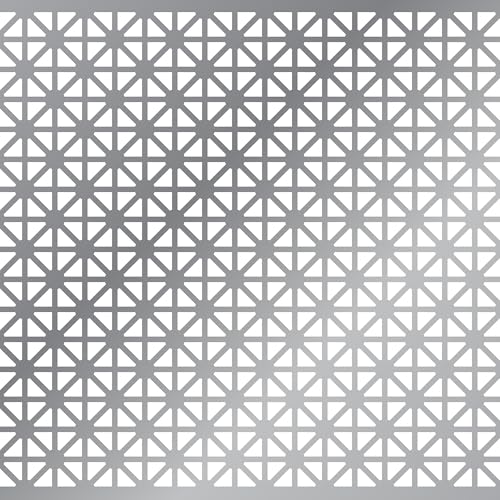
This large aluminum sheet showcases a Union Jack design in a 36″ x 36″ format with a .020″ thickness. The mill-finish silver aluminum is suitable for indoor and outdoor use, and the sheet can be cut to fit specific dimensions. Best for expansive decorative panels, screens, or custom room dividers. A limitation is its lighter gauge, which may not be ideal for high-load structural roles without reinforcement.
customcargrills 6×36 Grill Mesh

Designed as a perforated square grill mesh, this 6″ tall by 36″ wide sheet uses 3003 alloy aluminum with a 0.065″ thickness and a 1/2 inch square hole opening. It’s powder coated in gloss black, shipped flat for easy handling, and intended for grill guards, vents, and decorative panels. Best for bold, industrial-style accents. A note: the relatively thick gauge may be harder to bend for intricate curves compared with thinner sheets.
Buying Guide
What should you consider when choosing a powder coated perforated metal sheet?
- Material and corrosion resistance: Stainless steel offers superior rust resistance, while aluminum is lighter and easy to cut. Choose based on exposure (indoor vs outdoor) and weight considerations.
- Hole size and pattern: Hole diameter and spacing affect airflow, acoustics, and visual density. Larger holes improve ventilation but reduce privacy, while denser patterns offer more shading and ambience.
- Sheet size and thickness: Larger sheets reduce seams but may be heavier. Thicker sheets provide more stiffness but are harder to fabricate. Match size to your project dimensions and fabrication capabilities.
- Finish and color: Powder coating adds color, UV resistance, and weather protection. Dark gold and black finishes are popular for decorative panels and grills, while mill-finish or bright finishes suit modern applications.
- Fabrication considerations: Some sheets can be cut and welded, while others are best left to professional fabricators. Edges may be sharp; plan for edge protection or deburring as needed.
- Intended application: Decorative screens, cabinet inserts, and speaker grilles have different demands—consider airflow, aesthetics, and mounting hardware when selecting a sheet.
Practical tips for choosing and using perforated sheets
- For outdoor installations, prioritize corrosion resistance and powder coating durability.
- When using decorative Union Jack patterns, ensure alignment and mounting to showcase symmetry.
- Always handle sharp edges with protective gear and deburr edges after cutting.
FAQ
- What is the difference between stainless steel and aluminum perforated sheets?
– Stainless steel offers higher corrosion resistance and strength, suitable for harsh environments. Aluminum is lighter and easier to cut, often preferred for decorative or less demanding outdoor use. - Can these sheets be cut to custom sizes?
– Yes, several sheets are described as suitable for cutting or trimming to fit specific spaces. - Are powder-coated finishes durable for exterior use?
– Powder coatings generally provide good UV resistance and weather protection, but performance depends on coating quality and substrate. - What applications are best for Union Jack perforated designs?
– Decorative screens, cabinet inserts, grills, and accent panels where a bold motif is desired. - Should I worry about sharp edges on perforated sheets?
– Yes. Perforated sheets can have sharp edges; plan for deburring or edge protection during installation. - Is larger sheet size always better?
– Larger sheets reduce seams and joints but can be heavier and harder to transport or install depending on tools available.