When you need precise, portable temperature calibration, choose equipment designed for accuracy, reliability, and quick setup in the field. This guide highlights five top portable options, from compact dry blocks to versatile thermocouple simulators. Best for technicians working in marine, power, HVAC, and lab environments who need dependable performance on the go. The companion buying table below helps compare core specs at a glance.
| Product | Key Use Case | Best For |
|---|---|---|
| SIKA Dry Block Calibrator RT to 1202°F (650°C) 230V | High-range dry block for field and shop calibrations | Marine and industrial technicians needing wide range |
| SIKA Dry Block Calibrator RT to 1202°F (650°C) 115V | Same as above, optimized for 115V environments | Facilities with 115V power |
| FRU Professional Thermocouple Simulator Calibrator | Thermocouple signal simulation and calibration | Engineers requiring multi-type compatibility |
| Fluke Calibration 9100S-B-156 HDRC | Handheld dry-well for portable high-precision work | On-site calibration with compact footprint |
| INSTRUKART AI-DBC-01 Dry Block Calibrator | Thermocouple compatibility with broad range | Lab and field calibrations needing versatile probes |
SIKA Dry Block Calibrator RT to 1202°F (650°C) 230V

This dry block calibrator covers room temperature up to 1202°F (650°C) with an accuracy of ±2.16°F (±1.2°C) and stability of ±0.36°F (±0.2°C). It features a 2.4-inch color display and a simple 3-button interface for quick setup. Best for industrial plants, marine maintenance, HVAC service, and laboratories that require reliable field calibration. It accepts standard borehole inserts (3.5 mm, 6.5 mm, and 13.5 mm, 110 mm deep). The unit weighs about 11.2 lbs, enabling easy transport to job sites. Includes calibration inserts and a factory certificate; recalibration interval is 500 hours or 3 years as needed. Caution: calibration certainty relies on periodic recalibration and proper instrument insertion alignment.
Who it’s best for: Marine technicians, refinery maintenance crews, and field service engineers needing a rugged, portable calibration block with a broad temperature range.
SIKA Dry Block Calibrator RT to 1202°F (650°C) 115V
This 115V variant mirrors the 230V model with identical temperature range, accuracy, and borehole options. It shares the same 2.4-inch color display, lightweight build, and a 5-year warranty. It is best for facilities that operate on 115V power and require the same field-ready performance. Limitation: compatibility depends on local power supply; ensure proper plug type and outlet availability at the job site.
Who it’s best for: Contractors and service teams in facilities with standard 115V electrical infrastructure needing portable calibration capability.
FRU Professional Thermocouple Simulator Calibrator

Designed to simulate thermocouple signals for precise calibration and testing, this professional-grade tool supports multiple thermocouple types. It is ideal for technicians and engineers who require reliable signal generation across diverse calibration tasks. Best for lab calibrations and field checks where multi-type compatibility matters. Caution: ensure the device supports the specific thermocouple types you use most often.
Fluke Calibration 9100S-B-156 HDRC

Fluke’s 9100S-B-156 HDRC is a handheld dry-well calibrator designed for portability and high-precision tasks. It includes an RS-232 interface for software integration with support tools. Best for technicians who need a compact device for on-site calibration with reliable stability and a simple control layout. Limitation: handheld units generally have a smaller temperature range and shorter warm-up times compared with larger benchtop models.
INSTRUKART Dry Block Calibrator AI-DBC-01
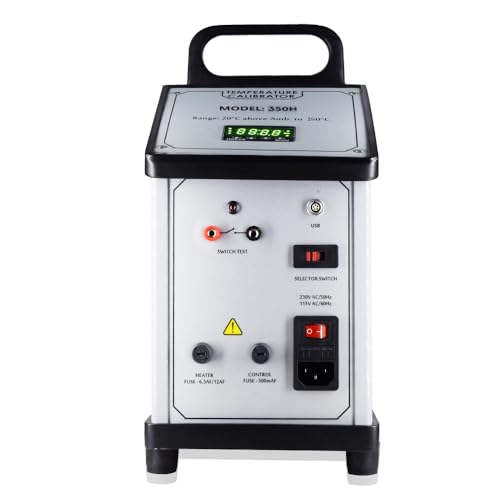
The AI-DBC-01 provides a broad ambient-to-350°C calibration range with an accuracy of ±0.4°C and a fast stabilization time. It supports multiple measurement parameters including RTD, mA, mV, and volts, making it suitable for calibration labs and field work. Best for users needing versatile probe compatibility and solid radial uniformity. Caution: check compatibility with your existing thermocouple types and interfaces before purchase.
Buying Guide
Key purchase considerations for portable temperature calibration equipment:
- : Higher ranges (up to 650°C/1202°F) cover more sensors but may increase cost and size. Choose based on the sensors you test most often.
- : Look for tight accuracy metrics (±0.2–±1.0°C ranges) and stable performance under field conditions. Consider recalibration intervals to maintain traceability.
- : Field work often requires 115V or 230V variants and light weight for transport. A handheld option adds mobility but may trade range.
- : Borehole size compatibility determines which probes you can calibrate. Standard inserts (3.5 mm, 6.5 mm, 13.5 mm) improve versatility.
- : A clear display and simple interface speeds up field calibrations. If you work in cramped spaces, a compact unit with intuitive controls is ideal.
- : Factory certificates and multi-year warranties add confidence for critical processes and compliance needs.
- : If your tasks include multiple thermocouple types or RTD configurations, prioritize devices offering broad compatibility and data logging options.
Frequently Asked Questions
- What is a dry block calibrator? A dry block calibrator provides a stable, uniform temperature source for calibrating sensors such as thermocouples and RTDs without immersion liquids.
- Why choose portable calibration equipment? Portability enables on-site verification, reduces downtime, and supports field service in industries like marine, power generation, and HVAC.
- What kind of probes can I calibrate with these devices? Most options support common thermocouples (T, J, K, N, R, S) and RTDs, with varying borehole sizes for probe compatibility.
- How often should calibration equipment be recalibrated? Recalibration intervals vary by manufacturer, but typical guidance is every 500 hours of operation or every 1–3 years, whichever comes first.
- Is a warranty important for calibration gear? Yes. A multi-year warranty reduces long-term maintenance risk and ensures better cost predictability for critical calibration tasks.
- Do these devices support data logging? Some models include interfaces and software for data capture; verify connectivity options if you require automated record-keeping.