Answer: For heavy-duty work trucks, vans, or trailers needing quick, onboard tire and suspension pressure control, these on-board air compressors deliver fast inflation, ease of use, and integrated air management. The top picks here suit truck and trailer owners who want in-cab control, reliable performance, and minimal ballast in the engine bay. The list highlights best for ease of use, wireless control, high PSI capacity, and compact installation to fit a variety of vehicle layouts.
Overview of top picks
| Product | Best For | Key Benefit |
|---|---|---|
| maXpeedingrods On Board Air Compressor System | Convenience on the go; no air tank needed | 100 psi max, quick bag inflation |
| Air Lift WirelessOne 2nd Gen + EZ Mount | Wireless control with presets | App control, fast install |
| CNRAQR 150 PSI Air Compressor Kit | Heavy-duty, high pressure | 150 psi working, 250 psi intermittent |
| VIAIR 88P Portable Compressor Kit | Mobile, portable inflation | 120 psi, compact case, multiple adapters |
| RETRUE Onboard Air Compressor System | In-cab control with fast inflation | Up to 100 psi, fast and safe operation |
maXpeedingrods On Board Air Compressor System
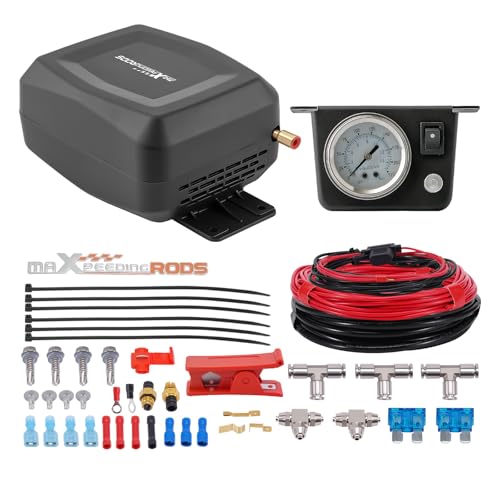
The maXpeedingrods system is designed for trucks and vans that carry heavy loads or tow trailers requiring additional ground clearance. It distributes air pressure evenly to air springs, reducing the need for manual adjustments. The unit provides a max air pressure of 100 psi and is praised for quick in-cab bag inflation, typically within a minute or two. This model is best for buyers who want a single-path, no-tank solution with simple operation via a gauge button and simultaneous filling of both bags. A potential limitation is its 100 psi ceiling, which may be lower than some high-demand applications.
Air Lift WirelessOne 2nd Generation + EZ Mount

This kit combines a compact, wireless handheld controller with a Bluetooth-enabled manifold and a 2nd-generation on-board compressor. It’s ideal for buyers who value wireless operation, digital preset memory, and faster installation. The included app linkages simplify monitoring and tuning, and programmable presets enable quick ride adjustments without fiddling with gauges. A caveat is the need for battery power and a proper mounting location to ensure reliable wireless connectivity in varied vehicle layouts.
CNRAQR 150 PSI Air Compressor Kit

CNRAQR offers a 150 psi working pressure with support for intermittent up to 250 psi, making it well-suited for heavy-duty inflation needs on trucks, trailers, and air suspension systems. The included 1.6-gallon aluminum air tank increases durability and longevity under demanding use. This kit is best for buyers seeking higher pressure performance and a compact aluminum tank, though the higher PSI range may require more careful monitoring to prevent over-inflation.
VIAIR 88P – 00088 Portable Compressor Kit

VIAIR’s 88P is a compact, portable 12V compressor designed for off-road and on-the-go inflation needs. It features a rugged motor, a built-in gauge, and a carry case with multiple inflation tips, making it versatile for tires, bikes, and gear. It’s best for buyers who want a portable solution that can be used across vehicles and gear. A limitation is that it lacks a built-in storage system for all accessories when not in use, requiring thoughtful organization in the vehicle.
RETRUE Onboard Air Compressor System
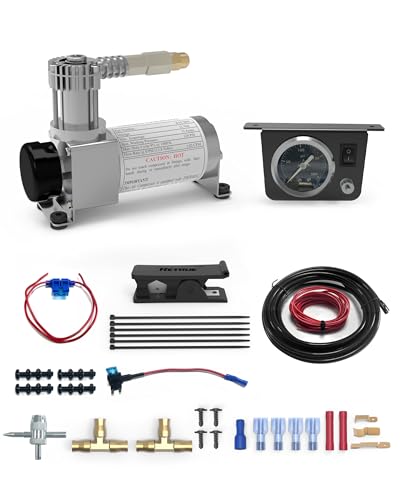
RETRUE emphasizes in-cab control and fast inflation, reaching up to 100 psi with a design focused on quick, safe operation. The system supports real-time pressure control for smoother suspension tuning. It’s well suited for buyers who want straightforward, seat-adjustable inflation without manual pumping. A potential drawback could be the limit of 100 psi for some high-demand heavy-duty applications, where higher pressures may be required.
Enocos CKMA12 12V On-Board High Performance

Note: This option is listed among similar products for reference. It features a 12V single-motor design, corrosion-resistant components, and a compact form factor. It’s best for buyers seeking a reliable aftermarket option with stable gauge performance. Some may prefer more integrated compressor kits with tanks, depending on vehicle space and mounting constraints.
Buying Guide
Key considerations for choosing an on-board air compressor kit
- Pressure requirements: Determine the maximum psi you need for tires, bags, or air suspension. If you regularly inflate large truck tires, prioritize kits rated for higher psi and reliable cycling.
- Tank vs. tankless: Consider whether you want a built-in air tank (more air storage) or a tankless, compact unit for simpler mounting and fewer components.
- Control method: In-cab gauges and wireless remotes can simplify operation. Apps and presets add convenience for quick ride height adjustments on long trips.
- Installation and space: Examine mounting options (vertical vs. horizontal) and whether the kit includes all necessary fittings, hoses, and mounting hardware for your vehicle.
- Durability and materials: Look for aluminum tanks or corrosion-resistant components for longevity in varying climates and road conditions.
- Power requirements: Ensure your vehicle electrical system can support the compressor’s amperage and fuse needs without draining essential systems.
- Safety features: Over-pressure protection and automatic shutoff help prevent damage to airbags and tires during inflation.
Comparison tips
- Best for ease of use: Choose kits with in-cab controls or wireless remotes and simple preset configurations.
- Better for high-demand use: Pick models offering higher PSI capacity and durable tanks for frequent heavy inflation.
- Choose this if space is limited: Favor compact, tankless units with flexible mounting options.
- Avoid this if: You need integrated app ecosystems without a separate controller or a remote-based workflow; ensure compatibility with your vehicle’s electrical system.
Frequently Asked Questions
- What is the typical PSI range for on-board air compressors?
Most on-board compressors operate from around 100 to 150 psi for tires and air bags, with some models supporting higher intermittent pressures.
- Do I need an air tank with an on-board compressor?
Not always. Tankless systems are simpler and lighter, while tanks store extra air for faster inflation and stability under load.
- Can I install an on-board compressor myself?
Many kits are designed for DIY installation, but some configurations may require professional help, especially when integrating with air springs or factory wiring.
- Is wireless control reliable for off-road use?
Wireless systems offer convenience and equal performance when properly installed, though metal interference or battery limitations can affect range.
- What maintenance is required for these systems?
Regular checks of fittings, hoses, electrical connections, and gauge accuracy help ensure consistent performance and safety.