Answering the buyer’s search for reliable nickel alloy welding rods, this guide highlights five top options ideal for cast iron repairs, joining cast iron to steel, and maintenance welds. These rods vary by nickel content, alloy type (pure nickel vs. nickel-iron), and use case. Best for professionals working with gray or ductile iron, or fabricators needing stable in-service performance, these selections balance machinability, current-carrying capacity, and resistance to solidification cracking. The quick-reference table below helps compare core traits at a glance.
| Product | ||||
|---|---|---|---|---|
| ENi-CI 99% Nickel Cast Welding Electrode Rods | Pure Nickel | 3/32″ x 12″ | Soft, highly machinable weld metal; good for cast irons | Grey and ductile iron repairs |
| ENiFe-CI 55% Nickel Cast Iron Welding Rods | Nickel-Iron (55% Ni) | 3/32″ x 12″ | Stronger weld metal; better current-carrying capacity | Cast iron joints to steel; reduced cracking risk |
| ENi-CI 15pcs 99% Nickel Cast Welding Electrodes | Pure Nickel | 3/32″ x 12″ | Very soft deposition; easy machining | Industrial and maintenance use on cast iron |
| ENiFe-CI Nickel-Iron 15 Pcs | Nickel-Iron (ENiFe-CI) | 3/32″ x 12″ | Stable performance; strong welds; good cracking resistance | Cast iron and cast iron-to-steel joints |
| ENiFe-CI Nickel-Iron 10 Pcs 1/8″ x 14″ | Nickel-Iron (ENiFe-CI) | 1/8″ x 14″ | Higher strength and crack resistance; broader heat tolerance | Higher-demand cast iron repair and heavy joints |
ENi-CI 99-Percent Nickel Cast Welding Electrode Rods 6pcs

Material: ENi-CI electrodes are 12″ long with a 3/32″ diameter package of six. They conform to AWS A5.15 ENi-CI and EN ISO 1071 standards, with GB/T10044 EZNi-1 certification. Advantage: deposits soft, highly machinable nickel weld metal suitable for normal cast iron grades. Deposition is practical on cold or slightly preheated material.
Best for: shops performing routine gray or ductile iron repairs where machinability matters. Limitations: pure nickel deposits can be softer; avoid high-temperature applications that require very hard welds.
ENiFe-CI 7pcs 55% Nickel Cast Iron Rods

Material: 12″ long, 3/32″ diameter, seven pieces. ENiFe-CI meets AWS A5.15 and EN ISO 1071 with GB/T10044 EZNiFe-1. Advantage: nickel-iron composition offers good current-carrying capacity and stronger welds with higher resistance to solidification cracking than standard nickel electrodes. Best for cast iron joints to steel.
Best for: bridging iron-to-steel joints with a focus on reducing cracking. Limitations: higher nickel content can influence deposition characteristics; adjust amperage accordingly.
ENi-CI 15pcs 99-Percent Nickel Rods
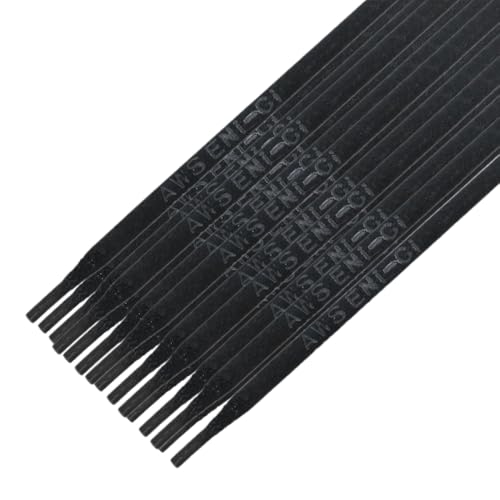
Material: 12″ length, 3/32″ diameter with fifteen rods. Meets AWS A5.15 and EN ISO 1071 standards, GB/T10044 EZNi-1. Advantage: pure nickel weld metal offers excellent softness and machinability, suitable for precise, maintenance-friendly repairs on gray and ductile iron. Ready for industrial use.
Best for: projects prioritizing easy machining and workable deposits on cast iron. Limitations: not ideal where very hard or highly crack-resistant welds are required.
ENiFe-CI Nickel-Iron 15 Pcs

Material: 12″ length, 3/32″ diameter, fifteen pieces. ENiFe-CI electrodes conform to AWS A5.15 and EN ISO 1071, GB/T10044 EZNiFe-1. Advantage: stronger welds, higher current-carrying capacity, and better resistance to solidification cracking than pure nickel electrodes. Suitable for cast iron and steel joints.
Best for: structural repairs where both iron content and steel compatibility matter. Limitations: nickel-iron compositions may require different heat control compared to pure nickel.
ENiFe-CI Nickel-Iron 10 Pcs 1/8″ x 14″

Material: 1/8″ diameter × 14″ length, ten pieces. Fully complies with AWS A5.15 (ENiFe-CI) and EN ISO 1071 (ECNiFe-CI 1 3), GB/T 10044 EZNiFe-1. Advantage: higher strength and crack resistance, suitable for demanding cast iron repairs and iron-to-steel joints.
Best for: heavy-duty cast iron work or joining cast iron to steel with enhanced crack resistance. Limitations: larger diameter may require careful arc control for thin sections.
Buying Guide: Nickel Alloy Welding Rods
What should you consider when choosing?
- Nickel content and alloy type: Pure nickel (high ductility and machinability) vs. nickel-iron blends (improved strength and cracking resistance).
- Cast iron compatibility: Gray vs. ductile iron; some rods excel at fixing cracks and joining to steel.
- Rod size: Length and diameter affect heat input and deposition rate. Thicker rods require more amperage and can alter penetration.
- Standards compliance: Look for AWS A5.15 and EN ISO 1071 certifications for consistent performance.
- Deposition and machinability: Softer nickel welds are easier to machine but may require heat control to prevent warping.
How to use nickel alloy rods effectively?
- Preheat and interpass care: Some cast iron repairs benefit from low to moderate preheating to reduce thermal shock.
- Current settings: Nickel-iron rods often handle higher current; follow manufacturer guidance to avoid excessive spatter or undercut.
- Joint preparation: Clean surfaces thoroughly; remove scale, oil, and contaminants for consistent fusion.
Common questions and practical answers
- Q: Which rod is best for repairing gray iron? A: ENi-CI and ENiFe-CI rods perform well on gray iron due to good deposition and cracking resistance.
- Q: Can nickel-iron rods be used to join iron to steel? A: Yes, ENiFe-CI types are designed for iron-to-steel joints with better strength than pure nickel in some cases.
- Q: Do I need preheating for all nickel rods? A: Not always, but low to moderate preheating can help prevent cracking on thicker sections.
- Q: Are these rods suitable for production welding? A: They are commonly used for maintenance and repair; verify process compatibility for high-volume fabrication.
- Q: How important are standards like AWS A5.15? A: Standards ensure consistent chemistry and mechanical behavior across batches.
For buyers focusing on cast iron repair, the five selected products offer a mix of pure nickel and nickel-iron options. The best choice depends on joint type, heat management, and whether cracking resistance or machinability is the priority. The table at the top helps with side-by-side comparison to expedite decision-making.