Looking for reliable magnetic flow meter manufacturers to fit industrial or process-control needs? This guide highlights top options, explains who each product best serves, and compares key features to help you choose confidently. Ideal buyers include process engineers, water treatment operators, and facility managers who require accurate, versatile flow measurement with multiple output options.
The following table summarizes five strong magnetic flow meters from recognized brands. Use it as a quick reference to compare output types, measurement range, and typical applications.
| Product | Brand | Measuring Range | Outputs | Best For |
|---|---|---|---|---|
| CHBMSS FlowMeter Electromagnetic Flowmeter | CHBMSS | DN100-500 (insertion) | 4-20mA, RS485, frequency | Industrial processes needing flexible integration |
| IFM Efector SM7000 | IFM Efector | 0.2 to 50 l/min | Binary and pulse outputs; analog or binary | Compact setups with multi-signal monitoring |
| TQKEBWGW Split Flow Meter | TQKEBWGW | DN50 | Flowmeter display | Remote display for basic flow indication |
| IFM Efector SM7004 | IFM Efector | 0.2 to 50 l/min | Analog flow and temperature signals | Applications needing combined flow and temp data |
| HUALUCK Plug-in Flow Meter | HUALUCK | DN100-500 | 4-20mA, RS485 | Interference-resistant measurement |
CHBMSS FlowMeter Electromagnetic Flowmeter

The CHBMSS electromagnetic flowmeter is designed for precise liquid measurement with an accuracy of ±0.5%. It offers three output signals: 4-20mA, frequency, and RS485, enabling flexible integration with various SCADA and control systems. This model is best for industrial users who require reliable data and adaptable signal compatibility. A potential limitation is the insertion design, which may require system modifications for full insertion integration in some pipelines.
IFM Efector SM7000 Magnetic-Inductive Flow Meter

The IFM Efector SM7000 offers a compact solution for measuring flow in low to moderate ranges (0.2 to 50 l/min) with a flat-seal connection and multiple outputs including binary and pulse signals for flow monitoring. Its strength lies in flexible outputs and straightforward integration with existing process controls. Best for small to mid-scale systems needing both flow rate and simple monitoring, with the caveat that extended analog options may require additional hardware for full sensing capabilities.
TQKEBWGW Split Magnetic Flow Meter Remote Display

The TQKEBWGW Split Flow Meter focuses on a DN50 footprint with a remote display option, making it suitable for plants needing visible flow readouts away from the main control panel. This choice is best for basic monitoring in compact lines. A limitation is the narrow DN range, which may not fit larger piping without upgrading to a different model.
HUALUCK Plug-in Magnetic Flow Meter

The HUALUCK plug-in magnetic flow meter supports DN100 to DN500 with 4-20mA and RS485 outputs, emphasizing signal stability with electrode design and digital processing. It is best for challenging environments where signal interference could affect measurements. Consider potential installation complexity due to plug-in integration in existing systems.
TQKEBWGW Stainless Steel Flow Meter
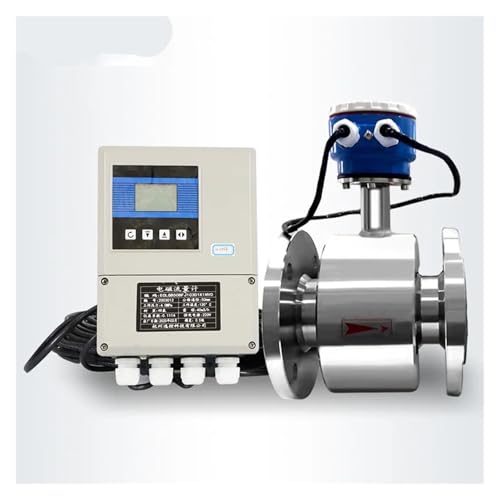
This stainless steel variant from TQKEBWGW offers durability with a DN32 (SS304) footprint, suitable for corrosive or high-purity flows. It is a solid choice for environments requiring stainless construction and robust protection against external factors. Best for lightweight industrial lines where cost is a consideration and corrosion resistance is essential.
WKFTKPAND Electromagnetic Flow Meter

The WKFTKPAND flow meter is characterized by a portable, compact design and easy installation, making it ideal for temporary measurements or field testing. This model is best for technicians who need a quick install with minimal equipment, yet it may be less suited for long-term, high-flow applications due to its small form factor.
Buying Guide: How To Choose A Magnetic Flow Meter
- Measuring Range And Pipe Size: Match the meter’s DN or insertion length to your pipe size and flow rates. Larger processes may require insertion or inline meters with higher DP accuracy.
- Output Options: Consider your control system. If you use SCADA, RS485 or modbus communications are often essential, while 4-20mA is widely compatible with analog interfaces.
- Material And Construction: For corrosive fluids or steam lines, stainless steel bodies and protective coatings enhance longevity and reduce maintenance.
- Electrical And Environmental Conditions: Check for temperature ranges (-20 to 80 C is common) and exposure to moisture or chemicals. Some models include grounding electrodes to improve stability.
- Installation Type: Inline versus insertion configurations have different installation requirements. Insertion models can minimize line downtime but may require pipeline access.
- Signal Stability And Interference: Electrode design, grounding, and digital processing impact accuracy in noisy environments. Look for SMT-welded components and protective finishes in data sheets.
- Future Upgrades: Choose meters with flexible outputs and scalable firmware to accommodate process changes without hardware swaps.
FAQ
- What is a magnetic flow meter best used for? Magnetic flow meters measure conductive liquids by detecting magnetic fields. They are common in water/wastewater, chemical, and food processing where accurate volumetric flow is required.
- Do magnetic flow meters require straight pipe runs? Inline meters may require straight runs upstream and downstream to minimize flow disturbances, depending on model and installation.
- Can magnetic flow meters measure non-conductive fluids? No, these meters rely on electromagnetic induction and require conductive liquids to generate a signal.
- What is the advantage of RS485 output? RS485 enables long-distance, multi-point communication with robust noise immunity for industrial networks.
- Are there maintenance concerns? Routine checks of electrodes, seals, and wiring help maintain accuracy. Some models offer self-diagnostic features for easier maintenance.
- How do I choose between an insertion vs inline meter? Insertion meters are useful for retrofits and large pipes with minimal downtime; inline meters provide full integration and typically require more upfront installation planning.