Answering your search for an industrial-grade CNC router table, these five machines stand out for heavy-duty aluminum, acrylic, wood, and multi-material work. Each is suitable for shop setups, prototyping, or small-batch production. The buyer types below indicate who benefits most from each pick.
Summary of chosen products:
| Product | Best For | Key Strength |
|---|---|---|
| Genmitsu 3030-PROVer Ultra CNC Router Machine | Pros and hobbyists moving to metal work | Powerful 710W spindle, ±0.03 mm precision |
| Genmitsu PROVerXL 4030S | Desktop shop with higher clearance and speed | 130 mm Z-height, 710W spindle, upgraded rails |
| Twotrees TTC450 Pro | Expanding to four-axis upgrades | Capacitive touchscreen, 4th-axis expansion, 0.0025 mm Z accuracy |
| Genmitsu 4040-PRO | Larger working area with metal frame | Steel HSS frame, dual X/Y rails |
| FoxAlien XE-Ultra 8080 | Large-format, high rigidity | 33″ workspace, closed-loop motors for precision |
Genmitsu 3030-PROVer Ultra CNC Router
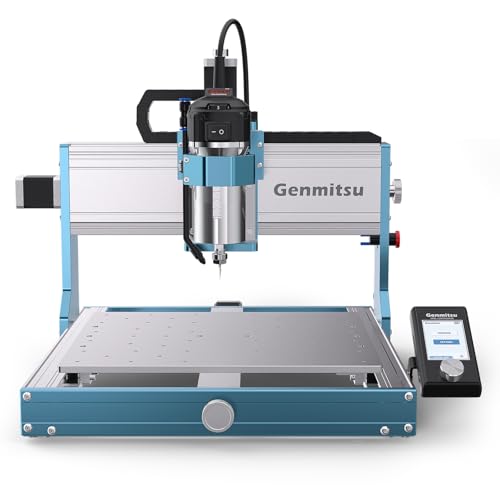
The Genmitsu 3030-PROVer Ultra is built around a 710W digital spindle, delivering substantial cutting force for aluminum and acrylic. This model emphasizes thermal and power reliability with a real-time display to prevent overheating and power loss. It uses thick all-metal construction and high-torque motors to minimize wobble, supporting precise engraving with a claimed ±0.03 mm accuracy. Industrial-grade rails and 1204 ball screws on each axis provide rigid, repeatable performance in demanding setups. Best for enthusiasts upgrading to metal work and professional hobbyists seeking robust results.
Best for: Professionals and advanced hobbyists who need solid metal cutting capability and tight tolerances. Limitations: The setup and maintenance are more involved than entry-level machines.
Genmitsu PROVerXL 4030S CNC Router
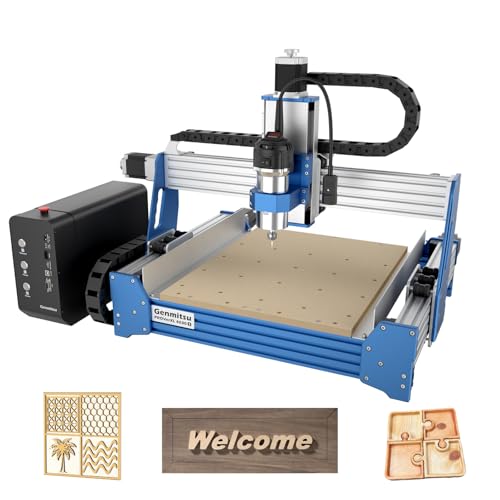
The PROVerXL 4030S is engineered for stability and precision, featuring an upgraded Z-axis linear guide and a heavy-duty frame. It achieves repeatable positioning accuracy around ±0.05 mm, offering results comparable to closed-loop systems in typical shop workflows. Its 710W spindle grants strong cutting performance on aluminum and acrylic, while a 130 mm pass height expands the range of compatible workpieces. Choose this if you want a desktop setup with bigger parts and better high-speed stability.
Best for: Shops that need higher clearance and stronger cutting on medium-to-large parts. Caution: Higher price and space requirements than smaller desktop models.
Twotrees TTC450 Pro All-Metal CNC Router

The TTC450 Pro brings a capacitive 3.5-inch touchscreen for intuitive control and supports upgrades to a 4-axis setup via expansion ports. It features a large 460 x 460 x 80 mm work area, enabling handling of larger panels and multi-layer projects. The high-precision Z-axis, driven by a 57-step motor, can position with accuracy near 0.0025 mm for fine depth control. This model suits users who want open-source GRBL compatibility and room to grow with additional axes and laser options.
Best for: Users planning to grow into multi-axis engraving and combined CNC work. Limitation: The GRBL ecosystem requires a learning curve for advanced features.
Genmitsu CNC Router Machine 4040-PRO
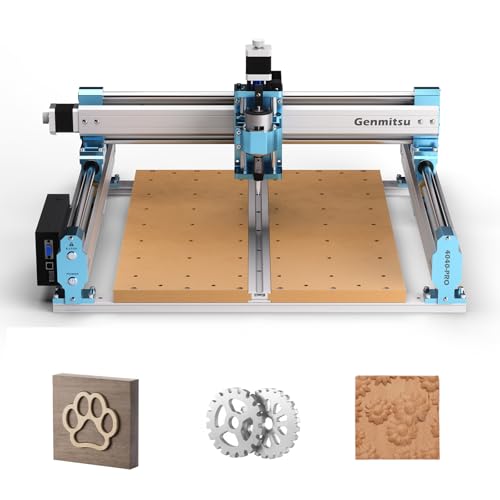
The 4040-PRO centers on stability and upgradeability. It uses a steel HSS frame, dual Y-axis rails, and all-metal construction for rigidity during heavy routing. The control box is upgraded with a dust-proof metal casing and a Toshiba TB6S109 driver, enhancing reliability and quiet operation. Compatible with 42 mm and 52 mm spindle mounts, it can accommodate various spindles to suit different materials. Best for: Projects requiring a larger working footprint and durable frame for continued use in a workshop. Caution: Watch for mounting compatibility when swapping spindles.
FoxAlien XE-Ultra 8080 CNC Router

The XE-Ultra 8080 offers a mega-scale workspace of 33″ x 33″ x 4.72″ with a strong 46×80 mm aluminum frame. It uses 16 mm XY ball screws and 12 mm Z ball screws with HG-15 linear rails for smooth, accurate motion. The machine is equipped with 2.6 N.m closed-loop stepper motors, delivering high torque with step-loss protection. It is best for large projects and production-like tasks that need robust rigidity and precise depth control at higher speeds. Limitation: Closed-loop motors require proper setup to avoid tuning issues for some users.
Buying Guide: Key Considerations For An Industrial CNC Router Table
- Work envelope vs. footprint: Balance the size of your largest part with your shop space. Larger tables mean more capability but require more room.
- Spindle power and materials: A 710W spindle handles aluminum and acrylic better than entry-level units, but confirm cutting depths and feed rates match your intended materials.
- Rigidity and rails: All-metal frames and dual linear rails reduce vibration and improve precision, especially at higher speeds or with tougher materials.
- Accuracy and repeatability: Look for specified axis tolerances (e.g., ±0.03 mm, ±0.05 mm). Higher precision benefits multi-pass engraving and fine detailing.
- Upgrade paths: Machines that support extra axes (4th axis, rotary) or laser modules offer growth without buying a new base machine.
- Software compatibility: Ensure the controller and firmware work with common CAD/CAM packages (e.g., Fusion 360, Easel, Carveco). Open-source options may require more setup.
- Maintenance and dust management: Dust-proof enclosures and easy access for servicing extend life and keep tolerances stable.
- Safety and control features: Emergency stop, safe wiring, and stable power delivery reduce risk during heavy machining.
Frequently Asked Questions
- What is the main difference between desktop and industrial CNC routers?
– Desktop models prioritize compact size and lower price, while industrial designs emphasize larger work areas, higher spindle power, and greater rigidity for demanding tasks. - Do I need a 4th axis for engraving?
– Not always. A 4th axis expands capabilities for complex rotary work, but many projects are doable with a solid 3-axis setup plus strategic workholding. - Is a closed-loop motor system necessary?
– Closed-loop motors offer improved torque consistency and reduced missed steps on large fast moves, but many users operate well with high-quality open-loop setups when tuned properly. - What materials can these machines typically cut?
– Aluminum, acrylic, wood, PVC, and some plastics. Heavier metals may require dedicated metalworking CNCs or additional cooling protections. - How important is spindle power?
– Spindle power correlates with cutting force and speed. For aluminum and acrylic, 710W is a common threshold in desktop-to-lab systems for practical cutting.