High shear mixer homogenizers are essential for rapid emulsification, dispersion, and homogenization across labs and small production settings. This guide highlights five dependable options, clarifying who each product suits best, and why one might be preferred over another. Ideal buyers include researchers, cosmetic formulators, food scientists, and small-scale manufacturers seeking efficient processing and clear operating data.
Below is a quick comparison of the selected products:
| Product | Best For | Key Benefit | Approx. Speed Range | Notes |
|---|---|---|---|---|
| INTBUYING 300W High Shear Emulsifier | Budget labs and entry-level projects | Compact, adjustable speed, clear digital readout | 2000-13000 rpm | 500 ml–20 L capacity |
| VEVOR 900 W High Speed Dispersing Homogenizer | Medium-volume cosmetic and food prep | Powerful motor, wide range, low noise | 2000-28000 rpm | 100–7000 ml capacity |
| VISOSCI High Speed Lab Homogenizer | Low–medium viscosity samples | Auto overload protection, high-speed control | 2000-20000 rpm | Best for liquids and semi-liquids |
| Consfly High Speed Homogenizer | Biological and chemical extraction tasks | Two working heads, versatile applications | Various speeds | Includes 13 mm and 18 mm heads |
| MXBAOHENG High Speed Homogenizer | Academic and research labs | Two heads, flexible speeds | 6000-22000 rpm | Solid for homogenizing tissues |
INTBUYING 300W High Shear Emulsifier

Features: A stainless steel working head with 2000-13000 rpm rotation, and a large capacity range from 500 ml to 20,000 ml. The unit emphasizes high efficiency and low noise, with a digital display for real-time data and a straightforward speed control interface. It is designed for fast processing, reducing cycle times and boosting productivity.
Best for: Small to mid-size labs needing a compact, fast emulsifier with an easy-to-read display. This model suits formulators who operate frequently with liquids on the order of half a liter to twenty liters.
Caution: The device’s capacity range is broad; ensure your container size is compatible with the 500 ml minimum to avoid underutilization.
VEVOR Homogenizer, 500 W

Features: A 500W motor drives a wide speed range of 200-11000 RPM and handles 500-4000 ml. It uses a stainless steel head for durability and is designed to process acidic and alkaline materials. An adjustable height clamp helps fit different container sizes while maintaining stability and reducing spill risk.
Best for: Laboratories and workshops needing a robust, mid-range homogenizer that balances speed, capacity, and stability. It works well for cosmetic and simple food formulations where viscosity stays moderate.
Better for: Users who value adjustable clamp height and a sturdy setup to minimize accidents during processing.
Caution: While capable, the 500 W model may require longer processing times for very viscous samples compared to higher-powered units.
VISOSCI High Speed Lab Homogenizer
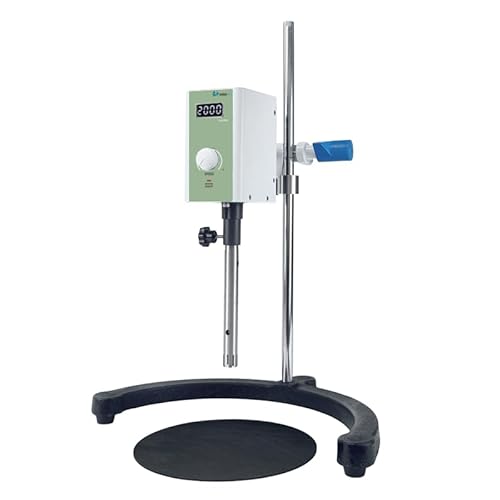
Features include an adjustable 2000–20000 rpm range and a 5000 mPa·s viscosity limit in its best operating window. It emphasizes auto overload protection, alerting users when viscosity or load is too high. The unit targets low to medium viscosity liquids like honey-like samples and similar consistencies.
Best for: Labs that primarily work with liquids or semi-liquids and need reliable automatic protection to prevent motor overload. It’s ideal for educational settings and routine emulsification tasks.
Limitations: Not suitable for thick pastes, gels, resins, or high-viscosity materials. Consider higher-viscosity models if you expect heavier loads.
Consfly High Speed Homogenizer
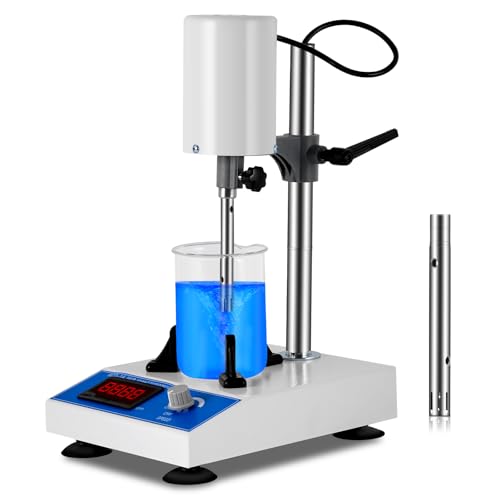
Features: Includes two extended working heads (13 mm and 18 mm) for flexible processing. The design supports homogenizing, emulsifying, and extracting trace compounds in liquids, particularly useful for separating components in complex mixtures. It is adaptable for various tissue and liquid-based applications.
Best for: Researchers needing two working heads to accommodate different sample types or volumes, especially in tissue homogenization or lipid-solvent extraction workflows.
Limitation: The dual-head design can add setup time; ensure you select the appropriate head for your sample to avoid inefficiency.
MXBAOHENG High Speed Homogenizer

Features: A versatile high-speed disrupter designed for efficient homogenization between two immiscible liquids and extraction of organic solvents. It supports tissue homogenization across various animal and plant samples and helps rupture cell membranes to release DNA and other components. The unit supports multiple speeds and two heads for flexible operation.
Best for: Academic and research labs focusing on biochemical extraction, DNA disruption, and multi-material emulsification where speed tuning matters. It’s a solid option for life sciences workflows requiring precise disruption at varied speeds.
Limitation: The description emphasizes tissue processing, which may be more than what some cosmetic or simple food applications require. Verify compatibility with your specific sample type.
Buying Guide
What should I look for in a high shear mixer homogenizer?
- Power and speed range: Higher wattage and a broad RPM range enable faster emulsification and handling of different viscosities.
- Processing capacity: Match the container size and batch volume to avoid underutilization or overflow.
- Head design and materials: Stainless steel heads are durable; consider models with multiple or replaceable heads for versatility.
- Clamp height and stability: An adjustable clamp and sturdy base reduce spills and improve repeatability.
- Protection features: Auto overload protection helps prevent damage when processing challenging samples.
Which model is best for different use cases?
- Best overall value for small labs with frequent emulsions: INTBUYING 300W provides clear readout and solid speed control.
- Best for higher throughput and larger volumes: VEVOR 900 W delivers higher RPMs and a larger processing range.
- Best for low to medium viscosity samples and educational settings: VISOSCI offers automatic protection and a controlled range.
- Best for tissue and biochemical extraction work: Consfly’s dual-head design adds versatility for complex samples.
- Best for academic or research labs focusing on rapid disruption: MXBAOHENG combines two heads with a wide speed range for diverse experiments.
What are common limitations to expect?
- Very high-viscosity materials may require more powerful units or specialized heads.
- Two-head configurations add setup steps and may require careful head selection for optimal results.
- Some models are optimized for liquids; thick pastes, resins, or gels may not emulsify efficiently.
Practical tips for use
- Always verify container compatibility before operation to prevent spills.
- Use the digital display to monitor speed and time for consistent batches.
- Periodically inspect and clean interchangeable heads to maintain performance and avoid cross-contamination.
FAQ
- What is high shear homogenization used for? It rapidly emulsifies and disperses mixtures, creating uniform emulsions and fine particle distributions.
- Can these units handle acidic and alkaline materials? Yes, several models use stainless steel heads designed for a range of chemical conditions.
- Is auto overload protection common? Yes, several models include this feature to protect the motor when processing heavy loads.
- What sample types are best? Low-to-medium viscosity liquids or semi-liquids are ideal for most of these units; very thick pastes may require higher-end equipment.
- Do I need two heads? Two-head configurations offer flexibility for different sample types and speeds, but many users can perform most tasks with a single head.
- Are these units suitable for lab-scale production? Yes, chosen models are designed for lab and small-scale production, balancing speed, capacity, and stability.