Looking for a heavy duty pallet jack to move large loads efficiently in a warehouse, factory, or retail setting? This guide highlights five top, user-friendly manual pallet trucks designed for high-capacity tasks. Each option targets different needs—from high-capacity lifts and smooth maneuverability to narrow aisles and durable construction. The buyers most likely to benefit are warehouse managers seeking reliability, maintenance crews needing steady lifting power, and supervisors aiming to optimize pallet handling in tight spaces. Below is a quick comparison to help you choose the right tool for your environment.
| Product | Forks | Capacity | Best For |
|---|---|---|---|
| Global Industrial High Capacity Pallet Jack (6600 lb) | 27″ W x 48″ L | 6600 lb | High-load environments; general warehouse use |
| NORTHSKY Standard Manual Pallet Jack (5500 lb) | 27″ W x 48″ L | 5500 lb | Tight aisles; versatile for warehouses and workshops |
| Global Industrial Industrial Duty Pallet Jack (5500 lb) | 27″ W x 48″ L | 5500 lb | Robust steel frame; factory or retail use |
| EZMHBRO Leak-Proof Pallet Jack (5500 lb) | 48″ L x 27″ W | 5500 lb | Stable lifting; suitable for warehouses and supermarkets |
| Tory Carrier Pallet Jack (5500 lb) | 21″ W x 48″ L | 5500 lb | Narrow aisles; heavy-duty performance |
Global Industrial High Capacity Pallet Jack

The Global Industrial High Capacity Pallet Jack is built for manual duty with a 3-stage lift cycle: raise, neutral, and lower. It features a safety loop handle with fingertip control and a spring-loaded grip that returns upright, reducing the need to bend. Mobility is enhanced by 3″ polyurethane load wheels and 7″ polyurethane steer wheels, offering a wide steering arc for smoother operation. This model is best for warehouses or manufacturing floors requiring high lift and dependable handling of heavy pallets. A potential limitation is that manual operation can be more demanding on long shifts compared to powered options.
NORTHSKY Standard Manual Pallet Jack
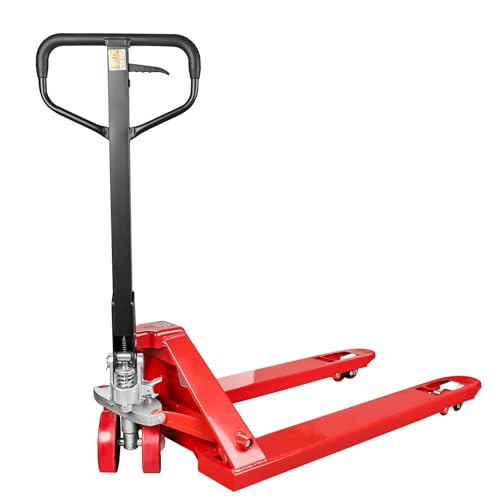
NORTHSKY’s Standard Manual Pallet Jack offers a narrow 48″ x 27″ fork size and a 5,500 lb capacity, ideal for pallets in tight aisles and confined spaces. Its ergonomic 3-position loop handle—Lower, Neutral, Lift—provides fingertip control to minimize operator fatigue. An integrated hydraulic system includes an overload relief valve to prevent overpressurization, helping extend the jack’s service life. Best for operators who need precise control in tight environments; be mindful that extreme loads may require extra space to turn safely.
Global Industrial Industrial Duty Pallet Jack
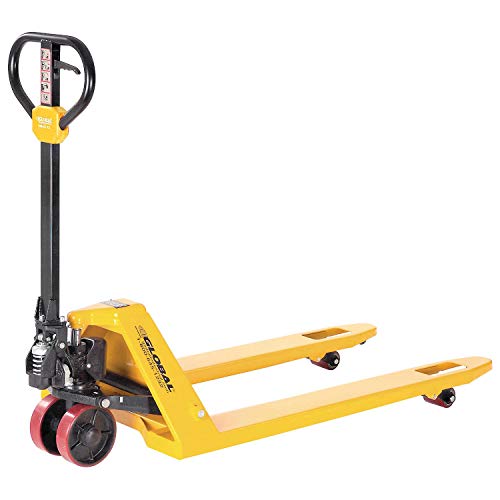
This Global Industrial model emphasizes a reinforced steel frame and a German-engineered pump, enabling up to 5,500 lb lifting. It uses standard manual controls and smooth wheels for easy maneuverability across factory floors and retail facilities. It suits environments where sturdy construction and reliable lifting are essential. A limitation to consider is that, like other manual jacks in this capacity range, productivity depends on operator effort and technique.
EZMHBRO Leak-Proof Pallet Jack

EZMHBRO’s Leak-Proof Pallet Jack handles 5,500 lbs with 48″ x 27″ forks and a 7.1-inch lift height for stable, tool-free operation. It uses dual 7″ wheels to deliver a 180-degree turning radius, improving maneuverability in aisles and tight spaces. Best for busy warehouses and supermarkets where sudden shifts or drops must be avoided. A caveat is that this jack’s size may require adequate aisle width, especially in compact facilities.
Tory Carrier Pallet Jack Truck

The Tory Carrier pallet jack offers a 5,500 lb capacity with 21″ wide x 48″ long forks and a maximum lift of 7.3 inches. Its tapered fork ends and integrated lead rollers simplify pallet entry, while the hand-controlled hydraulic pump provides adjustable lowering speed. This model is best for warehouses with narrow spaces and frequent pallet entry challenges. A limitation is that its narrower fork width may not suit all pallet configurations—check pallet dimensions before purchase.
Buying Guide
What capacity do I need? For most standard heavy-duty tasks, 5,500 lb is a common and practical rating. If you handle unusually heavy loads or bulkier pallets, a higher-capacity model (like 6,000+ lb) may be warranted, but ensure the rest of the system (forks, wheels, hydraulic pump) supports the load safely.
Which fork size is right? Forks sized at 48″ x 27″ are common for standard pallets. Narrower forks (e.g., 21″ width) help in tight aisles but may limit pallet compatibility. Consider your typical pallet dimensions when selecting forks.
Wheel type and turning radius matter. Polyurethane wheels provide smooth rolling and durability on concrete floors. A larger steer wheel improves steering in open spaces; dual wheels with a wide turning radius help in tight aisles for precise placement.
Ergonomics and safety features. Look for a loop-style handle with multiple lift positions to reduce operator fatigue. An overload relief valve protects the hydraulic system from excessive pressure, extending tool life. A spring-loaded handle that returns upright can reduce bending and improve safety during use.
Maintenance considerations. Manual pallet jacks generally require regular lubrication of the hydraulic pump, inspection of forks for cracks or bending, and checking wheels for wear. A robust frame and high-quality pump contribute to longer service life in demanding environments.
FAQ
- What does a 5500 lb pallet jack mean? It indicates the maximum effective load the jack can lift and transport safely under standard conditions.
- Are narrow fork jacks better for small aisles? Yes, narrower forks fit tighter spaces, but ensure they still accommodate your pallets.
- Do manual pallet jacks require maintenance? Yes, regular lubrication, wheel inspection, and fork integrity checks help prevent failures.
- Is a higher lift height useful? It helps when stacking or clearing pallets at higher levels, but often adds complexity and cost.
- Can I use these jacks on uneven floors? They work best on flat, clean concrete; uneven surfaces can affect stability and wheel wear.
- Which feature improves safety? An overload relief valve and a safety loop handle with multiple lift positions are key safety features.