Find reliable dual-rod pneumatic cylinders designed for stable, non-rotating linear motion. This guide highlights five models suited for automation, pick-and-place, and precise actuation. Best for compact spaces, heavy-duty cycles, or where minimal rotation is essential. Read on to compare bore sizes, strokes, and dual-rod benefits to choose the right unit for your setup.
Action
| Product | Bore / Stroke | Best For | |
|---|---|---|---|
| HNJPC TN25-25 | 1″ bore, 1″ stroke | Double Action | Compact, light-duty cycles with precise alignment |
| VIILOCK TN32x50 | 32mm bore, 50mm stroke | Double Action | Medium length strokes, stronger output |
| Baomain CXSM25x200 | 25mm bore, 200mm stroke | Double Acting | Long travel in compact body, industrial automation |
| HNJPC TN25-50 | 1″ bore, 2″ stroke | Double Action | Longer throw within same footprint |
| TAILONZ TN20-100 | 20mm bore, 100mm stroke | Double Acting | Budget-friendly with good reach |
Notes: Each model features dual rods to improve guidance and reduce piston wobble. All data reflects listed specifications. For applications requiring precise alignment, consider models with longer strokes and compatible mounting options. This table is intended to help you compare core specs quickly.
HNJPC TN25-25 Dual Axis Cylinder
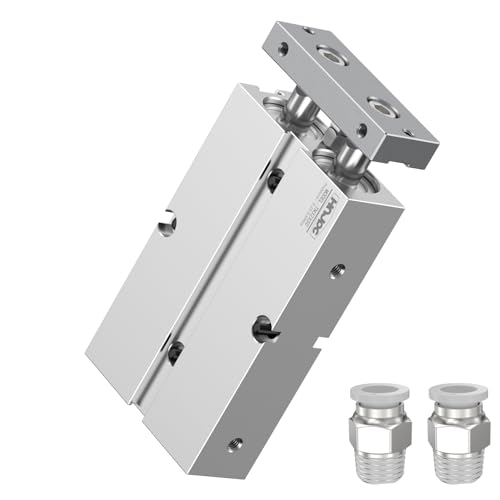
Features: PT1/8 air inlet/outlet, 1″ bore, 1″ stroke, operating temp −5 to 60°C, pressure 14.5–145 PSI. Dual-rod design reduces rotation and improves stability in short-throw applications. Best for compact automation tasks where space is limited and precise linear motion is needed.
Best for: small-scale pick-and-place or fixture actuation in constrained spaces. Choose this if you need a lightweight dual-rod cylinder with predictable stroke in a compact package. Caution: smaller stroke may limit reach in some setups.
VIILOCK TN32x50 Pneumatic Cylinder

Features: 32mm bore, 50mm stroke, aluminum body, double action, double-rod design. PT porting similar to other models; suitable for slightly longer reach with sturdy guidance. Operating with standard pneumatic fittings, this unit balances stroke length with compact form.
Best for: automation tasks requiring more stroke while maintaining stable alignment. Better for medium-duty cycles compared with smaller bore units. Caution: larger bore means heavier actuation mass and may affect response time in very fast cycles.
Baomain CXSM25x200 Dual Rod Cylinder

Features: 25mm bore, 200mm stroke, dual piston rod, aluminum body, standard PT 1/8 ports. Dual-rod design reduces kinetic energy loss and minimizes swinging to provide consistent long-stroke linear motion. Best for automated lines needing extended reach without sacrificing stability.
Best for: longer travel in compact setups, such as assembly lines or conveyors. Choose this if you need a robust long-stroke option in a small footprint. Caution: longer stroke may require additional space for installation and clearance.
HNJPC TN25-50 Dual Axis Cylinder
Features: 1″ bore, 2″ stroke, PT1/8 ports, working pressure 14.5–145 PSI, operating range −5°C to 60°C. Dual-rod design supports stable, non-rotating motion over a longer throw. Best for tasks requiring a taller stroke within a compact cylinder body.
Best for: use cases needing a longer stroke without increasing bore size. Better for equipment requiring extended reach while preserving dual-rod guidance. Caution: taller profile may affect fit in tight enclosures.
TAILONZ TN20-100 Double-Rod Cylinder

Features: 20mm bore, 100mm stroke, PT1/8 port, 0–145 PSI working pressure. Dual-rod design improves guiding accuracy across a longer stroke. This unit offers a cost-effective option with good reach for light-to-medium duty automation.
Best for: budget-conscious projects needing a longer throw with reliable dual-rod guidance. Caution: smaller bore limits force and may not suit high-load applications.
Buying Guide: Key Considerations For Dual Rod Pneumatic Cylinders
- Bore size and stroke length — Match the bore for force needs and the stroke to travel distance. Longer strokes fit larger work areas; smaller bores favor compact systems.
- Dual-rod benefits — Dual-rod cylinders reduce rotation and improve linear alignment. Ideal for precision tasks and when preventing piston rod twist matters.
- Port size and mounting compatibility — PT1/8 ports are common. Verify mounting options (feet, flange, footers) to fit your machine frame.
- Operating environment — Check temperature and pressure ranges. Some models tolerate wider temps; others are suited for controlled settings.
- Material and construction — Aluminum bodies provide lightness and corrosion resistance; higher-grade slides reduce play and extend life in demanding cycles.
- Application fit — Consider whether you need long travel in a compact footprint or a compact unit with a quick cycle for rapid actuation.
- Maintenance and installation — Look for standard fittings and easy replacement rods or seals. Adequate space for service should be planned.
Frequently Asked Questions
- What is a dual-rod pneumatic cylinder?
Answer: A cylinder with two piston rods that provides improved guiding and reduced rotation, enhancing straight-line motion. - When should I choose a longer stroke?
Answer: Choose a longer stroke when the end-to-end movement must reach farther while staying within a compact bore. - Are dual-rod cylinders suitable for high-speed cycles?
Answer: They can be, but you should consider piston mass and system pressure which influence acceleration and response times. - What port size is common for these cylinders?
Answer: PT1/8 (1/8 inch NPT) ports are standard for many models, ensuring broad compatibility with fittings. - Can I mix brands in a single automation line?
Answer: Mixing brands is possible if the port sizes and mounting interfaces align, but check tolerances and mounting specs. - How do I verify durability for long-term use?
Answer: Review material quality, corrosion resistance, and the presence of precision guides or bearings that minimize wear.