Answering the search for a reliable desktop pick and place machine, this guide highlights five economical models suited for prototyping, education, LED prototyping, and small-batch PCB assembly. Each model is evaluated on accuracy, throughput, feeder options, and ease of use. The top picks are best for hobbyists, startups, makerspaces, and small shops seeking compact, desktop footprints with varying head configurations and feeder flexibility.
| Product | Best For | Key Benefit |
|---|---|---|
| MKPARTY Fully Automatic SMT Desktop Pick Place | Prototyping teams needing fast throughput | Triple vision, automatic head change, diverse feeder compatibility |
| SMT802A-S Automatic Low Price | Beginners and budget-friendly setups | Low-cost entry with desktop footprint |
| 2026 SMT802B-F Pick and Place | Compact production lines | Two heads, many feeders |
| Charmhigh CHMT36VA | Compact, precise SMD placement | Moderate feeder count, PC control |
| Charmhigh CHMT48VB | Higher density placements | Double-head, larger feeder capability |
MKPARTY Fully Automatic SMT Desktop Pick Place Machine
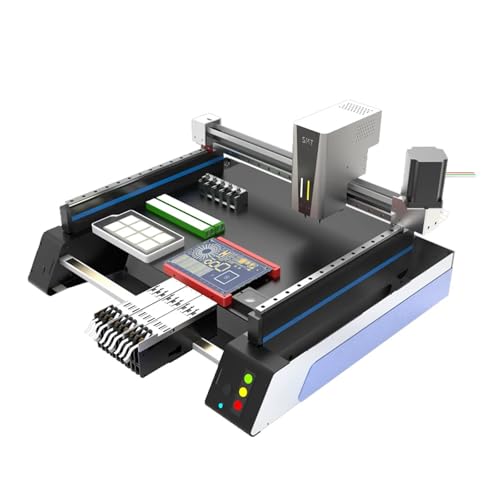
Best for: Prototyping teams and small-batch projects that require high throughput. The MKPARTY model features a triple vision camera system with dual bottom cameras for fast component capture and alignment, enabling precise placement of complex footprints. It supports marks and mark-free modes, aiding boards with varied solder pads, vias, and screen printing patterns. An advanced S-curve motion control delivers up to 3000 points per hour, making it suitable for rapid prototyping cycles. Automatic head replacement and multiple feeder options improve efficiency when mounting diverse components.
Why selected: This model combines fast, reliable alignment with flexible feeding and automatic head changes, which is helpful for teams handling varied parts in one run. The robust vision system helps minimize misplacements in small-batch production.
Caution: The system’s complexity may require a learning curve for setup and maintenance. Ensure feeder libraries and head configurations match your component mix before heavy use.
SMT802A-S Automatic Low Price Pick And Place

Best for: Budget-conscious buyers seeking a basic desktop option for LED and SMT prototyping. The SMT802A-S emphasizes a low price point while retaining essential desktop placement capabilities. This model is suitable for simple boards and small components, where budget matters more than ultra-fast throughput or extensive feeder libraries.
Why selected: It provides an entry path into automated assembly without overwhelming initial costs, making it attractive for classrooms, makerspaces, or early-stage startups.
Caution: Feeder capacity and head versatility may be limited compared to higher-end units, so assess your component range before committing to high-mix production.
2026 New SMT802B-F Pick And Place Machine

Best for: Small production lines needing two heads and 58 feeders across a compact footprint. The 2026 SMT802B-F expands capacity with dual heads and a larger feeder library, enabling moderate mixed SMT runs and LED assembly. It is well-suited for shops that must handle various small components efficiently.
Why selected: The two-head configuration improves placement cadence and can better balance throughput with component variety, reducing cycle times in mid-mix jobs.
Caution: More heads and feeders introduce setup complexity; plan for calibration and routine maintenance to sustain accuracy over longer runs.
Charmhigh CHMT36VA Desktop SMT Pick and Place

Best for: Users needing a compact, precise desktop machine with PC control. The CHMT36VA offers a straightforward setup and reliable SMD placement for small to mid-size boards. It is a practical choice for labs or classrooms focusing on education and hands-on prototyping.
Why selected: Its PC-controlled operation provides familiar workflows for engineers and students, making it easier to integrate into existing design and testing cycles.
Caution: Fewer feeders than larger models may limit high-mix production capability; verify your component range aligns with the available libraries.
Charmhigh CHMT48VB Desktop SMT Place Machine

Best for: Higher-density placements with a double-head configuration. The CHMT48VB targets users who need increased throughput and more footprint in a desktop form factor. It suits more complex boards or moderate-volume LED and PCB assembly.
Why selected: The double-head arrangement can significantly improve cycle times for multi-part boards and larger footprints while remaining compact for a desktop shop.
Caution: More heads and larger feeders require careful calibration and thorough automation planning to prevent placement errors in initial uses.
Buying Guide: Desktop Pick And Place Essentials
- Throughput vs. complexity: Higher throughput machines with multiple heads and many feeders can speed up production but add setup and maintenance complexity. Match throughput to your expected run length and component variety.
- Vision and alignment: Vision systems (including bottom cameras) improve placement accuracy, especially for irregular marks and fine-pitch parts. Prioritize models with robust alignment features for high-minimum-pitch components.
- Head and feeder configurations: Determine the range of components you plan to mount. If you work with a lot of small chips and mixed packages, choose a model with versatile heads and a broad feeder library.
- Footprint and workspace: Desktop units vary in height and width. Measure your workspace and consider clearance for feeders, stacks, and operator access.
- Ease of use and integration: PC control and intuitive software help reduce training time. Consider compatibility with your design workflow and any required file formats.
- Maintenance and support: Check for available spare parts, service options, and community or vendor support, especially for lower-cost models.
- Power and ventilation: Ensure your workspace meets power and cooling requirements, particularly for faster or more aggressively moving heads.
FAQ
- What is a desktop pick and place machine best used for? Prototyping, small-batch PCB assembly, LED prototyping, and educational environments where space and budget are considerations.
- Do these machines handle mixed-component boards? Yes, many models support multiple feeders and interchangeable heads to handle a range of components from resistors to small ICs, though exact limits vary by model.
- Is vision-based alignment essential for beginners? Vision systems improve accuracy, especially for irregular pads and fiducials, but entry-level machines may work for simple boards with careful setup.
- Can I expand feeders later? In many cases, yes. Check the model’s feeder library compatibility and available add-on kits before purchase.
- What maintenance is typical for these machines? Routine calibration, cleaning of nozzles and cameras, and occasional replacement of worn feeders or nozzles are common tasks.
- How do I choose between one or two heads? Two heads increase cadence and allow more complex jobs; one head keeps initial costs down and simplifies maintenance.