Need a reliable copper tube heat exchanger for a residential hot-water or forced-air system? This guide highlights five top options that balance copper performance with durable construction. Best for outdoor wood-fired setups, closed-loop hydronic systems, or hybrid solar-burner installs, these units emphasize high heat transfer, robust joints, and space-conscious designs. Each entry includes who it’s best for, key strengths, and a practical caveat to consider before you buy. Below is a quick summary to compare core specs and suitability.
| Product | Best For | Key Benefit | Limitations |
|---|---|---|---|
| AB 12×15 Water to Air | Outdoor wood furnaces | Great heat transfer with epoxy-coated fins | Heavier footprint |
| Outdoor Furnace Supply 8×8 | Compact installs | 1″ copper connections | Smaller heat capacity |
| GPOAS 12×15 | Versatile residential heating | Easy four-port installation | Floor space impact |
| Raypak Tube Bundle | Industrial-look upgrades | Solid tube bundle design | May require professional fit |
| VEVOR 18×20 | Balanced air-to-water | High heat transfer area | Complex setup for beginners |
Water to Air Heat Exchanger 12×15 With 1″ Copper Ports

Best for larger residential heating or cooling loads that rely on water-to-air transfer. This unit uses 12 aluminum fins and 3 rows of 3/8″ seamless copper tubes per inch. It is steel-shelled with base-brazed edges for strong performance under high pressure and temperature. Epoxy-coated fins extend service life and reduce wear. Best for homes with boilers or solar-assisted heating seeking energy efficiency and versatility.
Who it’s for: homeowners needing robust water-to-air performance for heating and cooling with renewable energy options. Why selected: high-fin density and seamless copper tubes maximize heat transfer; epoxy-coated fins improve durability. Caution: heavier and larger footprint may require ample plenum space and secure mounting.
8×8 Water to Air Heat Exchanger Hot Water Coil

Better for compact installations where space is a primary constraint. Features 1″ copper connections that simplify plenum integration. The product emphasizes practical, tool-free installation and a design aimed at reducing floor space impact. Best for small to mid-sized homes or retrofit projects where ducting is already in place and a straightforward coil path is preferred. Caution: modest size may limit peak heat output in very large homes.
12×15 Heat Exchanger Water To Air, 1″ Copper Ports
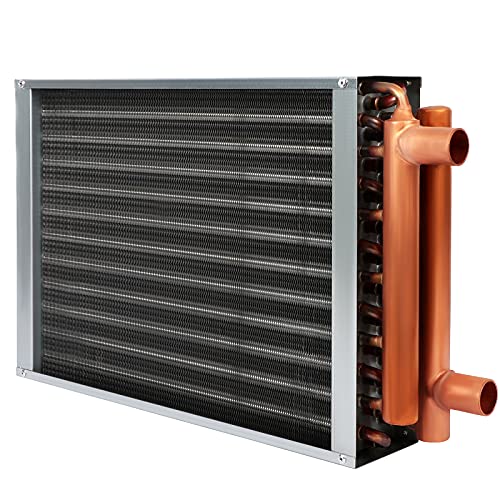
Selected for versatile residential heating setups that need strong performance with easy installation. The unit supports a 12-fin-per-inch configuration and 3 rows of 3/8″ copper tubes, with steel shell edges base brazed for durability. This makes it well-suited for homes using boilers or solar leaders in a hydronic-to-air transfer. Caution: unlike fully modular units, replacement parts may require matching the specific model’s fit compared to newer designs.
VEVOR Water to Air Heat Exchanger 24 x 24

Best for larger heat transfer surface needs, offering 24 x 24 inch area with 290 fins and 3 rows of 3/8″ copper tubes. The unit is copper-brazed at edges for leak resistance and uses epoxy-coated fins to resist scale buildup. Suitable for outdoor wood furnaces, hydronic heating, and cooling systems. Caution: larger footprint means more space and potentially more complex installation.
VEVOR Heat Exchanger, 18×20, Copper/Tubes

Chosen for a balance of transfer area and compact form. It features copper brazing at joints and epoxy-coated fins to resist corrosion and scale. Up to 160kBtu per hour with 12 fins per inch and 3/8″ copper tubes characterize its performance. Best for mid-sized homes or add-on heating/cooling projects where a reliable copper-based coil is desired. Caution: ensure compatible plenum dimensions before purchase.
Buying Guide
What to consider when selecting a copper tube heat exchanger:
- Heat transfer capacity: Match the unit’s BTU rating to your home’s heating or cooling load. Higher BTU means more capacity but may require more space.
- Port size and connections: Most listed units use 1″ copper ports. Verify plumbing compatibility and space inside the plenum or casing.
- Materials and durability: Copper tubes with aluminum fins offer strong heat transfer; epoxy-coated fins extend life in corrosive environments.
- Mounting and space: Larger 24×24 units deliver more surface area but demand more installation space and precise alignment with ductwork.
- Installation complexity: Some units are designed for quick install with fewer tools; others may need professional fitting, especially in forced-air systems.
- Operating environment: Look for wide operating temperature ranges if outdoor placement or solar integration is planned.
Frequently Asked Questions
- What is a copper tube heat exchanger best used for?
Designed for transferring heat between water and air, supporting boiler, solar, hydronic, and forced-air systems.
- Why choose epoxy-coated fins?
They improve wear resistance and reduce corrosion, extending service life in challenging environments.
- How do I determine the right size?
Estimate your heating or cooling load (BTU/h) and select a unit with capacity that meets or exceeds that value, while considering space constraints.
- Is professional installation recommended?
For complex plenum integrations or large units, professional installation ensures proper sealing and performance.
- Can I mix brands in a system?
It is possible but ensure compatible fittings, flow rates, and pressure ratings to avoid inefficiencies or leaks.
- Do these units require electricity?
Most are passive heat exchangers; some systems may rely on pumps or fans for circulation, depending on the setup.