Answering the need for accurate belt speed monitoring, this guide highlights five practical sensor options. These products suit industries ranging from small workshops to industrial facilities, including packaging lines, manufacturing cells, and laboratory setups. Buyers looking for precise magnetic, rotational, or digital outputs will find clear comparisons and concrete usage notes here.
Top picks focus on clear output types, reliability in challenging environments, and ease of integration with existing control systems. The following selections are ideal for buyers who require robust sensing, straightforward installation, and predictable performance under varying speeds and temperatures. Whether you need a ready-made motorized belt system or an add-on sensor for existing conveyors, these options offer solid starting points.
Summary at-a-glance: the five featured products cover Hall-effect analog/digital outputs, programmable belt conveyors with sensors, and rotation-detection switches. The table below briefly contrasts core strengths and best-use cases for quick reference.
| Product | Best For | Output Type | Key Benefit |
|---|---|---|---|
| 5pcs/1pc A1324LUA-T A1324LUA A1324 SIP-3 | Industrial precision benches, automation cells | Analog & Digital | High-precision Hall effect sensing |
| Moonshan Programmable Belt Conveyor 39 inch | Packaging lines, desktop setups | Digital/Programmable control | 32 running programs, stepless speed control |
| Rotation Detection Sensor Belt Conveyor XSAV11801 | Harsh environments needing robust digital output | Digital | High-temperature tolerance, reliable data |
| 1PCS 11801 12373 12801 11373 XSAV12801 | Compact belt monitoring | Proximity/Rotation | Versatile compatibility with standard sensors |
| VEVOR Belt Conveyor 59 x 7.8 inch | Industrial-grade conveyors | Speed adjustable, dual-rail | Wide speed range and robust frame |
5pcs/1pc A1324LUA-T Hall Effect Sensor

Overview: This low-noise linear Hall effect sensor offers high-precision magnetic sensing with both analog and digital outputs. It is suitable for applications requiring reliable field measurements and easy data processing in industrial and automotive contexts.
Best for: Industrial automation engineers and automotive systems integrators needing precise magnetic field readings with flexible output options. The analog output supports nuanced speed measurements, while the digital output is useful for simple on/off signaling in control loops.
Caution: Environmental contaminants and moisture are common in industrial settings; ensure proper sealing and wiring to maintain signal integrity.
Moonshan Programmable Belt Conveyor 39 Inch

Overview: A desktop belt conveyor with 32 programmable operating programs and stepless speed regulation. The PVC belt is water-resistant and wear-resistant, making it versatile for packaging, light assembly, and testing tasks.
Best for: Teams needing repeatable, programmable belt movements with easy speed adjustments in a compact footprint. It’s especially suitable for small-scale production lines or laboratory demonstrations.
Caution: This model emphasizes control software options; ensure compatible integration with your existing controller hardware.
PXPKMACTFG Rotation Detection Sensor XSAV11801

Overview: A belt conveyor speed measurement switch with a robust digital output designed for harsh environments. It targets reliable rotational sensing and data transmission to monitoring systems.
Best for: Industrial lines needing dependable digital feedback in high-temperature or demanding settings. It provides clear signals for belt speed monitoring and fault detection.
Caution: Designed for digital output; compatibility with analog measurement needs may be limited.
1PCS 11801 12373 12801 11373 XSAV11373

Overview: A rotation detection sensor offering compatibility with multiple standard part numbers for belt speed measurement. This sensor helps detect rotational movement critical for monitoring belt velocity and synchronization.
Best for: Projects that require a compact, adaptable rotation sensor that can slot into existing sensor arrays with minimal changes.
Caution: Ensure correct matching of part numbers for your conveyor system to avoid compatibility gaps.
VEVOR Belt Conveyor, 59 x 7.8 Inch
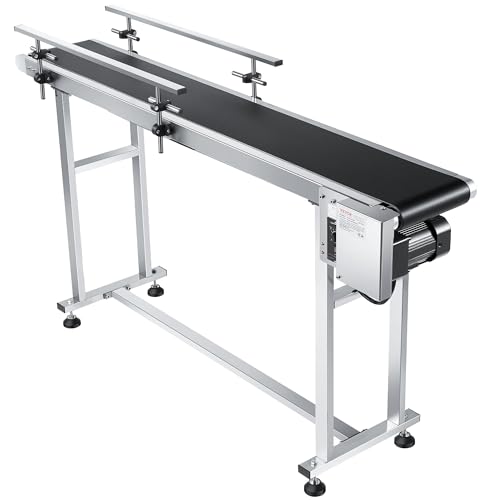
Overview: A stainless steel, industrial-grade belt conveyor with a PVC anti-static belt and adjustable speed. The design includes dual guardrails and adjustable belt tension for stable operation across tasks.
Best for: Facilities needing a durable, ready-to-run conveyor with a wide speed range and robust construction for continuous production or testing lines.
Caution: The system emphasizes belt-driven motion; verify belt replacement schedules and drive maintenance for long-term reliability.
Buying Guide
What sensor output should you prioritize?
- Analog output for nuanced speed data and integration with process controllers that read continuous signals.
- Digital output for straightforward on/off state signaling and simple PLC compatibility.
How do environmental conditions affect selection?
- Harsh or high-temperature settings favor sensors with robust housings, high-temperature tolerance, and digital outputs to minimize noise.
- Moisture, dust, or chemicals call for sealed enclosures and corrosion-resistant materials.
What belt and speed ranges matter?
- Consider the belt width, material, and maximum rotation per minute (RPM) supported by the unit.
- Verify compatibility with your existing drive system and mounting options.
How important is programmability?
- Programmable controllers offer flexibility for start/stop timing, direction changes, and cycling patterns, which can reduce downtime.
- Non-programmable options may be easier to deploy but offer fewer customization opportunities.
What installation considerations help reliability?
- Secure mounting, shielded wiring, and proper cable routing reduce vibration-induced errors.
- Regular calibration and maintenance checks ensure consistent performance over time.
FAQ
- What is a conveyor belt speed sensor used for?
- Can I mix analog and digital sensors on the same line?
- Are these sensors suitable for high-temperature belts?
- Do these sensors require calibration?
- What output should I choose for PLC systems?
- Is a heavy-duty sensor necessary for labs?
It detects belt movement or rotational speed to monitor throughput, control conveyors, and ensure system safety.
Yes, if your control system supports multiple input types, but ensure proper interfacing and signal conditioning.
Some are; check the product specifics for temperature tolerance and enclosure ratings to ensure suitability.
Calibration needs vary by model; follow manufacturer guidelines to maintain accuracy.
Digital outputs are often easiest to integrate with PLCs, while analog outputs are better for detailed speed profiling.
Not always; for controlled lab environments, a compact, accurate sensor with proper shielding can be sufficient.