For makers and production-focused buyers, a conveyor belt 3D printer enables continuous or large-format builds with less manual intervention. This guide highlights five top options, focusing on long or batch printing, auto-calibration, and durable belt systems. Best for prototyping teams, cosplay workshops, or education labs that need steady throughput and minimal setup between prints. The table below compares each model at a glance to help you choose quickly.
| Product | Best For | Key Benefit |
|---|---|---|
| IdeaFormer IR3 V2 Conveyor Belt 3D Printer | Production runs | Infinite Z-Axis with auto leveling |
| IdeaFormer IR3 Continuous Belt 3D Printer | Long models and high-volume prints | CoreXY with up to 400 mm/s |
| Smart Mini Desktop Conveyor Belt (LeTkingok) | Small projects and education | Stepless speed, forward/reverse |
| 3D Printer Belt 5 Meters (Fajoeda) | Spare belt and customization | PU with steel core |
| IdeaFormer-3D Metal PEI Textured Belt | IR3 V2 users needing replacement belt | PEI texture, durable belt |
IdeaFormer IR3 V2 Conveyor Belt 3D Printer
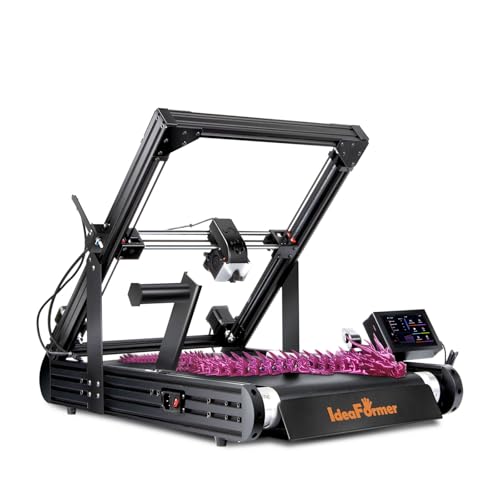
The IdeaFormer IR3 V2 combines a large, infinite Z-axis belt system with auto-leveling for streamlined production. Best for teams that require continuous or batch printing without manual bed calibration. The durable metal conveyor belt with PEI coating supports a wide filament range from PLA to ABS and PETG, delivering strong adhesion and reliable first layers. One-click auto calibration reduces setup time and worker intervention, making it ideal for prototyping and small-batch production. The main limitation is potential complexity for single hobbyists who do occasional prints and prefer simpler desktop devices.
- Large 250×250×∞ mm build area.
- Auto leveling with Y-offset strain sensor.
- Integrated continuous Z-axis belt for long prints.
IdeaFormer IR3 Continuous Belt 3D Printer

This model emphasizes uninterrupted long-model printing with an endless Z-axis and high-speed CoreXY mechanics. It is best for those needing flawless integrity in a single, continuous print or high-volume batch runs. The printer supports auto leveling with a high-sensitivity Y-offset sensor, eliminating the need for calibration cards. Users should be aware that higher speeds demand stable materials and precise bed alignment to maintain print quality over long spans.
- Endless 250×250×∞ mm Z-axis with continuous printing.
- Speeds up to 400 mm/s for fast production.
- Smart auto leveling reduces manual setup.
Smart Mini Desktop Conveyor Belt (LeTkingok)

Designed for DIY projects, education, and small packaging tasks, this compact conveyor belt blends aluminum frame with PLA-printed parts for a light yet sturdy setup. It features an industrial-grade belt with wear resistance and stepless speed control, plus forward/reverse rotation for flexible workflow. Best for classrooms, hobbyists, or small studios needing a hands-on, affordable belt printer option. A potential drawback is its smaller footprint, which limits larger print sizes.
- Aluminum and PLA-printed frame for light use.
- Wear-resistant belt with stepless speed control.
- Forward/reverse operation for varied tasks.
3D Printer Belt 5 Meters (Fajoeda)

This 5-meter GT2 open timing belt provides an affordable, flexible option for upgrading or stocking spare belt for Ender-series or similar printers. Its PU material with a steel core improves abrasion resistance and strength. Best for users who need a reliable replacement belt to support longer or batch runs. A limitation to note is that belt compatibility depends on the printer’s existing drive system and pulley alignment.
- PU material with steel core for durability.
- GT2 timing belt, 6 mm wide, 2 mm pitch.
- Five meters long for extended use or custom builds.
IdeaFormer-3D Metal PEI Textured Belt

This replacement belt is designed for the IR3 V2 conveyor belt 3D printer. The PEI-textured surface provides reliable adhesion for a range of filaments, including PLA, PETG, ABS, and TPU. Best for IR3 V2 owners seeking improved texture and durability. A limitation is that it is printer-specific, so compatibility is essential before purchase.
- Metal PEI textured belt for durable adhesion.
- Width 300 mm, perimeter 1390 mm to fit IR3 V2 systems.
- Matte surface achieved through advanced coating.
Buying Guide: Conveyor Belt 3D Printer Essentials
- Build area versus throughput: Larger belts enable long prints, but consider the printer’s drive system stability and cooling for long jobs.
- Auto leveling and sensors: Auto calibration reduces manual setup time and improves repeatability, especially for batch production.
- Material compatibility: Look for belts and beds compatible with PLA, PETG, ABS, TPU, ASA, and other common filaments if you plan varied projects.
- Center of gravity and frame quality: A sturdy frame minimizes vibrations during high-speed printing, improving surface finish on long prints.
- Maintenance and spares: Consider belts and PEI sheets as readily available spares to minimize downtime in production environments.
- Upgrade paths: If you anticipate expanding to longer prints, ensure your printer’s Z-axis and belt system can handle extended builds or batch runs.
FAQ
- What is an infinite Z-axis belt printer? It uses a belt-driven Z-axis to allow continuous vertical dimension growth, enabling long, uninterrupted prints.
- Who should use a belt-based 3D printer? Production teams, cosplay studios, educators, and hobbyists who need long or high-volume prints and consistent first layers.
- Are auto-leveling features essential? They improve first-layer reliability and reduce setup time, especially in batch printing scenarios.
- Can I replace a belt on an existing printer? Yes, but ensure compatibility with the printer’s drive pulleys, belt width, and pitch (GT2 or similar).
- Is a larger belt always better? Not always; balance build size with printer rigidity, motor power, and thermal management for consistent results.
- What maintenance should I expect? Regularly inspect belt wear, re-tension when needed, and replace PEI surfaces if adhesion drops over time.